For most of the last five centuries, the story of America was told as though it began in 1492. It did not. When Columbus sailed, a city on the Mississippi had already risen, ruled a trade network that reached from the Gulf of Mexico to the Great Lakes, and been abandoned for over a hundred years. Norse ships had already reached Newfoundland, wintered there, and gone home. This page is the map to everything History Candle has written about that older America.
What “ancient America” actually means
Archaeologists use pre-Columbian for the whole span of American history before sustained European contact, and divide North America into cultural periods rather than the dynasties and reigns that organise European history. The three names you will meet most often on this site are:
- The Woodland period (roughly 1000 BCE – 1000 CE) — the long stretch when pottery, gardening and burial mounds spread across eastern North America. The Adena and Hopewell mound-building traditions belong here.
- The Mississippian culture (roughly 800 – 1600 CE) — maize agriculture, flat-topped platform mounds, and the first true cities north of Mexico. Cahokia is its capital and its high point.
- The Norse voyages (around 1000 CE) — a separate, short-lived thread: Greenlandic Norse crews reaching the coast they called Vinland, four centuries before Columbus and with no lasting settlement to show for it.
You will also see the phrase Medieval America on this site. It is our own shorthand for the same centuries — chosen because Cahokia rose and fell while Europe was building its cathedrals — not a term archaeologists use. The standard names are the ones above.
Cahokia: the city North America forgot
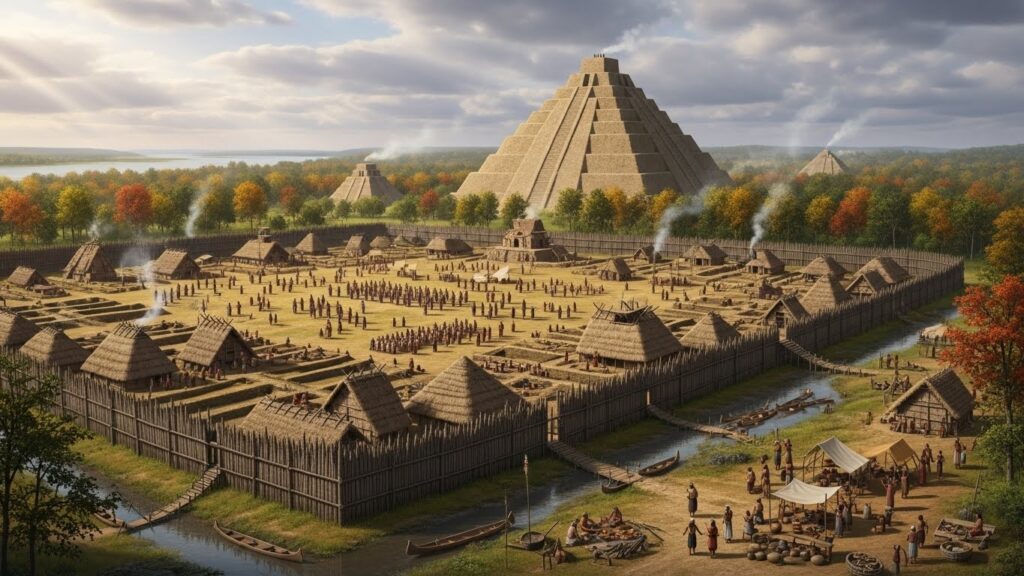
Around 1050 CE, on the Mississippi floodplain across the river from present-day St. Louis, a settlement expanded fast enough that archaeologists call it a “big bang.” At its height Cahokia held an estimated 10,000 to 20,000 people — a population comparable to contemporary London — inside a planned landscape of more than a hundred earthen mounds, a timber post circle used to track the sun, and a Grand Plaza levelled by hand.
Monks Mound, its central platform, is the largest pre-Columbian earthwork anywhere in the Americas: about 30 metres tall, with a base covering more ground than the Great Pyramid of Giza. It was raised in stages out of roughly 22 million cubic feet of carried earth, without draft animals, wheels or metal tools.
By about 1350 the city was empty. No single cause is agreed: soil exhaustion, deforestation of the surrounding uplands, flooding, climate shift, and political fracture all have evidence behind them and none explains it alone. Cahokia Mounds is now a UNESCO World Heritage Site in Collinsville, Illinois.
- The Forgotten Religion of Cahokia: Uncovering Ancient America’s Lost Spiritual Empire
- Who Built Cahokia? The Mystery of the Mound Builders
- 700-Year-Old Sports That Will BLOW YOUR MIND: Cahokia’s Ancient Games
- Laws of Cahokia Revealed: How Native Americans Built Cities Without Police or Prisons
- Medieval USA: The Lost City of Cahokia – America’s Forgotten Kingdom
- History Candle: Your Gateway to Medieval American History and Peaceful Sleep
- 5 Myths About the Inca Empire, and the Real History Behind Them
- Vikings Reached America 471 Years Before Columbus: Here’s the Proof
The Mound Builders
Cahokia was not an isolated wonder. Earthen monuments were being raised in eastern North America for three thousand years before it — Poverty Point in Louisiana around 1700–1100 BCE, the Adena burial mounds of the Ohio Valley, the vast geometric earthworks of the Hopewell exchange network, the quarter-kilometre Serpent Mound in Ohio.
Nineteenth-century writers invented a lost white “Mound Builder race” to explain them, precisely because they refused to credit the ancestors of living Native nations. That myth was dismantled by excavation more than a century ago. The mounds were built by Indigenous Americans, and their descendants are still here.
- 5 Myths About the Inca Empire, and the Real History Behind Them
- What Medieval America Can Teach Us About Addiction: Lessons from History
- Ancient Medicine in Medieval America: The Healing Wisdom of Indigenous Civilizations
- Harsh Winters Couldn’t Kill Them: How Native Americans Built Medieval Heating Systems
- Did the Vikings Meet Native Tribes? The Shocking Truth About First Contact in North America
- Vikings Reached America 471 Years Before Columbus: Here’s the Proof
- Who Built Cahokia? The Mystery of the Mound Builders
- How to Relax Like an Aztec Noble: An Evening in Tenochtitlan
Vinland and the Norse
Around the year 1000, Norse crews sailing from Greenland reached a coast they named Vinland. For centuries this survived only in two Icelandic sagas and was treated as legend — until excavations at L’Anse aux Meadows in Newfoundland uncovered Norse turf halls, a smithy and boat rivets. In 2021 a study of felled timber from the site fixed a precise year of occupation: 1021 CE, the earliest exactly-dated European presence in the Americas.
It remains the only confirmed Norse site in North America. The settlement lasted perhaps a decade. Whatever Leif Erikson and those who followed him found, they did not stay — which is exactly why 1492 still marks the turning point, and why 1021 is still worth knowing.
- Irish Monks Sailed to America Before the Vikings? The Forgotten Voyage
- Medieval USA: Inside the Controversial Vinland Map and Norse Exploration
- Vinland: The Vikings Who Reached America 500 Years Before Columbus
- Medieval USA: Proof Vikings Discovered America First
- The Legend of Madoc: Did a Welsh Prince Discover America Before Columbus?
- Vikings Reached America 471 Years Before Columbus: Here’s the Proof
- Did the Vikings Meet Native Tribes? The Shocking Truth About First Contact in North America
- 5 Myths About the Inca Empire, and the Real History Behind Them
A short timeline
| Date | Event |
|---|---|
| c. 1700–1100 BCE | Poverty Point earthworks raised in the lower Mississippi Valley |
| c. 800 BCE – 100 CE | Adena culture builds burial mounds across the Ohio Valley |
| c. 100 BCE – 500 CE | Hopewell exchange network moves obsidian, copper and shell across half a continent |
| c. 800 CE | Maize agriculture and platform mounds mark the start of the Mississippian period |
| c. 850–1150 CE | Chaco Canyon flourishes as the Ancestral Puebloan centre of the Southwest |
| c. 1021 CE | Norse crews occupy L’Anse aux Meadows in Newfoundland — dated exactly by tree rings |
| c. 1050 CE | Cahokia expands rapidly into the largest city north of Mexico |
| c. 1350 CE | Cahokia is abandoned |
| 1492 CE | Columbus reaches the Caribbean; sustained European contact begins |
Every article on ancient America
19 articles, free to read.
- How to Relax Like an Aztec Noble: An Evening in Tenochtitlan
- 5 Myths About the Inca Empire, and the Real History Behind Them
- Vikings Reached America 471 Years Before Columbus: Here’s the Proof
- What Medieval America Can Teach Us About Addiction: Lessons from History
- 700-Year-Old Sports That Will BLOW YOUR MIND: Cahokia’s Ancient Games
- Laws of Cahokia Revealed: How Native Americans Built Cities Without Police or Prisons
- The Forgotten Religion of Cahokia: Uncovering Ancient America’s Lost Spiritual Empire
- Ancient Medicine in Medieval America: The Healing Wisdom of Indigenous Civilizations
- Harsh Winters Couldn’t Kill Them: How Native Americans Built Medieval Heating Systems
- The Legend of Madoc: Did a Welsh Prince Discover America Before Columbus?
- Irish Monks Sailed to America Before the Vikings? The Forgotten Voyage
- Cacao Was Worth More Than Gold: The Ancient Currency of Empires
- Who Built Cahokia? The Mystery of the Mound Builders
- Did the Vikings Meet Native Tribes? The Shocking Truth About First Contact in North America
- Medieval USA: Inside the Controversial Vinland Map and Norse Exploration
- Vinland: The Vikings Who Reached America 500 Years Before Columbus
- Medieval USA: The Lost City of Cahokia – America’s Forgotten Kingdom
- Medieval USA: Proof Vikings Discovered America First
- History Candle: Your Gateway to Medieval American History and Peaceful Sleep
Questions readers ask
What was the largest city in ancient America?
North of Mexico it was Cahokia, on the Mississippi floodplain in present-day Illinois. At its height around 1100 CE it held an estimated 10,000 to 20,000 people. Larger cities existed further south in Mesoamerica — Tenochtitlan and, earlier, Teotihuacan.
Who built the mounds in North America?
Indigenous Americans did — the Adena, Hopewell and Mississippian cultures, among others, over roughly three thousand years. The nineteenth-century idea of a vanished non-Native "Mound Builder race" was a myth, and excavation disproved it more than a century ago. The descendants of the builders are living Native nations today.
Did the Vikings reach America before Columbus?
Yes. Norse crews from Greenland reached Newfoundland and built a settlement at L'Anse aux Meadows. A 2021 study of felled timber from the site dated occupation precisely to 1021 CE — 471 years before Columbus. The settlement lasted perhaps a decade and left no lasting colony.
What is the difference between "pre-Columbian" and "Medieval America"?
"Pre-Columbian" is the standard scholarly term for the Americas before sustained European contact. "Medieval America" is not a term archaeologists use — it is a popular shorthand for the same centuries, borrowed from European periodisation because Cahokia rose and fell while Europe was building its cathedrals.
Why was Cahokia abandoned?
No single cause is agreed. Soil exhaustion, deforestation of the surrounding uplands, repeated flooding of the Mississippi, a shift to cooler and drier conditions, and political fragmentation all have evidence behind them. The city was largely empty by about 1350 CE.
Can you visit these places today?
Yes. Cahokia Mounds State Historic Site in Collinsville, Illinois is a UNESCO World Heritage Site with Monks Mound open to visitors. L'Anse aux Meadows in Newfoundland is a Canadian national historic site and also UNESCO-listed. Chaco Culture National Historical Park, Serpent Mound and Poverty Point are all open to the public.