
On the morning of 24 July 1911, a Yale lecturer climbed a wet mountainside above the Urubamba River in Peru and was told he had found a lost city. Two farming families were already living in it. An eleven-year-old boy led him to the walls. More than a century later, the story that followed him home is still the one most of us know, and it is only one of five popular ideas about the Incas that fall apart when you look closely.
The short answer
The Incas were not ancient, not without records, not defined by gold, not the people of a lost city, and not beaten by a handful of Spaniards. Their empire lasted roughly a century. They kept records on knotted cords called khipus. They valued fine cloth at least as highly as gold. Machu Picchu was a royal estate that local families never forgot. And the conquest took forty years and tens of thousands of Andean allies.
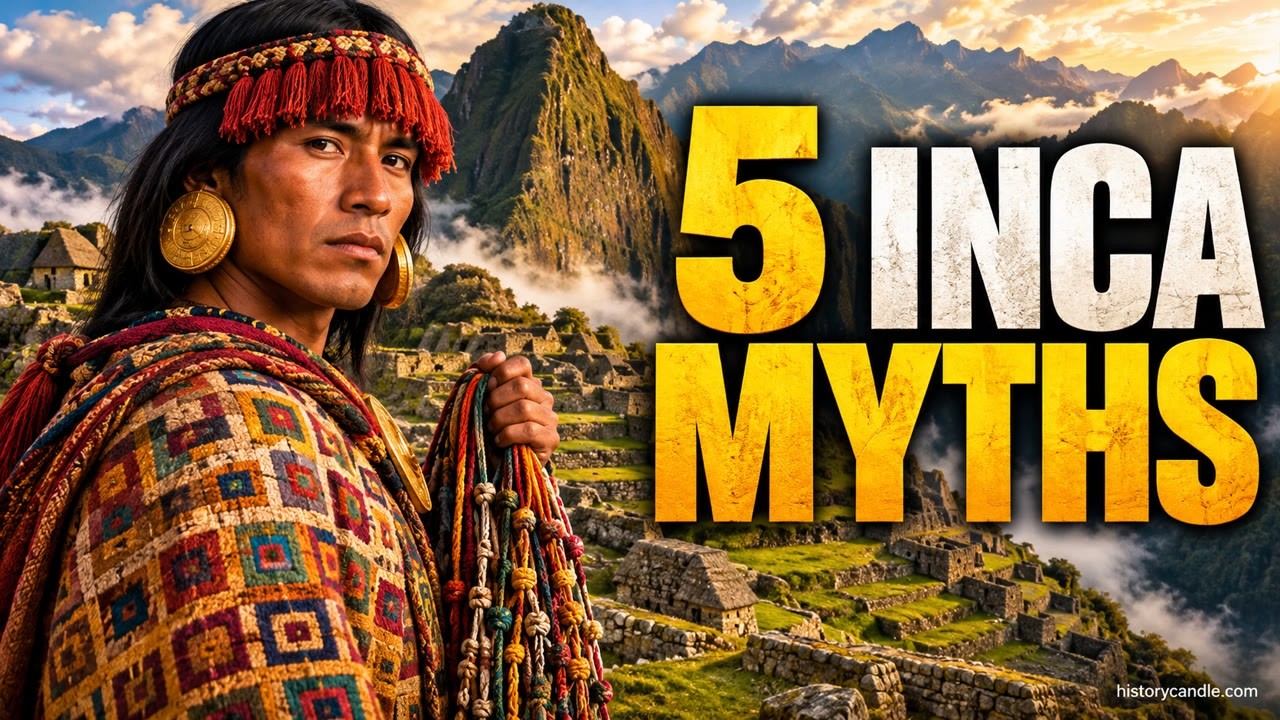
This article follows our documentary, 5 Myths About the Inca Empire, one myth at a time, from a small highland valley to the long, tangled story of how Tawantinsuyu really fell. Where historians still disagree, we say so.
Key dates at a glance
| Year | What happened |
|---|---|
| c. 1200 | The small Kingdom of Cusco takes shape |
| c. 1420 | Radiocarbon dates show people already living at Machu Picchu (Burger et al., 2021) |
| 1438 | The traditional date for Pachacuti’s victory over the Chanka, now debated |
| c. 1527 | Huayna Capac dies in the north; civil war follows from about 1529 |
| 16 Nov 1532 | Atahualpa is captured at Cajamarca by 168 Spaniards |
| 1533 | Atahualpa is executed |
| 1536–1537 | Manco Inca besieges Cusco |
| 1537–1572 | The Neo-Inca State survives at Vilcabamba |
| 24 Sep 1572 | Túpac Amaru is executed in Cusco’s main plaza |
| 24 Jul 1911 | Hiram Bingham reaches Machu Picchu with a farmer, a sergeant and a boy |
Myth 1: The Incas were an ancient empire
They were one of the youngest great empires in history. As an empire, the Inca state lasted only about a hundred years. For most of the twentieth century historians dated the great expansion to 1438, using a chronology built from Spanish accounts written long after the events. In 2021 a team led by the Yale archaeologist Richard Burger dated the remains of 26 people buried at Machu Picchu and found the site occupied by around 1420, about two decades earlier than that chronology allows. Other radiocarbon work also points to an earlier start. The exact year is still argued over. The outline is not: a small ruling family built an empire in a few generations and lost it within one long human lifetime.
Even the word “Inca” is misleading. In Quechua, Inka meant ruler or lord, the Sapa Inca and the noble families of Cusco, perhaps 15,000 to 40,000 people ruling something like ten million others. Those millions spoke Quechua, Aymara, Mochica and many other languages. The empire’s own name was Tawantinsuyu, “the land of four parts,” and it reached from southern Colombia to central Chile, about two million square kilometres.
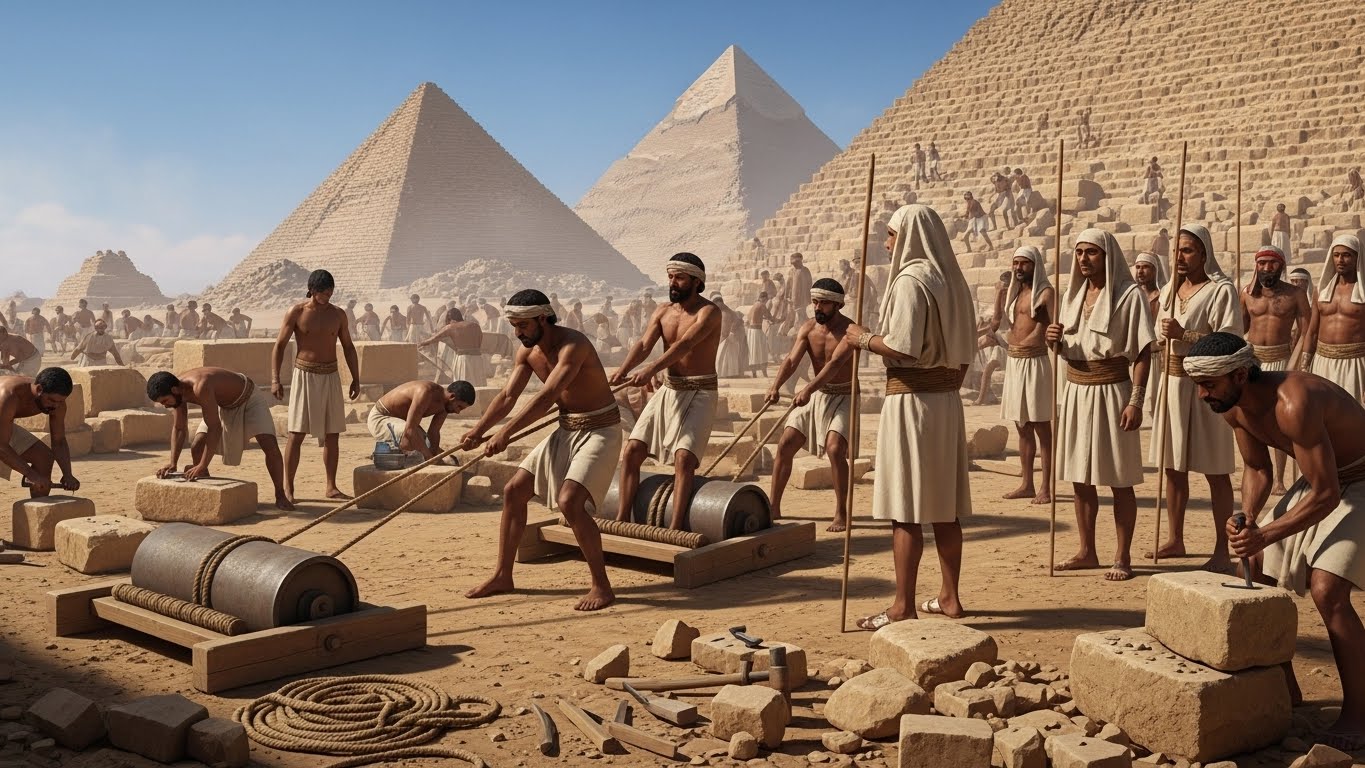
The feeling of great age comes from what the Incas inherited. Caral, north of modern Lima, flourished nearly 5,000 years ago and is the oldest known civilization in the Americas. Chavín, Paracas, Nazca, Moche, Wari and Tiwanaku followed. The Incas gathered those threads together faster than anyone before them, joining existing roads into a network of perhaps 40,000 kilometres. The pyramids of Giza, by contrast, were already old when the Romans arrived. For the continent’s deeper past, see our guide to Ancient America; for the Egyptian comparison, Ancient Egypt behind the pyramids.
Myth 2: The Incas had no writing
They had no alphabet, no paper and no ink. They did have the khipu (Quechua for “knot”): a main cord with dozens, sometimes thousands, of thinner cords hanging from it in cotton or camelid wool, dyed in many colours and tied with different knots. In 1533 Hernando Pizarro watched keepers of the storehouses untie knots in one part of their cords and retie them in another, moving goods from one column of the accounts to another.
In 1912 the American scholar Leland Locke showed that many khipus record numbers in a decimal system, with units at the bottom of each cord, then tens, hundreds and so on. A gap could stand for zero. Marcia and Robert Ascher later confirmed that most readable khipus are numerical, with totals and sums of sums, like a balanced ledger. The keepers, the khipukamayuq, recorded tribute, storehouse contents and household labour, and took the census. According to Felipe Guaman Poma de Ayala, the census counted everyone from babies in the cradle to old blind men over eighty. Colonial courts accepted khipu records as evidence, yet in 1583 the Third Council of Lima ordered some of them burned. Just under 1,400 survive, almost 300 of them in Berlin.
Could a khipu record language? Scholars disagree. Gary Urton has argued for a binary code in the choices makers repeated. In 2017 Sabine Hyland proposed that two khipus kept in the village of San Juan de Collata could be read phonetically, spelling out the names of two lineages. Her reading is still debated. Khipus never fully disappeared: in Tupicocha and Rapaz they are still brought out when village officers begin or end their service.
Watch the documentary
We untie the khipu question, and the other four myths, in our full 65-minute documentary on YouTube.
Myth 3: The Inca Empire ran on gold
In 1532 Atahualpa, a prisoner at Cajamarca, offered to fill a room about seven metres long and five metres wide with gold as high as he could reach, and twice more with silver. Treasure arrived from December 1532 to May 1533, much of it from the Coricancha in Cusco, whose walls had once been covered with sheets of gold. The Spanish melted it into bars: over 1.3 million pesos of gold and more than 50,000 marks of silver. Atahualpa was executed in 1533 anyway.
The Incas did have plenty of gold, but the empire did not run on money. Most of its territory had no coins and no great markets, though some forms of currency existed on the northern and central coast. It ran on labour. Every household owed work to the state, and the state returned food and goods from its storehouses. In Inca belief gold was the sweat of the sun and silver the tears of the moon: sacred material for temples and rulers, not a price tag. (A very different American currency: cacao in Mesoamerica.)
What came first was cloth. Scholars describe gold and silver as second only to cloth as signs of wealth and spiritual power, a point John Murra made famous in 1962. The finest cloth, qompi, had more than 600 threads per inch, finer than contemporary European fabric. It was woven by male specialists and by the aclla, girls of about eight to ten chosen from the provinces, in houses that might hold up to 200 of them. Cloth rewarded soldiers, bound new provinces to the ruler and was burned as an offering.
Myth 4: Machu Picchu was a lost city
On 24 July 1911 Hiram Bingham, leading a Yale expedition to find the last Inca capital, climbed from the river with a local farmer, Melchor Arteaga, and a Peruvian sergeant, Carrasco. Near the top, two farmers, Toribio Richarte and Anacleto Álvarez, were growing crops on terraces they had cleared about four years earlier. Richarte sent his eleven-year-old son Pablito to show the visitor the way.
So it was not lost. Local people knew it. In 1902 Agustín Lizárraga had written his name in charcoal on a temple wall, and an atlas printed in 1904 marked a town on the spot. Bingham documented the site superbly, but “discovery” is the wrong word. Nor was it a capital: that was always Cusco, about eighty kilometres away. Most archaeologists now see Machu Picchu as a royal estate for Pachacuti, at about 2,400 metres, occupied from around 1420 to 1530. Perhaps 750 people lived there, mostly servants and craftspeople whose burials show origins across the empire, from the coast to the Amazon lowlands. The old idea that it housed “Virgins of the Sun” is not supported by the remains.
Two more twists. In 2021 Donato Amado Gonzales and Brian Bauer argued the original name may have been Huayna Picchu, since a 1904 atlas, Bingham’s own informants and a late-sixteenth-century Spanish account all use it. And Bingham was really hunting for Vilcabamba, where the last Inca rulers held out. In 1911 his expedition also reached Espíritu Pampa and did not recognise it. In 1964 Gene Savoy identified it, and the historian John Hemming later backed the conclusion: the real lost city of the Incas, which Bingham walked through and left.
Myth 5: A handful of Spaniards conquered the Incas
The scene is real. On 16 November 1532, 168 Spaniards (62 on horseback), with a few small cannon and a dozen harquebuses, ambushed Atahualpa in the plaza of Cajamarca while a force of perhaps 80,000 soldiers camped on the hills. Thousands of attendants, mostly unarmed, were killed. But the historian Matthew Restall calls the tidy version a myth in Seven Myths of the Spanish Conquest, and the record gives three corrections.
The empire was already broken. Huayna Capac died in the north, probably around 1527 (the year is debated), and his chosen heir died at about the same time. Many historians suspect smallpox, though early descriptions of his mummy mention no pockmarks. With no clear rule of succession, his sons Huáscar and Atahualpa fought a civil war from about 1529. When Pizarro marched inland in 1532, Atahualpa had just won, and much of the empire had been fighting against him.
The Spaniards were never alone. The Cañari, Chachapoya and Huanca sent fighters, and even the Chanka, old rivals of the Incas, joined in. Royal family members sided with the Spanish too: Paullu Inca became their Inca, and Quispe Sisa, a daughter of Huayna Capac, became Francisco Pizarro’s partner; in September 1536 her mother, Contarhuacho, sent an army to help defend Lima.
It did not end at Cajamarca. In 1536 Manco Inca raised a huge army and besieged Cusco for about ten months, burning much of it with fire arrows and heated stones; the Incas then won at Ollantaytambo. Manco withdrew to Vilcabamba and founded a kingdom that lasted 35 years. In 1572 Viceroy Toledo declared war; Túpac Amaru was captured and executed on 24 September in Cusco’s main plaza before an estimated 10,000 to 15,000 people. Epidemics, war and forced labour followed, and some historians believe the Andean population fell by as much as ninety per cent over the next century.
Why the myths last, and what is still alive
The first people to write the story down were conquerors and later explorers, and simple stories travel well: a lost city beats a royal estate with a family farming its terraces. But Quechua is still spoken by millions and gave English words like llama, condor, puma, poncho and quinoa. The Inca roads are a World Heritage Site, and villagers near Cusco still rebuild the Q’eswachaka rope bridge. The Incas were not a lost people. For another American civilization whose story keeps being rewritten, see who built Cahokia.
Now watch it
Hear all five myths told slowly, by candlelight, in the full documentary. If you enjoy it, subscribe to History Candle for new long-form history every week.
Frequently asked questions
How long did the Inca Empire last?
About a hundred years. Historians traditionally dated the great expansion to 1438, and radiocarbon work now suggests an earlier start in the early fifteenth century, but the Spanish captured the Inca ruler in 1532. The small Kingdom of Cusco itself dates to around 1200.
Did the Incas have a writing system?
Not an alphabet. They kept records with khipus, cords tied with knots in a decimal system. Most readable khipus are numerical, and scholars still debate whether some also recorded language.
Was Machu Picchu a lost city?
No. Local families farmed its terraces when Hiram Bingham arrived on 24 July 1911, and Agustín Lizárraga had left his name on a wall in 1902. Most archaeologists see it as a royal estate built for Pachacuti, not a capital.
What did the Incas value more than gold?
Fine cloth. Scholars describe gold and silver as second only to cloth as marks of wealth and spiritual power. The finest cloth, qompi, had more than 600 threads per inch.
How did the Spanish defeat the Inca Empire?
With help. An epidemic and a civil war had already weakened the empire, and tens of thousands of Andean allies fought beside the Spanish. Inca resistance continued for about forty years, until Túpac Amaru was executed in 1572.
Where was the real lost city of the Incas?
Probably Vilcabamba, the last Inca stronghold, identified with Espíritu Pampa in the forest. Bingham reached the place in 1911 without recognising it; Gene Savoy concluded in 1964 that it was Vilcabamba.
Sources and further reading
- Burger, R. L. et al. (2021). Radiocarbon dating of Machu Picchu, Antiquity; reported in Smithsonian Magazine, “Machu Picchu Is Older Than Previously Thought, Radiocarbon Dating Suggests”.
- Amado Gonzales, D. & Bauer, B. S. (2021). Study of the original name of Machu Picchu, Ñawpa Pacha.
- Murra, J. V. (1962). “Cloth and Its Functions in the Inca State”.
- Restall, M. (2003). Seven Myths of the Spanish Conquest. Oxford University Press.
- Guaman Poma de Ayala, F. Nueva corónica y buen gobierno (c. 1615).
- Wikipedia articles “Inca Empire”, “Quipu”, “Ransom Room”, “Spanish conquest of the Inca Empire”, “Siege of Cusco”, “Neo-Inca State”, “Machu Picchu” and “Andean textiles”, and the scholarship they cite.