
Discover the Ancient Justice System That Maintained Order in North America’s Largest Pre-Columbian City

Cahokia Mounds: North America’s ancient metropolis that thrived without modern law enforcement
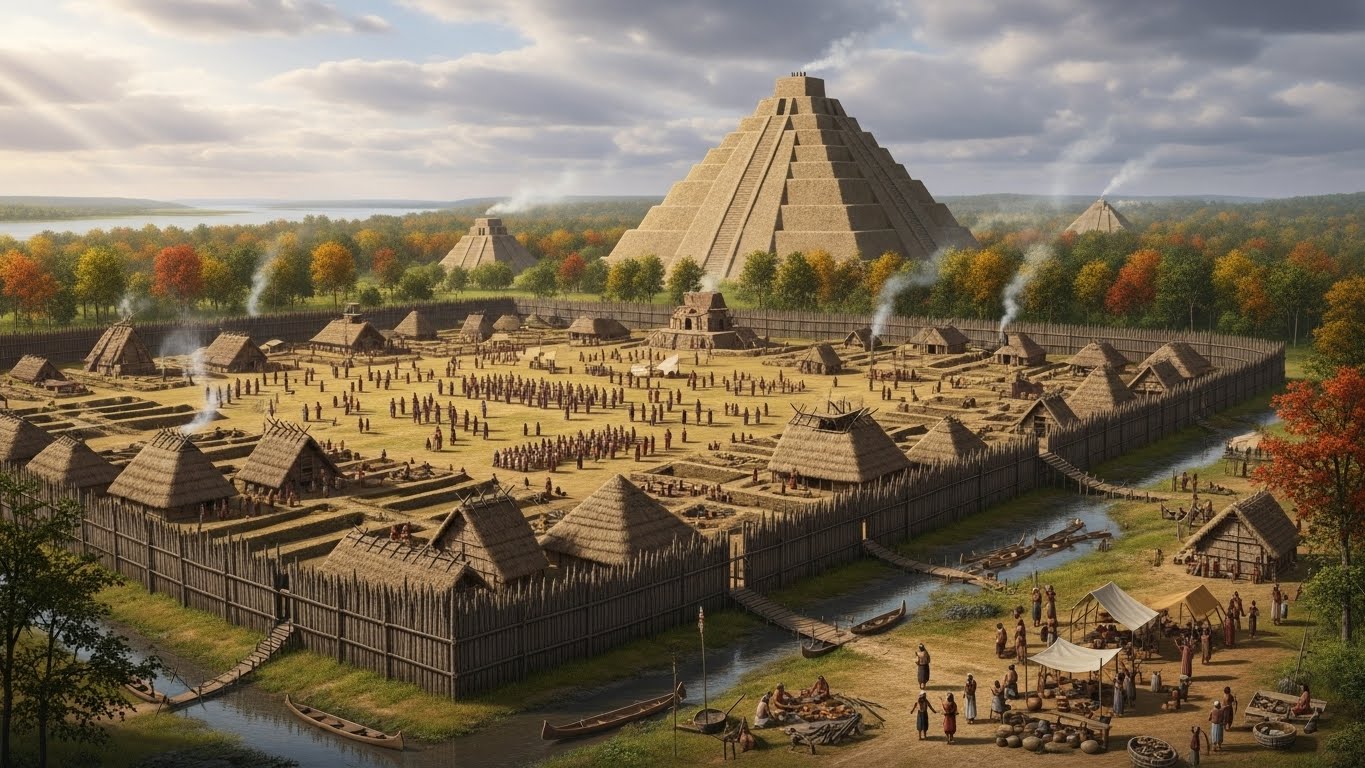
Imagine a bustling city of 20,000 people, larger than medieval London, operating without a single police officer, courthouse, or prison. This wasn’t a utopian fantasy but the reality of Cahokia, the magnificent Native American metropolis that dominated the Mississippi River Valley from 1050 to 1350 CE. How did they maintain order, resolve disputes, and ensure justice without the coercive institutions we consider essential today?
The answer lies in one of history’s most sophisticated yet overlooked legal systems, a framework built on community consensus, restorative justice, and sacred obligations rather than punishment and imprisonment. Understanding Cahokia’s approach to law and order challenges everything we think we know about civilization, governance, and human nature itself.
The Magnificent City of Cahokia: A Brief Overview
Located in present-day Illinois, just across the Mississippi River from modern St. Louis, Cahokia was the largest urban center in North America before European contact. At its peak around 1100 CE, the city sprawled across six square miles and featured:
- 120 earthen mounds, including the massive Monks Mound standing 100 feet tall
- Population of 10,000-20,000 residents within the city, with up to 50,000 in the greater metropolitan area
- Advanced urban planning with designated residential, ceremonial, and commercial districts
- Sophisticated astronomical observatories known as “Woodhenge”
- Complex trade networks extending from the Great Lakes to the Gulf Coast

The Foundation: Community-Based Social Control
Unlike modern Western legal systems that rely on state-enforced punishment, Cahokian society maintained order through a radically different approach: collective responsibility and community oversight. This system operated on several interconnected principles that archaeologists and anthropologists have pieced together from material evidence and comparative ethnography of related Indigenous cultures.
The Clan System: Your Family as Your Court
Cahokian society was organized into matrilineal clans, extended family groups that traced descent through the mother’s line. These clans served as the primary unit of social organization and the first line of conflict resolution. When disputes arose, the matter was brought before clan elders rather than external authorities.
Key Insight: In clan-based systems, individual misbehavior reflected on the entire family unit. This created powerful social pressure to resolve conflicts quickly and maintain harmony, as the reputation of dozens or even hundreds of relatives depended on it.
Restorative Justice: Healing Rather Than Punishing

Perhaps the most revolutionary aspect of Cahokian law was its focus on restoration over retribution. Rather than asking “What punishment does the offender deserve?” Cahokian justice asked “How can we repair the harm and restore balance to the community?”
The Process of Conflict Resolution
| Stage | Process | Outcome Goal |
|---|---|---|
| 1. Acknowledgment | The offender publicly acknowledges the harm caused | Validation of victim’s experience |
| 2. Circle Gathering | Affected parties meet with elders and community members | Open dialogue and truth-telling |
| 3. Restitution Plan | Community determines appropriate compensation or action | Material and symbolic repair of harm |
| 4. Reintegration | Offender completes obligations and is welcomed back | Restored community harmony |
This process prioritized healing over punishment, relationship over isolation, and community involvement over delegation to specialists. Archaeological evidence suggests this approach was remarkably effective, with no signs of large-scale imprisonment or execution facilities at Cahokia.
Sacred Law: When Religion and Justice Intertwine
In Cahokian society, there was no separation between the sacred and the secular. Laws weren’t merely social contracts but sacred obligations tied to the cosmological order. Breaking these laws meant disrupting the balance between the human world and the spirit realm.
The Role of Spiritual Leaders
Cahokia’s priest-chiefs served as intermediaries between the physical and spiritual worlds. They presided over important disputes not as judges in the Western sense, but as spiritual guides helping the community understand the cosmic implications of human actions.
Their authority came not from force but from spiritual legitimacy, their perceived ability to maintain harmony with the supernatural realm that governed everything from crop yields to community health.
Economic Obligations: The Redistribution System

One fascinating aspect of Cahokian law involved economic redistribution. Elite families and clan leaders had legal obligations to share wealth and resources with community members, particularly during times of hardship. This wasn’t charity—it was a legal and spiritual duty.
This system served multiple purposes: it prevented extreme inequality, reinforced social bonds, and gave elites their legitimacy. Leaders who hoarded resources or failed in their redistribution duties faced social sanction and loss of status, effectively removing them from power without formal impeachment proceedings.
Of surplus goods redistributed to community
Annual ceremonial feasts requiring elite contributions
Evidence of wealth-based prisons or detention
Dealing with Serious Offenses: Exile and Ostracism
For the most serious violations—repeated violence, violations of sacred laws, or refusal to participate in restorative processes—Cahokian society did have consequences, though radically different from imprisonment. The ultimate sanction was exile or ostracism.
Being cast out from the community was considered worse than death in a society where identity and survival were deeply interconnected with community membership. This wasn’t temporary banishment but complete social death—the person’s name would no longer be spoken, their existence effectively erased from community memory.
Archaeological Evidence: Some burial sites show individuals interred without the typical grave goods and ceremonial treatment, suggesting they may have been social outcasts. However, these cases are extremely rare, indicating exile was used sparingly as a last resort.
The Role of Public Shame and Honor
In a society without prisons, social reputation became the primary currency of order. Public ceremonies and gatherings served multiple functions, including the recognition of good deeds and the acknowledgment of harm. Through elaborate ritual performances, the community reinforced its values and expectations.
Honor and Status Markers
Archaeological findings reveal sophisticated systems of status markers—specific types of pottery, shell beads, copper ornaments—that indicated an individual’s standing in the community. These weren’t mere decorations but visual representations of one’s adherence to community laws and obligations.
Losing these markers through misconduct was a powerful deterrent, making wrongdoing immediately visible to everyone in the community. In modern terms, imagine if breaking laws caused your professional credentials, awards, and social media presence to instantly disappear—that’s the level of social consequence Cahokians faced.
Women’s Authority in Cahokian Justice

A striking feature of Cahokian law was the significant authority held by women, particularly elder women or clan mothers. In this matrilineal society, women controlled property, made crucial decisions about resource distribution, and held veto power over many community decisions.
Clan mothers often served as mediators in disputes, and their word carried tremendous weight. This gender-balanced approach to justice stands in stark contrast to the male-dominated legal systems that would later be imposed by European colonizers.
Historical Note: European observers of related Indigenous societies consistently expressed shock at the authority wielded by Native women, unable to comprehend legal systems that didn’t subordinate women to male authority.
Why Did This System Work?
The success of Cahokia’s legal system for over three centuries raises profound questions about our assumptions regarding law enforcement. Several factors contributed to its effectiveness:
Key Success Factors
- Scale and Interconnection: While large for its time, Cahokia remained small enough that anonymity was impossible. Everyone knew everyone, making accountability automatic.
- Shared Cosmology: Universal belief in spiritual consequences for wrongdoing created internal motivation to follow laws, not just fear of external punishment.
- Economic Interdependence: The redistribution system meant individuals’ wellbeing depended on community cooperation, creating material incentives for harmony.
- Collective Identity: Strong clan and community identities meant individual actions reflected on larger groups, multiplying social pressure.
- Restorative Focus: By emphasizing repair over punishment, the system reduced recidivism and maintained social cohesion.
Lessons for Modern Justice Systems
The Cahokian approach to law challenges fundamental assumptions of modern justice systems. While we can’t simply transplant their system into contemporary society, several principles offer valuable insights:
| Cahokian Principle | Modern Application |
|---|---|
| Restorative over retributive justice | Restorative justice programs, victim-offender mediation |
| Community involvement in conflict resolution | Community courts, neighborhood justice centers |
| Focus on reintegration, not isolation | Prison alternatives, rehabilitation programs |
| Economic redistribution as social obligation | Progressive taxation, social safety nets |
| Prevention through social connection | Community building, social services investment |
The Decline of Cahokia: Did the Legal System Fail?
By 1350 CE, Cahokia was abandoned. While the exact reasons remain debated, most scholars point to environmental factors—flooding, drought, deforestation—rather than social collapse from legal system failure. The city’s decline reminds us that even sophisticated social systems cannot overcome certain ecological constraints.
Interestingly, there’s no archaeological evidence of violent overthrow or internal civil conflict during Cahokia’s decline, suggesting the legal system maintained social order even as environmental conditions forced population dispersal.
Conclusion: Rethinking Civilization and Order
The laws of Cahokia reveal a profound truth: police and prisons are not inevitable features of civilization. For centuries, one of North America’s largest cities maintained order, resolved conflicts, and ensured justice through community consensus, restorative practices, and sacred obligations rather than coercive state power.
This doesn’t mean their system was perfect or easily replicable in our vastly different world. But it does prove that the path we’ve taken—toward mass incarceration, punitive justice, and impersonal law enforcement—is one choice among many, not the only way to organize society.
The story of Cahokia challenges us to imagine: What if we took seriously the idea that justice is about healing rather than punishment, that safety comes from community rather than coercion, and that law’s highest purpose is restoration, not retribution?
Want to Dive Deeper into Cahokia’s Fascinating History?
This article only scratches the surface of Cahokia’s incredible story. From astronomical observatories