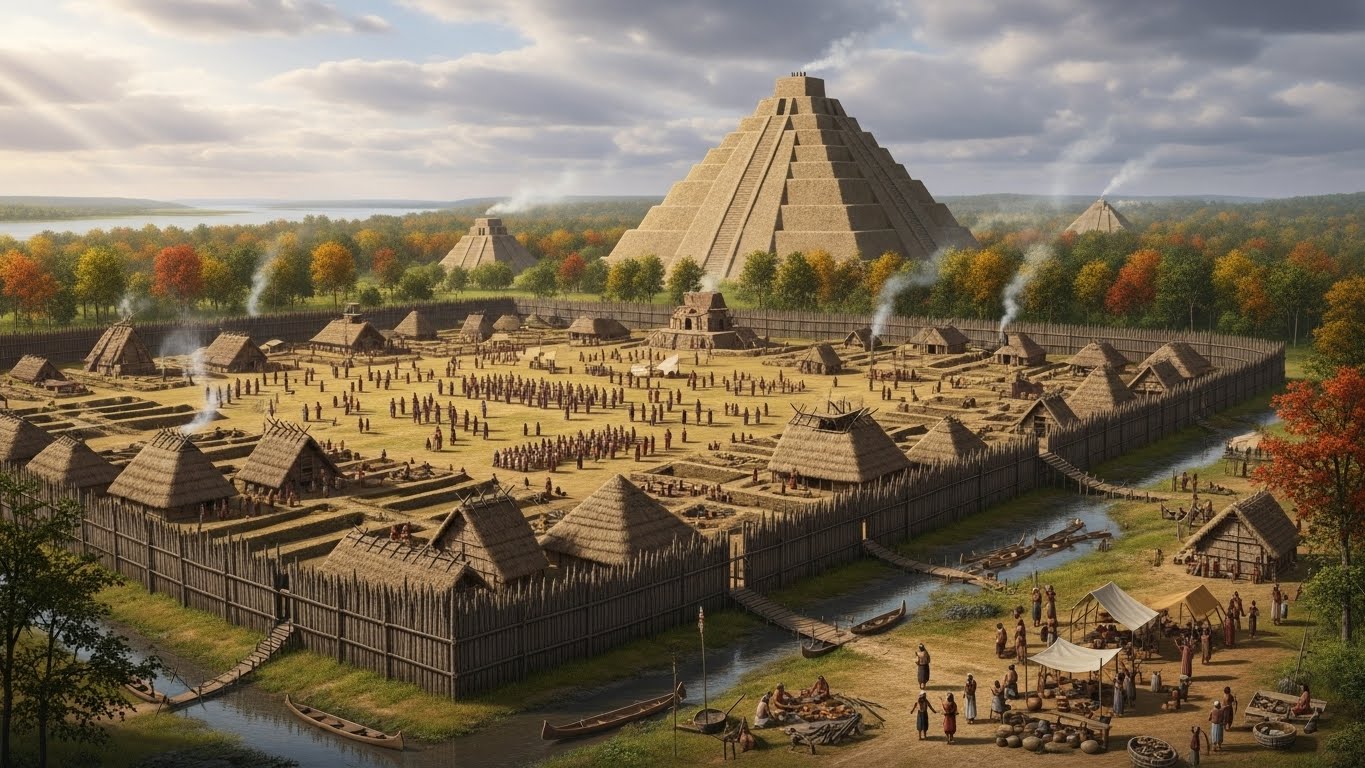


Monks Mound, the largest prehistoric earthwork in the Americas
Hidden in the heartland of America lies one of archaeology’s most fascinating enigmas. Long before European explorers set foot on North American soil, a sophisticated civilization flourished along the Mississippi River, constructing massive earthen pyramids that rival those of ancient Mesoamerica. This is the story of Cahokia—a forgotten metropolis that challenges everything we thought we knew about pre-Columbian America.
The Discovery That Shocked Archaeologists
When early American settlers first encountered the massive earthen mounds scattered across the Mississippi Valley, they refused to believe that Native Americans could have built such impressive structures. The sheer scale and precision of these monuments seemed impossible without advanced engineering knowledge.
Located near present-day St. Louis, Missouri, Cahokia once covered nearly six square miles and housed an estimated 10,000 to 20,000 people at its peak around 1050-1200 CE. This made it larger than London at the same time period, establishing it as the largest city north of Mexico in pre-Columbian times.
Cahokia by the Numbers
| Statistic | Value |
|---|---|
| Peak Population | 10,000-20,000 people |
| Total Area | 6 square miles |
| Number of Mounds | 120+ earthen mounds |
| Monks Mound Height | 100 feet (10 stories) |
| Peak Period | 1050-1200 CE |
| Soil Moved | 55 million cubic feet |
Who Were the Mound Builders?

Artist’s reconstruction of Cahokia at its peak
The builders of Cahokia were part of what archaeologists call the Mississippian culture—a sophisticated civilization that emerged around 800 CE and dominated the southeastern United States for centuries. These were not primitive hunter-gatherers, but organized societies with:
- Advanced Agriculture: They cultivated maize, beans, and squash in extensive fields
- Complex Social Hierarchy: A structured society with chieftains, priests, artisans, and laborers
- Long-Distance Trade Networks: Artifacts from the Great Lakes to the Gulf of Mexico have been found at Cahokia
- Astronomical Knowledge: They built sophisticated solar calendars and aligned structures with celestial events
- Urban Planning: The city was laid out in a precise grid pattern around a central plaza
The Engineering Marvel of Monks Mound
At the heart of Cahokia stands Monks Mound, the largest prehistoric earthwork in the Americas. This massive pyramid rises 100 feet above the surrounding plain and covers 14 acres at its base—making it larger in footprint than the Great Pyramid of Giza.
Mind-Blowing Facts About Monks Mound
- Built entirely by hand—basketful by basketful of earth
- Required moving approximately 55 million cubic feet of soil
- Took an estimated 200-300 years to complete
- Would have required 15 million basket loads of earth
- The chief’s residence sat atop this massive structure
Woodhenge: America’s Ancient Observatory
One of Cahokia’s most remarkable features is a series of timber circles archaeologists call “Woodhenge”—named after England’s famous Stonehenge. These circular arrangements of massive cedar posts served as astronomical calendars, precisely marking the summer and winter solstices as well as the spring and fall equinoxes.
The precision of these structures demonstrates that Cahokia’s builders possessed sophisticated mathematical and astronomical knowledge. They used these observations to determine planting seasons, schedule religious ceremonies, and maintain their agricultural calendar.

Reconstructed Woodhenge at Cahokia Mounds State Historic Site
Daily Life in Ancient Cahokia
Archaeological evidence paints a vivid picture of life in this ancient metropolis. The city was a bustling center of commerce, religion, and political power. Artisans crafted elaborate pottery, carved stone figurines, and worked copper and shell into intricate ornaments.
Social Structure of Cahokia
| Social Class | Role & Residence |
|---|---|
| Elite/Chief | Lived atop Monks Mound; religious and political leaders |
| Priests/Nobles | Resided on smaller mounds; conducted ceremonies |
| Artisans/Merchants | Lived in the city; specialized craftspeople and traders |
| Farmers/Laborers | Majority of population; worked fields and built mounds |
The Mysterious Decline
Perhaps the greatest mystery of Cahokia is not who built it, but why it was abandoned. By 1350 CE, this once-thriving metropolis was deserted. The city that had dominated the Mississippi Valley for centuries simply ceased to exist.
Theories for Cahokia’s decline include:
- Environmental Degradation: Deforestation and soil depletion from supporting such a large population
- Climate Change: A cooling period that affected agricultural productivity
- Political Instability: Internal conflicts or the breakdown of centralized authority
- Disease: Epidemics in the densely populated urban center
- Resource Depletion: Overhunting and overfishing of local wildlife

Modern aerial view showing the scale of Cahokia’s mound complex
Legacy and Modern Recognition
Today, Cahokia Mounds State Historic Site preserves what remains of this incredible civilization. In 1982, UNESCO designated it a World Heritage Site, recognizing its significance as “the largest pre-Columbian settlement north of Mexico.”
The descendants of Cahokia’s builders include modern Native American tribes such as the Osage, Omaha, Ponca, and Quapaw nations. While much of the specific cultural knowledge was lost over centuries, these peoples maintain spiritual and historical connections to the site.
Why Cahokia Matters Today
Cahokia challenges the Eurocentric narrative of American history. It proves that sophisticated, urban civilizations flourished in North America long before European contact. The site reminds us that complex societies, monumental architecture, and advanced knowledge were not limited to the Old World or Mesoamerica—they existed right in America’s heartland.
Unanswered Questions
Despite decades of archaeological research, many mysteries remain:
- What language did they speak?
- What was their system of government?
- What religious beliefs motivated mound construction?
- Why did they choose this specific location?
- What happened to the inhabitants after abandonment?
Each excavation season brings new discoveries, slowly piecing together the story of this remarkable civilization.
Watch the Full Documentary!
Dive deeper into the fascinating world of Cahokia and the Mound Builders! Our comprehensive video documentary explores archaeological discoveries, expert interviews, stunning reconstructions, and the latest theories about this lost civilization.
▶️ Watch Now on History Candle
Subscribe to History Candle for more incredible stories from ancient America!
Conclusion: A Civilization Rediscovered
The story of Cahokia is a testament to human ingenuity and ambition. Without metal tools, draft animals, or the wheel, the Mound Builders created a metropolis that stood as the greatest city in North America for centuries. Their astronomical observations, architectural achievements, and complex society deserve recognition alongside other great civilizations of the ancient world.
As we continue to uncover Cahokia’s secrets, we gain not just knowledge of the past, but a deeper appreciation for the rich and complex history of the Americas. The massive earthen pyramids that still dot the landscape stand as silent witnesses to a civilization that once thrived in the heart of what would become the United States.
The next time you drive through the American Midwest, remember: beneath those rolling hills and modern highways lies the story of a great civilization that built pyramids, tracked the stars, and created one of the ancient world’s most remarkable cities.
Want to Learn More?
History Candle brings forgotten stories to light. From ancient civilizations to mysterious historical events, we explore the narratives that shaped our world.
👉 Don’t forget to watch our full Cahokia documentary: Click here to watch!
Keywords: Cahokia, Mound Builders, Mississippian culture, ancient America, pre-Columbian civilizations, Monks Mound, Native American history, archaeological mysteries, ancient pyramids, North American archaeology