
New: The strongest single piece of evidence now has its own article. Vikings reached America in 1021: how a solar storm in the tree rings proved it.
Long before Columbus set sail in 1492, Norse explorers had already planted their boots on North American soil. Discover the fascinating evidence that rewrites American history.

The Viking Voyages: Setting the Stage
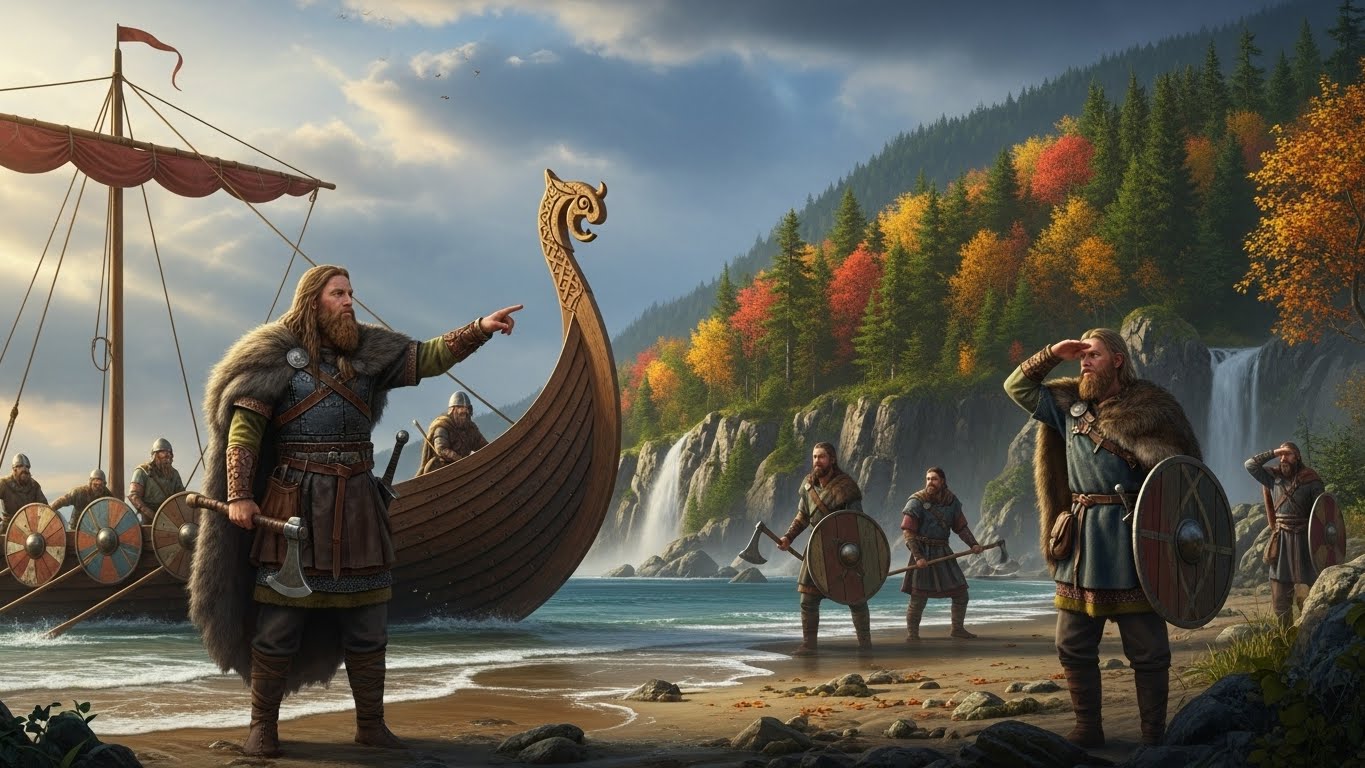
For decades, the story of Christopher Columbus discovering America in 1492 dominated history textbooks. However, archaeological evidence and historical records now confirm that Norse Vikings reached North America nearly 500 years earlier, establishing settlements and trading with indigenous peoples.
The Vikings, renowned for their seafaring prowess and longship technology, didn’t just stumble upon the New World. They systematically explored, mapped, and colonized parts of North America in a remarkable feat of medieval navigation and courage.
Quick Facts: Viking Discovery Timeline
- 986 CE: Bjarni Herjólfsson possibly first sights North America
- 1000 CE: Leif Erikson establishes settlement at Vinland
- 1960: L’Anse aux Meadows discovered in Newfoundland
- 2021: New evidence confirms additional Viking sites
L’Anse aux Meadows: The Smoking Gun

In 1960, Norwegian explorer Helge Ingstad and his archaeologist wife Anne Stine Ingstad made a groundbreaking discovery on the northern tip of Newfoundland, Canada. They uncovered L’Anse aux Meadows, an authentic Norse settlement dating back approximately 1,000 years.
This UNESCO World Heritage Site provided irrefutable proof that Vikings had established a foothold in North America centuries before Columbus. The site included eight timber-framed turf structures, a forge for working iron, and various Norse artifacts that definitively linked the settlement to Scandinavian origins.
| Evidence Type | Discovery | Significance |
|---|---|---|
| Buildings | 8 turf structures | Identical to Norse Greenland/Iceland buildings |
| Artifacts | Bronze pin, spindle whorl | Distinctly Norse objects not native to Americas |
| Iron Production | Forge and slag | Technology unknown to indigenous peoples |
| Dating | Carbon-14 testing | Confirms settlement around 1000 CE |
The Sagas Tell the Tale
Long before archaeologists confirmed the Viking presence, Icelandic sagas had documented Norse voyages to a land they called “Vinland” or “Wineland.” Two primary sagas, the Saga of Erik the Red and the Saga of the Greenlanders, provide detailed accounts of expeditions led by Leif Erikson and other Norse explorers.
“Leif said to his shipmates: ‘We shall now divide our labors, and each day shall either gather grapes or cut vines and fell trees, so as to obtain a cargo of such things for my ship.’ They acted upon this advice, and it is said that their after-boat was filled with grapes.”
— The Saga of Erik the Red
These medieval texts, written in the 13th century but describing events from around 1000 CE, were long dismissed as mythology. The discovery of L’Anse aux Meadows transformed scholarly understanding, proving that the sagas contained genuine historical information.
Recent Discoveries: The Evidence Keeps Growing

Research hasn’t stopped with L’Anse aux Meadows. In 2021, scientists using advanced dating techniques on wood samples discovered that Vikings were present in the Americas in precisely 1021 CE, exactly 1,000 years ago. This dating came from wood showing evidence of metal blade cutting, a technology the indigenous peoples didn’t possess.
Researchers continue to explore potential Viking sites along the North American coast, using satellite imagery, ground-penetrating radar, and other modern technologies. Evidence suggests the Norse may have ventured much farther south than previously believed, potentially reaching areas that are now part of the United States.
Viking Exploration Range
Why Did the Vikings Leave?
Despite their successful landing and settlement, the Viking presence in North America was relatively brief and limited. Historians and archaeologists have proposed several theories for why the Norse eventually abandoned their North American colonies.
The distance from Scandinavia and Greenland made sustained colonization difficult. Supply lines were extraordinarily long, and the small Norse population couldn’t maintain permanent settlements. Additionally, conflicts with indigenous peoples, whom the Vikings called “Skraelings,” likely made life dangerous and unpredictable.
Climate change also played a role. The Medieval Warm Period that had allowed Norse expansion began cooling, making North Atlantic voyages more treacherous. Eventually, even the Greenland colonies that served as stepping stones to North America were abandoned by the 15th century.
Rewriting American History

The confirmation of Viking exploration fundamentally changes how we understand the history of the Americas. It demonstrates that the Atlantic Ocean wasn’t an impenetrable barrier and that transatlantic contact occurred far earlier than previously believed.
While Columbus’s voyages had far more significant and lasting consequences for world history, the Vikings deserve recognition as the first Europeans to reach and settle in the Americas. Their achievement showcases medieval navigation skills, shipbuilding technology, and the adventurous spirit that drove Norse expansion across the North Atlantic.
Today, L’Anse aux Meadows stands as a monument to this remarkable chapter in history, drawing thousands of visitors annually who come to walk in the footsteps of Leif Erikson and his fellow explorers.
Want to Dive Deeper Into Viking America?
Join us on History Candle for an immersive video journey exploring the complete story of Viking discovery, archaeological evidence, and the fascinating details that textbooks often miss!
Subscribe to History Candle for more fascinating historical discoveries!
Frequently Asked Questions
Did Vikings reach mainland United States?
While confirmed evidence exists only for Newfoundland (Canada), researchers believe Vikings may have explored farther south along the North American coast. However, no definitive archaeological sites have been confirmed in the present-day United States.
How long did Vikings stay in North America?
The L’Anse aux Meadows settlement was likely occupied for only 10-20 years, though Vikings may have made return voyages for timber and other resources over several decades following the initial settlement.
Why didn’t Vikings colonize America permanently?
Distance from Scandinavia, conflicts with indigenous peoples, small population size, and deteriorating climate conditions all contributed to the abandonment of Norse settlements in North America.
The Bottom Line
The Viking discovery of America represents one of history’s most remarkable achievements in navigation and exploration. While their stay was brief, the evidence is undeniable: Norse explorers reached North America around 1000 CE, making them the first Europeans to set foot in the New World. This medieval chapter of American history continues to fascinate researchers and history enthusiasts alike, reminding us that the story of human exploration is far more complex and interconnected than we once believed.
For the complete story with stunning visuals and expert analysis:
Don’t forget to like, subscribe, and hit the notification bell! 🔔