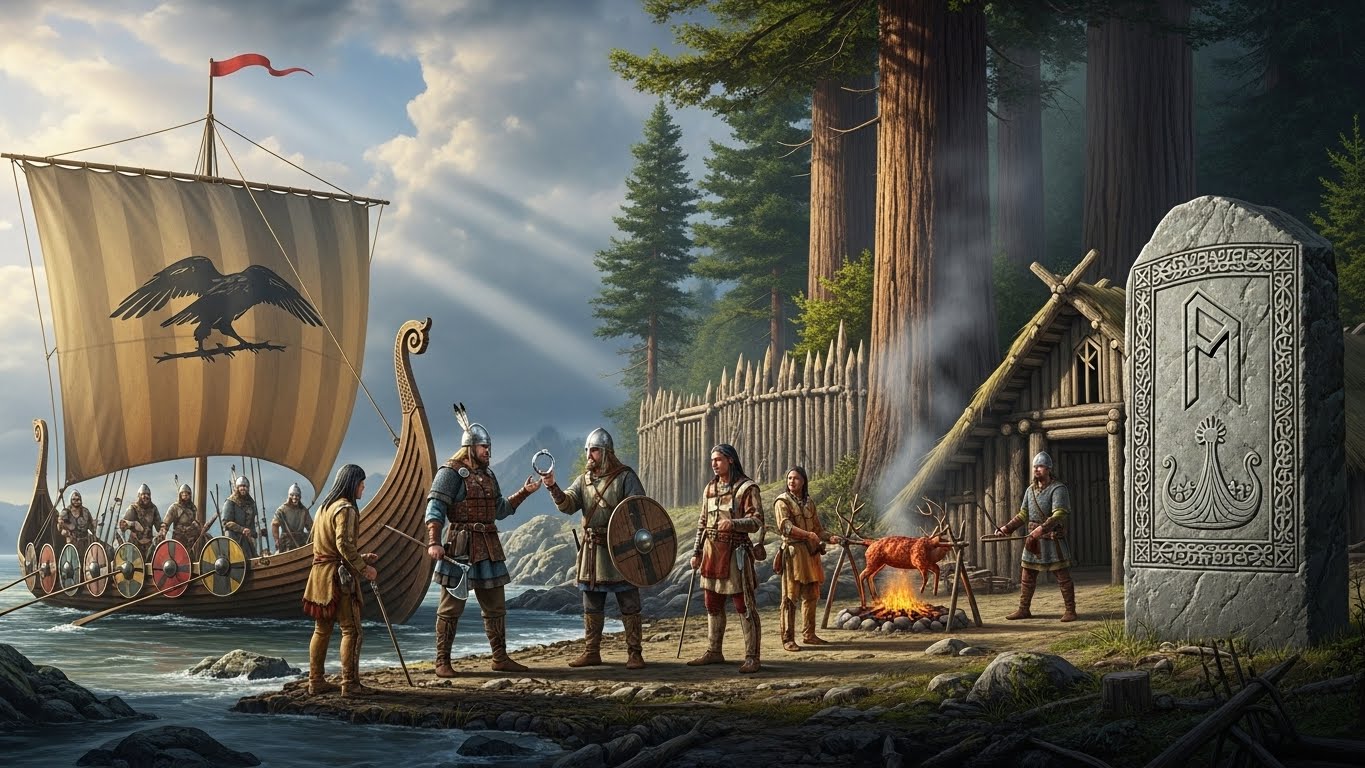

New: We now know the exact year the Norse were in Vinland. Vikings reached America in 1021: how a solar storm in the tree rings proved it.
Discover the untold story of Norse exploration and the first European settlement in North America
Reading Time: 8 minutes | Last Updated: December 2025
The Misconception About Columbus
For centuries, schoolchildren have been taught that Christopher Columbus discovered America in 1492. However, archaeological evidence and ancient sagas tell a dramatically different story. Nearly 500 years before Columbus set foot in the Caribbean, Norse explorers had already established settlements on the North American continent.
This remarkable chapter of history, often overshadowed by later European exploration, reveals the extraordinary seafaring capabilities of the Vikings and challenges our understanding of early transatlantic contact.
Watch the Full Documentary
Dive deeper into the fascinating story of Viking exploration with our comprehensive video on the History Candle YouTube Channel!
the History Candle channel on YouTubeWho Were the Vikings?
The Vikings, or Norse people, were seafaring Scandinavians who dominated much of Europe between the 8th and 11th centuries. Far from being merely raiders and warriors, they were sophisticated traders, skilled craftsmen, and exceptional navigators who ventured far beyond their homeland.
Their innovative longships, capable of traversing both open oceans and shallow rivers, gave them unparalleled mobility. This maritime prowess would eventually lead them across the North Atlantic to the shores of a new world they would call Vinland.
The Journey to Vinland: A Timeline
| Year | Event | Explorer |
|---|---|---|
| c. 870 CE | Settlement of Iceland begins | Norse settlers |
| c. 982 CE | Discovery and settlement of Greenland | Erik the Red |
| c. 986 CE | First sighting of North American coast | Bjarni Herjólfsson |
| c. 1000 CE | First landing in Vinland | Leif Erikson |
| c. 1000-1015 CE | Settlement attempts and exploration | Various Norse expeditions |
Leif Erikson: The True Discoverer of America
Key Facts About Leif Erikson
- Born: c. 970 CE in Iceland
- Father: Erik the Red (founder of Greenland settlement)
- Achievement: First European to set foot in North America
- Landing Date: Approximately 1000 CE
- Legacy: October 9th is celebrated as Leif Erikson Day in the USA
Leif Erikson, son of the legendary Erik the Red, heard tales from sailor Bjarni Herjólfsson about land sighted west of Greenland. Intrigued by these accounts, Leif assembled a crew and sailed westward around the year 1000 CE.
His expedition discovered three distinct regions, which they named Helluland (likely Baffin Island), Markland (likely Labrador), and finally Vinland (likely Newfoundland). The name “Vinland” may have come from the wild grapes or berries found there, though scholars debate the exact meaning.

L’Anse aux Meadows: Archaeological Proof
For centuries, the Viking sagas were considered mere mythology. That changed in 1960 when Norwegian explorer Helge Ingstad and archaeologist Anne Stine Ingstad discovered the remains of a Norse settlement at L’Anse aux Meadows in Newfoundland, Canada.
Archaeological Findings
- Eight Norse-style buildings
- Iron nails and rivets
- Bronze cloak pin
- Spindle whorl (for spinning wool)
- Iron-working facilities
Dating Evidence
- Radiocarbon dating: 990-1050 CE
- Tree-ring dating confirms circa 1000 CE
- Matches timeline from Norse sagas
- UNESCO World Heritage Site (1978)
This site provides irrefutable evidence that Vikings established a presence in North America approximately 500 years before Columbus’s voyage in 1492. The settlement appears to have been a base camp for further exploration rather than a permanent colony.
The Norse Sagas: Historical Documents
Two medieval Icelandic texts provide detailed accounts of the Viking voyages to Vinland:
The Saga of Erik the Red
Written in the 13th century, this saga recounts Erik the Red’s settlement of Greenland and his son Leif’s voyage to Vinland. It describes the land as abundant with resources, including salmon, timber, and grapes or berries.
The Saga of the Greenlanders
Also from the 13th century, this saga provides alternative details about the expeditions and mentions several subsequent attempts to settle Vinland, including voyages led by Thorvald Erikson and Thorfinn Karlsefni.
While these sagas contain some embellishments and contradictions, the archaeological evidence at L’Anse aux Meadows confirms their core narrative: Vikings reached and settled in North America around 1000 CE.
Why Didn’t the Viking Settlement Last?
Despite successfully reaching North America, the Norse settlements in Vinland were short-lived. Several factors contributed to their abandonment:
1. Conflicts with Indigenous Peoples
The sagas mention encounters with people they called “Skrælings” (likely Indigenous Americans). These interactions became increasingly hostile, leading to violent confrontations.
2. Distance from Home
Vinland was extremely far from Greenland and Iceland, making supply lines difficult and reinforcements nearly impossible.
3. Small Population
The Norse populations in Greenland and Iceland were relatively small, limiting the number of colonists available for distant expeditions.
4. Lack of Economic Incentive
Unlike later European colonization driven by gold and valuable resources, Vinland offered mainly timber and furs—useful but not lucrative enough to sustain large-scale settlement efforts.
Comparing Viking and Columbian Voyages
| Aspect | Viking Voyages (c. 1000 CE) | Columbus Voyage (1492 CE) |
|---|---|---|
| Purpose | Exploration and settlement | Trade route to Asia, colonization |
| Duration | Brief, approximately 10-20 years | Led to permanent colonization |
| Documentation | Oral sagas, written down centuries later | Extensive written records from the time |
| Historical Impact | Limited immediate impact on Europe | Transformed world history and geography |
| Evidence | Archaeological sites discovered in 1960s | Well-documented from the beginning |
Want to Learn More?
This article only scratches the surface! Watch our full documentary on the History Candle YouTube Channel for fascinating details, expert interviews, and stunning visuals that bring the Viking Age to life.
🔥 Watch Full Video NowThe Legacy of Vinland
The Viking voyages to Vinland represent a remarkable achievement in human exploration. These Norse seafarers demonstrated incredible courage, navigational skill, and adaptability in reaching a new continent across treacherous Atlantic waters.
While their settlements didn’t endure, their legacy persists in several ways:
- Historical Recognition: Leif Erikson is now widely acknowledged as the first European to reach North America
- Cultural Pride: Nordic countries and people of Scandinavian descent celebrate this achievement
- Scientific Interest: Ongoing research continues to uncover new details about Norse exploration
- Educational Value: The story teaches us about the complexity of history and the importance of archaeological evidence
- Tourism: L’Anse aux Meadows attracts thousands of visitors annually, educating people about this chapter of history
Recent Discoveries and Ongoing Research
Archaeological research into Viking presence in North America continues to yield fascinating results. While L’Anse aux Meadows remains the only confirmed Norse settlement, researchers are investigating other potential sites along the North American coast.
Latest Research Developments
- Advanced dating techniques provide more precise timelines
- Climate data helps explain why settlements were abandoned
- DNA studies explore potential contact between Norse and Indigenous peoples
- Satellite imagery aids in identifying potential new archaeological sites
- Analysis of trade goods reveals extent of Norse exploration
Each new discovery adds another piece to the puzzle of Viking exploration, deepening our understanding of these remarkable voyages and their place in world history.
Conclusion: Rewriting History
The story of Vinland fundamentally changes our understanding of early transatlantic contact. The Vikings didn’t just raid and plunder—they were explorers who pushed the boundaries of the known world, establishing a European presence in North America five centuries before Columbus.
This remarkable chapter of history reminds us that exploration is a complex, ongoing process involving many peoples and cultures. While Columbus’s voyages had greater immediate impact on world history, we must acknowledge and celebrate the Norse achievement that preceded them.
The Vikings’ journey to Vinland stands as a testament to human curiosity, courage, and the eternal drive to discover what lies beyond the horizon.