
Discover the mysterious spiritual practices of North America’s largest pre-Columbian city
Watch the Full Documentary
Dive deeper into Cahokia’s mysteries with our comprehensive video
The Rise of Cahokia: America’s Hidden Metropolis
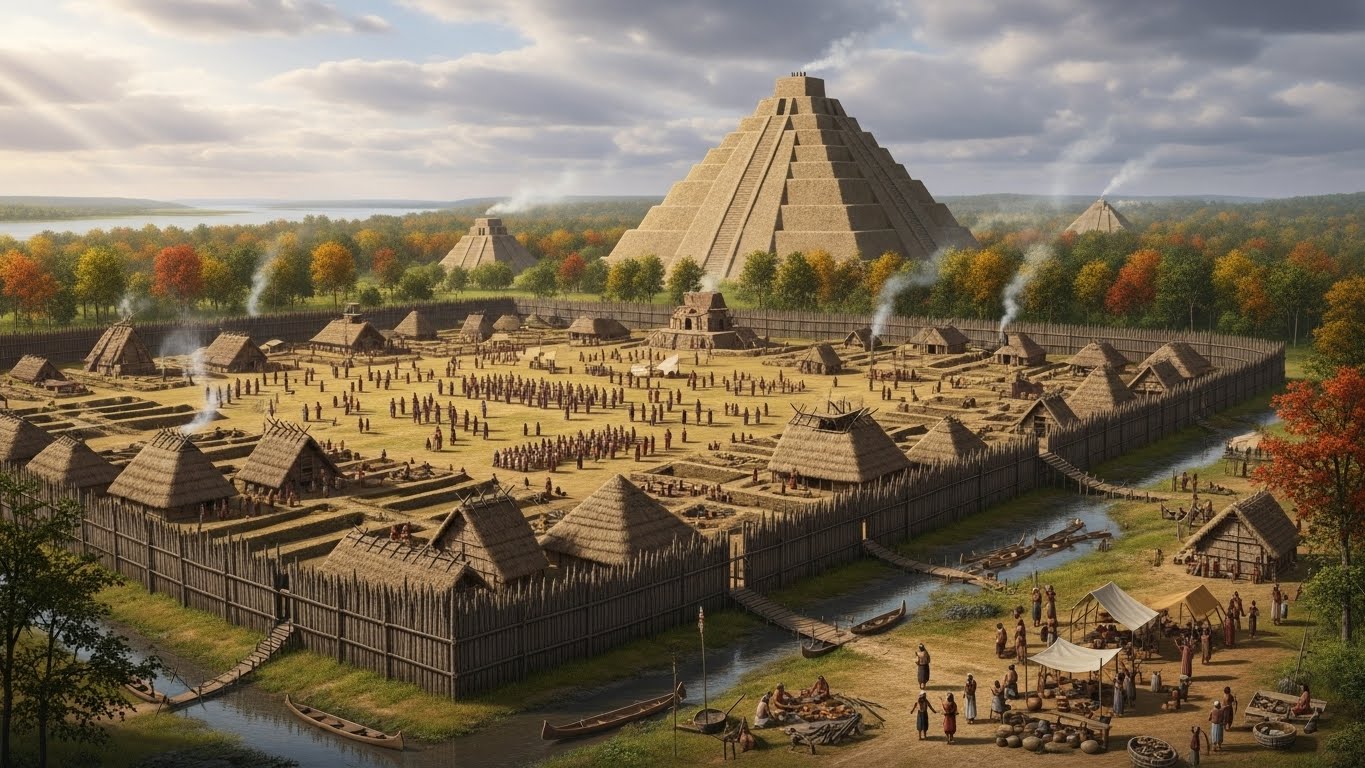
Long before European ships touched American shores, a magnificent city thrived in the heart of the Mississippi River Valley. Cahokia, located near modern-day St. Louis, Missouri, was once home to an estimated 10,000 to 20,000 people—making it larger than London at the time. Yet today, most Americans have never heard of it.
Between 1050 and 1350 CE, Cahokia stood as the center of the Mississippian culture, a complex civilization that developed sophisticated agriculture, extensive trade networks, and most intriguingly, an elaborate religious system that shaped every aspect of daily life.
Quick Facts About Cahokia
- Peak population: 10,000-20,000 people (1050-1200 CE)
- Area covered: 6 square miles at its height
- Number of mounds: Over 120 earthen structures
- Largest mound: Monks Mound – 100 feet tall, larger than the base of the Great Pyramid
- UNESCO World Heritage Site since 1982
The Sacred Landscape: Mounds as Cosmic Architecture

The most striking feature of Cahokia was its massive earthen mounds—over 120 of them at the city’s peak. These weren’t random constructions; they formed a carefully planned sacred landscape that reflected the Cahokian worldview.
Monks Mound, the centerpiece, towers 100 feet high and covers 14 acres at its base. Built entirely by hand using basket-loads of earth, it required an estimated 22 million cubic feet of soil. This monumental structure served as both a platform for religious ceremonies and a residence for the city’s elite priest-rulers.
| Mound Name | Height | Purpose |
|---|---|---|
| Monks Mound | 100 feet | Elite residence & ceremonial platform |
| Mound 72 | 6 feet | Elite burial mound |
| Platform Mounds | Varies | Temples & public ceremonies |
| Conical Mounds | 10-30 feet | Burial sites & markers |
Woodhenge: The American Stonehenge
Perhaps the most fascinating religious structure at Cahokia was Woodhenge—a series of timber circles that functioned as astronomical calendars. These wooden post circles, similar in concept to England’s Stonehenge, aligned with solar events including the equinoxes and solstices.
Archaeologists have discovered evidence of at least five different Woodhenge structures built and rebuilt over time, suggesting continuous religious observance spanning generations. The posts were precisely positioned to track the sun’s movements, allowing priests to predict seasonal changes critical for agriculture and to schedule religious ceremonies.
Want to see Woodhenge reconstructed?
Our video features stunning visualizations of this ancient calendar
The Cahokian Cosmology: Understanding Their Spiritual World
The religious beliefs of Cahokia centered on a complex cosmology that divided the universe into three realms:
Upper World (Sky Realm)
Home to celestial beings, the sun, moon, and thunderbirds. Associated with order, light, and masculine energy.
Middle World (Earth)
The realm of humans, animals, and plants. A balance between the upper and lower worlds where life unfolds.
Lower World (Underworld)
Home to water spirits, underwater panthers, and ancestors. Associated with chaos, fertility, and feminine energy.
This tripartite worldview is common among many Native American cultures and appears in Cahokian art, burial practices, and urban planning. The mounds themselves may have represented mountains connecting these cosmic realms.
Ritual Sacrifice: The Dark Side of Cahokian Religion
One of the most controversial discoveries at Cahokia comes from Mound 72, where archaeologists uncovered evidence of large-scale human sacrifice. The burial site contained over 270 bodies, many showing signs of ritual execution.
The most striking burial featured a male (likely a high-ranking leader) laid on a bed of 20,000 shell beads arranged in the shape of a falcon—a powerful symbol in Mississippian culture. Surrounding him were the remains of:
- Four males with their heads and hands removed
- 53 young women (ages 15-25) buried in a mass grave
- Multiple individuals showing evidence of violent death
While disturbing to modern sensibilities, these sacrifices likely played a crucial role in Cahokian religious practice, possibly related to renewal ceremonies or the death of important leaders.
Religious Authority and the Priest-Kings
Cahokia’s leaders were likely priest-kings—individuals who held both political and religious authority. Living atop Monks Mound, these elite figures would have been visible from throughout the city, reinforcing their connection between earth and sky.
Evidence suggests these leaders claimed descent from celestial beings or possessed supernatural powers. They wore elaborate regalia including:
- Copper headdresses – Often featuring falcon or thunderbird imagery
- Shell gorgets – Engraved with religious symbols
- Stone maces – Symbols of authority and ritual power
- Feathered cloaks – Connecting them to bird spirits
The Chunkey Game: Sport as Religious Ritual

The most popular pastime in Cahokia was chunkey, a game that blended sport, gambling, and religious significance. Players rolled a stone disc down a packed clay court and threw spears at where they predicted it would stop.
Large plazas were dedicated to chunkey, and the game appears frequently in Mississippian art. Some scholars believe chunkey had cosmological significance, with the rolling disc representing celestial bodies or the cycle of life and death.
The Mystery of Cahokia’s Collapse
By 1350 CE, Cahokia was abandoned. The reasons remain debated, but may include:
| Theory | Evidence |
|---|---|
| Environmental Degradation | Deforestation, soil depletion, flooding |
| Climate Change | Little Ice Age brought colder temperatures |
| Social Upheaval | Rebellion against elite religious authority |
| Disease | Dense population vulnerable to epidemics |
Some researchers suggest the collapse of the religious system itself may have triggered abandonment. If the priest-kings’ promises of cosmic order and agricultural abundance failed, people may have lost faith in the entire system.
Explore Every Detail
Our comprehensive documentary covers theories about Cahokia’s mysterious collapse with expert interviews and archaeological evidence
Legacy and Rediscovery
For centuries, Cahokia’s mounds were misattributed to various groups—from Vikings to a “lost race.” It wasn’t until serious archaeological work in the 20th century that the true nature of this Native American metropolis was understood.
Today, Cahokia Mounds State Historic Site preserves this incredible legacy. The site educates visitors about the sophisticated civilization that once flourished in North America, challenging persistent myths about pre-Columbian societies.
The descendants of Cahokia’s people—including the Osage, Omaha, Ponca, Quapaw, and other Native American nations—maintain cultural and spiritual connections to this sacred landscape.
Why Cahokia Matters Today
Understanding Cahokia’s forgotten religion offers crucial insights into:
- Complex pre-Columbian societies – Cahokia proves sophisticated civilizations existed in North America
- Urban planning and religion – How spiritual beliefs shape entire cities
- Environmental sustainability – Lessons from a civilization that grew beyond its resources
- Cultural heritage – Honoring Native American history and achievements
Conclusion: Remembering Cahokia
The forgotten religion of Cahokia reveals a civilization of remarkable sophistication—one that built astronomical observatories, conducted elaborate ceremonies, and created a religious system that unified thousands of people across the Mississippi Valley.
Though the city fell silent centuries ago, its mounds still rise from the Illinois landscape, silent witnesses to a spiritual tradition that once moved mountains of earth and reshaped the cosmos itself.
Ready to Journey Back in Time?
Experience the full story of Cahokia’s mysterious civilization with stunning visuals, expert commentary, and archaeological discoveries you won’t find anywhere else.
Don’t forget to subscribe for more ancient history documentaries!
Related Topics You Might Enjoy:
- The Aztec Religion and Human Sacrifice
- Mayan Astronomy and Cosmology
- Ancient Pueblo Peoples and Their Spiritual Practices
- The Inca and Their Sun Worship
- Native American Creation Myths
Found this article fascinating?
Share it with fellow history enthusiasts and help spread awareness about Cahokia’s incredible legacy!
👉 The Bird-Man Tablet's Cosmic Secrets at Cahokia for more ancient civilization documentaries