
Uncovering the Ancient Mystery of Pre-Viking Transatlantic Voyages
Reading Time: 8 minutes | Last Updated: December 2024
Ancient Irish monasteries perched on Atlantic cliffs – launching points for incredible voyages?
Quick Summary
Long before Columbus and even before the Vikings, Irish monks may have crossed the Atlantic Ocean in simple leather boats. This article explores the compelling evidence, ancient texts, and archaeological discoveries that suggest these brave voyagers reached North America centuries before anyone else.
The Legend That Refused to Die
For centuries, historians dismissed the idea as fantasy—Irish monks crossing the treacherous Atlantic Ocean in leather boats? Impossible. Yet, mounting evidence suggests these holy men, driven by faith and a desire for spiritual isolation, may have accomplished one of history’s most remarkable feats of navigation and courage.
The story centers on a 6th-century Irish abbot named Saint Brendan the Navigator, whose legendary voyage was documented in the medieval text “Navigatio Sancti Brendani Abbatis” (The Voyage of Saint Brendan the Abbot). But was this merely Christian allegory, or did it contain the kernel of historical truth?

Could simple leather boats have conquered the Atlantic?
Who Were These Fearless Monks?
The early Irish monks were unlike any religious order that came before or after. Following a tradition called peregrinatio pro Christo (pilgrimage for Christ), these ascetic Christians sought isolation in the most remote places imaginable. They established monasteries on windswept islands, barren rocks, and cliff faces throughout Ireland and Scotland.
| Time Period | Irish Monastic Achievement | Distance from Ireland |
|---|---|---|
| 500-600 AD | Skellig Michael monastery established | 8 miles offshore |
| 625 AD | Reached Faroe Islands | 430 miles |
| 700 AD | Settled Iceland | 870 miles |
| 800-900 AD | Possibly reached North America? | 2,000+ miles |
These weren’t comfortable journeys. The monks traveled in currachs—boats made from leather hides stretched over wooden frames, waterproofed with animal fat. Yet historical records confirm they reached Iceland long before the Vikings, with Icelandic chronicles mentioning the “papar” (Irish monks) who fled when Norse settlers arrived around 870 AD.
The Voyage of Saint Brendan: Myth or Memory?
Key Clues from the Navigatio
- “Islands of Sheep” – Possibly the Faroe Islands (literally means “Sheep Islands”)
- “Crystal Pillars” – Likely icebergs near Greenland
- “Island of Smiths” – Volcanic Iceland with its active volcanoes
- “Promised Land of the Saints” – A vast, forested land (North America?)
The Navigatio, written around 900 AD but describing events from the 6th century, tells of Brendan’s seven-year voyage westward across the Atlantic. For centuries, scholars dismissed it as religious allegory. However, the text contains remarkably accurate descriptions of real North Atlantic phenomena that a landlocked medieval author couldn’t have invented.

“Crystal pillars” – Medieval monks’ description of Atlantic icebergs
Tim Severin’s Epic Proof
In 1976-1977, British explorer Tim Severin decided to test whether the voyage was possible. He constructed a 36-foot currach using only medieval materials and methods—oak-tanned leather, ash wood frames, and 49 oxhides. No modern equipment, no engine, just sails and oars.
The result? Severin and his crew successfully sailed from Ireland to Newfoundland, following the route described in the Navigatio. They stopped at the Hebrides, Faroe Islands, Iceland, and Greenland before reaching North America—proving that Irish monks could have made the journey over 1,400 years ago.
The Currach Specifications
| Length: | 36 feet (11 meters) |
| Material: | 49 oxhides, ash wood frame |
| Crew: | 5 men |
| Journey Time: | 13 months (with winter stops) |
| Result: | Successfully reached North America |
Archaeological Whispers from America
While no definitive Irish artifacts have been found in North America (yet), several tantalizing clues hint at pre-Viking European presence:
West Virginia Stone Inscriptions
Ogham-like markings (ancient Irish script) found on stones, though their authenticity remains hotly debated among scholars.
Mystery Stone Structures
Beehive-shaped stone cells in New England bearing similarities to Irish monastic architecture—though many are likely colonial root cellars.
Viking Sagas
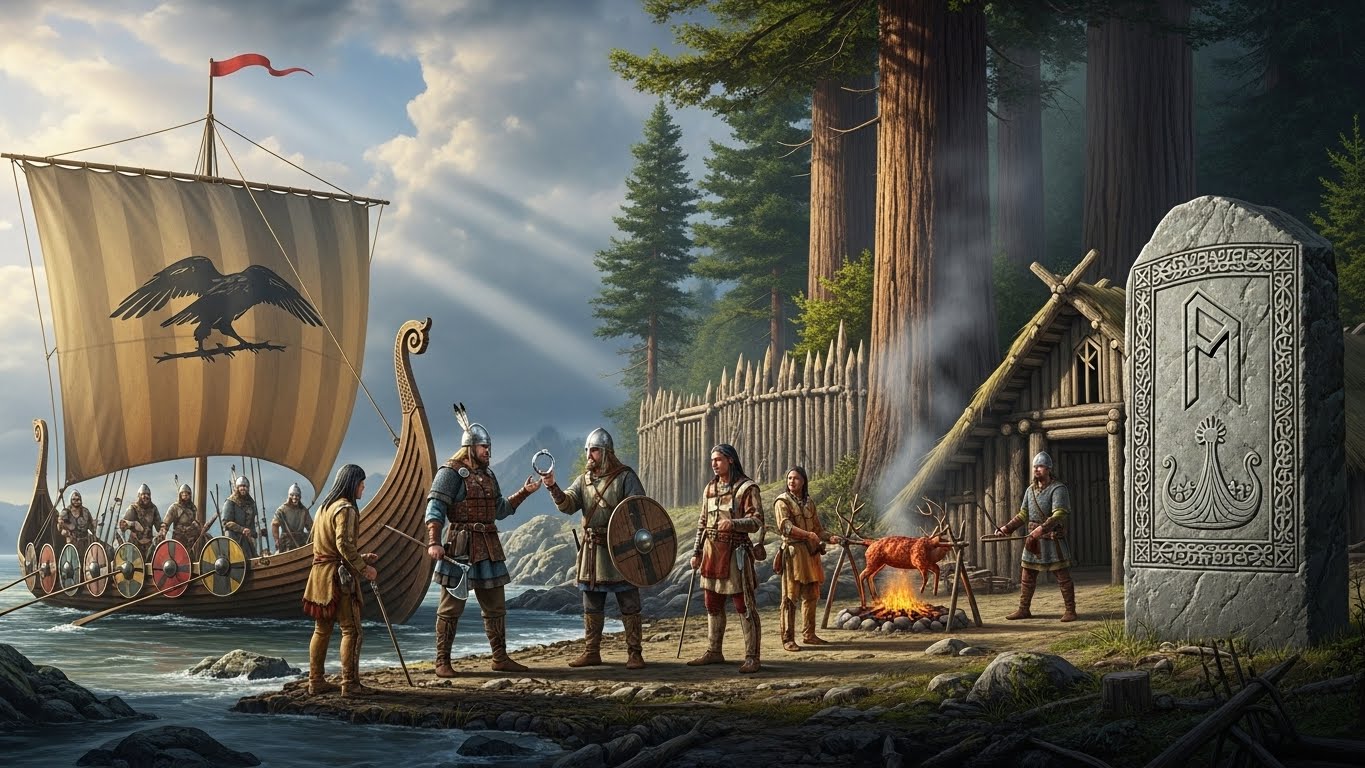
Norse explorers around 1000 AD reported encountering “white men” in Vinland (Newfoundland) who wore white robes and carried poles—possibly Christian monks with processional crosses.

Mysterious stone structures in North America—Irish monastic cells or colonial construction?
Why Don’t We Know for Sure?
The lack of definitive proof doesn’t mean the voyages didn’t happen. Consider these factors:
- Organic Materials Decay: Leather boats, wooden tools, and woolen clothing decompose completely within decades, leaving no trace after 1,400 years.
- Small Populations: Monks sought isolation, not colonization. Small groups leave minimal archaeological footprints.
- No Metal Artifacts: Unlike Vikings with their iron tools and weapons, monks carried little metal, reducing chances of lasting evidence.
- Vast Search Area: The North American coastline spans thousands of miles—potential landing sites could be anywhere from Labrador to Florida.
- Later Disturbances: Viking settlements, Indigenous movements, and later European colonization may have obscured or destroyed earlier evidence.
The Historical Timeline: Who Really Got There First?
| Time Period | Explorer/Group | Evidence Level |
|---|---|---|
| ~500-600 AD | 🇮🇪 Irish Monks (Possible) | ⭐⭐ Circumstantial |
| ~1000 AD | ⚔️ Vikings (Leif Erikson) | ⭐⭐⭐⭐⭐ Confirmed (L’Anse aux Meadows) |
| 1492 AD | 🇪🇸 Christopher Columbus | ⭐⭐⭐⭐⭐ Well-Documented |
What Motivated These Incredible Voyages?
Unlike later explorers seeking gold, trade routes, or territorial conquest, Irish monks had radically different motivations:
Spiritual Isolation
Seeking the ultimate desert—a place so remote they could commune only with God.
White Martyrdom
The Irish concept of martyrdom through self-imposed exile rather than death.
Divine Providence
Trusting God to guide their boats wherever He willed—the ultimate act of faith.
Modern Research and New Technologies
Today’s archaeologists are using cutting-edge technology to search for evidence:
- LiDAR scanning revealing hidden structures beneath forest canopies
- Ground-penetrating radar detecting buried artifacts without excavation
- DNA analysis of ancient populations looking for European markers
- Paleobotany studies searching for non-native plants monks might have introduced
- Deep-sea archaeology exploring potential shipwreck sites along the North Atlantic route

Modern archaeology continues searching for definitive proof
Why This Story Matters Today
Whether or not Irish monks reached America, their story challenges our assumptions about history, capability, and human determination. It reminds us that:
- Ancient peoples were far more capable than we often credit
- Written records can preserve truth even when dismissed as myth
- Faith and determination can achieve seemingly impossible feats
- History’s “firsts” are rarely as clear-cut as textbooks suggest
- There’s still so much we don’t know about our past
The Verdict: Did They Make It?
Based on available evidence, we can conclude:
✓ CONFIRMED: Irish monks reached Iceland by 700 AD
⚠️ HIGHLY PROBABLE: They had the technology and motivation to reach North America
? UNPROVEN: No definitive archaeological evidence… yet
The absence of evidence isn’t evidence of absence. Each year brings new archaeological discoveries and analytical techniques. Perhaps tomorrow, next year, or next decade, a researcher will uncover the proof that rewrites history books.
Watch the Full Documentary
Want to dive deeper into this fascinating historical mystery? Watch our complete documentary featuring expert interviews, 3D reconstructions of currach voyages, and exclusive footage from archaeological sites.
✅ Expert historian commentary
✅ Rare archaeological footage
✅ Stunning cinematic visuals
✅ Evidence analysis and debate
Don’t forget to subscribe for more incredible historical mysteries!
Join the Discussion
What do you think? Did Irish monks reach America before the Vikings? Share your theories in the comments below or on our YouTube channel!
Follow History Candle for more forgotten chapters of history that challenge everything you thought you knew.