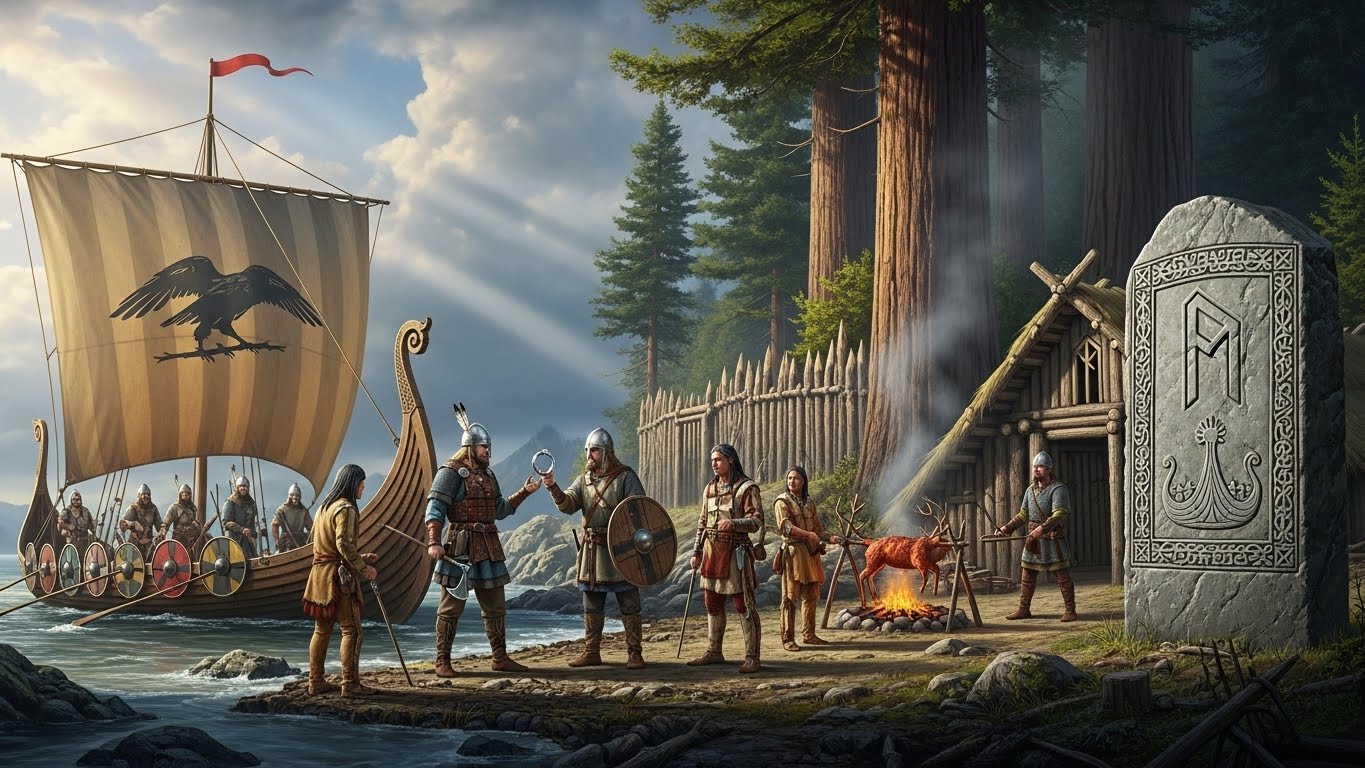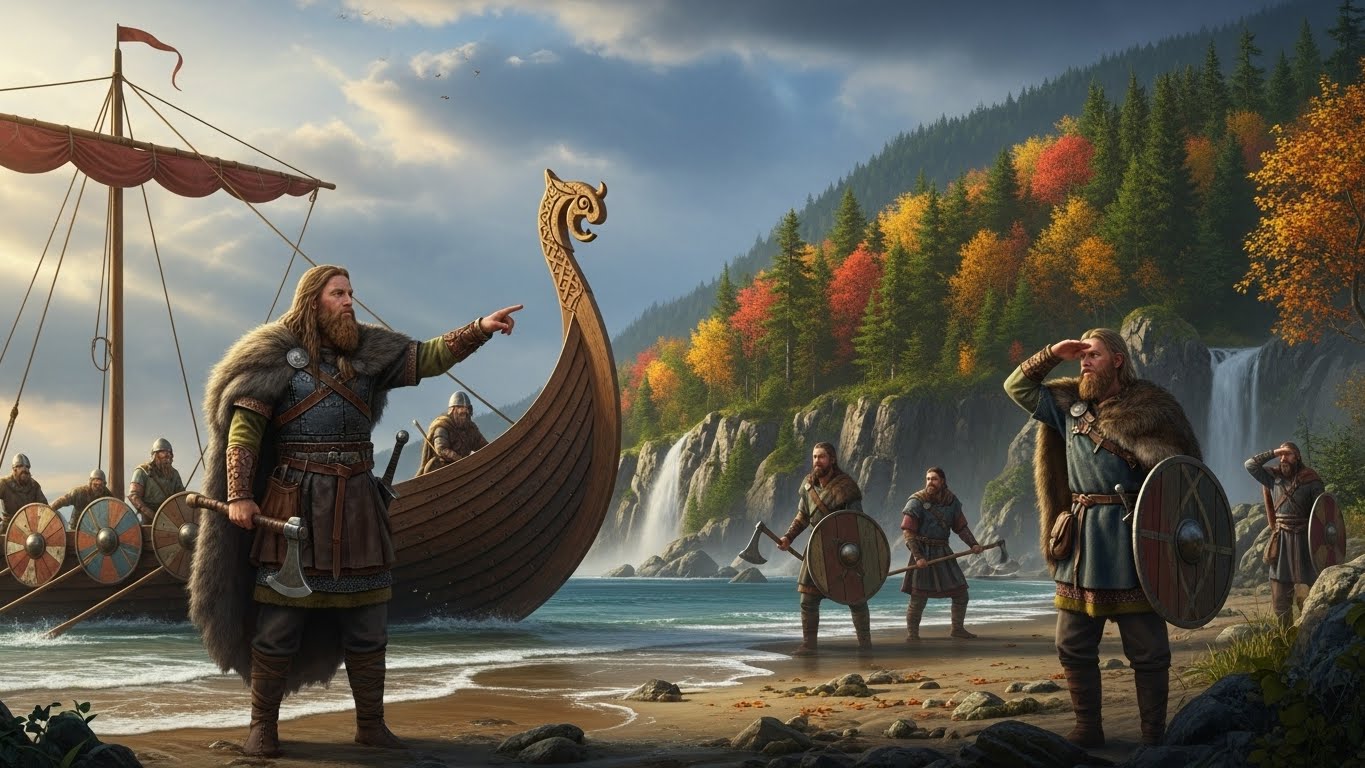

The Vikings believed the end of the world would arrive on a ship built from the fingernails of the dead. That detail is not a modern invention. It is written in a book more than eight hundred years old, which warns that anyone who dies with untrimmed nails is adding material to the ship of doomsday. It is a good introduction to Ragnarök: strange, specific, and far more human than its reputation.
The short answer
Ragnarök, Old Norse for “the fate of the gods”, is the end of the world in Norse mythology. After the death of the god Baldur and a winter that lasts three years, the monsters break free and the gods fight a final battle in which Odin, Thor, Freyr, Tyr, Heimdall and Loki all die. The fire giant Surtr burns the world and it sinks into the sea. Then a green earth rises again, with a handful of surviving gods and two humans, Líf and Lífthrasir, to begin a new world.
This article follows our documentary Ragnarök: How Vikings Believed the World Would End: what the name means, where the story comes from, the signs of the end, the final battle, who survives, and the secret Odin whispered to his dead son. Along the way we look at the real volcanic catastrophe of the 530s that may lie behind the myth, and at the Christian stone crosses in Britain that carved Ragnarök into their sides.
What does Ragnarök mean?
The word comes from Old Norse. Ragna means the gods, the ruling powers of the universe, and rök means fate, doom or final outcome. Ragnarök is therefore “the fate of the gods”. A closely related form, ragnarøkkr, ends in a word meaning twilight, and even medieval writers mixed the two up. That is where the phrase “Twilight of the Gods” comes from, made famous when Richard Wagner called the last opera of his Ring cycle Götterdämmerung, first staged in 1876.
Where the story of Ragnarök comes from
The Vikings never collected their religion into a holy book. Their stories were told aloud, and almost everything we know about Ragnarök was written down in Iceland in the 1200s, more than two centuries after Iceland officially became Christian. There are two main sources:
- The Völuspá (“the Prophecy of the Seeress”), a poem in which a wise woman tells Odin how the world began and how it will end. Again and again she asks him: do you want to know more, or not? He always does.
- The Prose Edda, written around 1220 by the Icelandic chieftain Snorri Sturluson, a Christian who retold the old stories in plain prose so they would not be forgotten.
The best copy of the Völuspá survives in a small, battered manuscript called the Codex Regius, the King’s Book. For most of its poems it is the only copy in the world. It was sent to the king of Denmark as a gift in 1662 and stayed in Copenhagen for three centuries, through the great fire of 1728 and the British bombardment of 1807. In April 1971 Denmark returned it to Iceland, not by aeroplane but aboard a navy ship, and crowds gathered at the harbour in Reykjavík to welcome a book home.
A world built to fall
At the centre of the Norse cosmos stands Yggdrasil, the World Tree, an ash so vast that nine worlds hang on and around it: Asgard, fortress of the gods; Midgard, the world of humans, linked to Asgard by the rainbow bridge Bifröst; the lands of the giants; Muspelheim, the world of fire; and the cold realm of the dead, ruled by the goddess Hel.
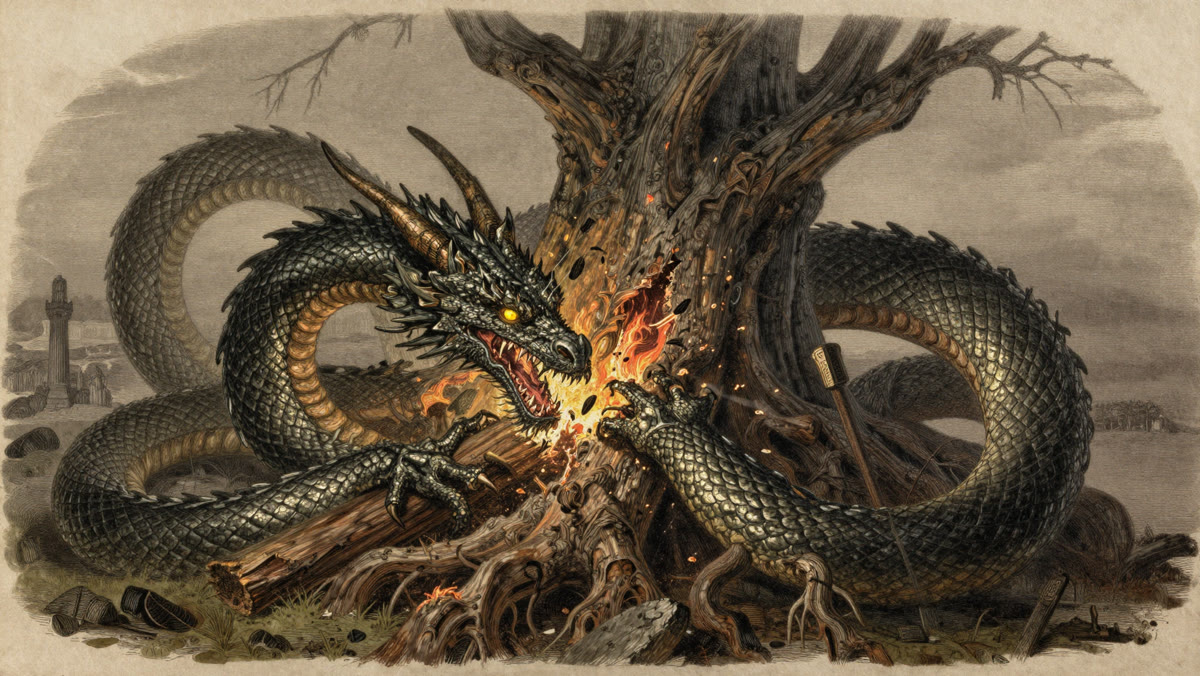
What makes this mythology unusual is that the world is falling apart from the start. The dragon Nidhogg gnaws the roots of Yggdrasil, deer chew its branches and one side of the trunk is rotting. Near the roots live the Norns, who carve the fate of every living being, and not even the gods can change what they have decided.
Odin, the Allfather, knows this. He gave an eye for a drink from the well of wisdom and hung himself on the World Tree for nine nights to learn the runes, and what he learned was how it would all end, including which monster would kill him. Valhalla, often imagined as a warrior’s paradise, was really a training camp. The Valkyries carried half of the bravest fallen warriors to Odin (the other half went to the goddess Freya), and every day they fought, healed and feasted. One poem gives Valhalla 540 doors, with 800 warriors marching out of each on the last day: 432,000 dead heroes. Odin was building an army for a battle he knew he could not win.
Loki’s children and the binding of Fenrir
Loki was born among the giants but lived in Asgard as Odin’s sworn blood brother: clever, funny and completely unpredictable. With the giantess Angrboda he had three children. The serpent Jörmungandr was thrown into the ocean, where it grew until it circled the whole of Midgard and bit its own tail. The girl Hel, half living flesh and half the colour of death, was sent to rule the dead. The wolf Fenrir the gods kept in Asgard, where only Tyr, god of war and justice, was brave enough to feed him.
Fenrir grew so fast that the gods decided to chain him, pretending it was a test of strength. He snapped the first chain and then a second, twice as strong. So the dwarves made Gleipnir, a ribbon as thin as silk and impossible to break, from six impossible things: the sound of a cat’s footsteps, the beard of a woman, the roots of a mountain, the sinews of a bear, the breath of a fish and the spit of a bird. Snorri jokes that this is why cats walk silently and mountains have no roots.
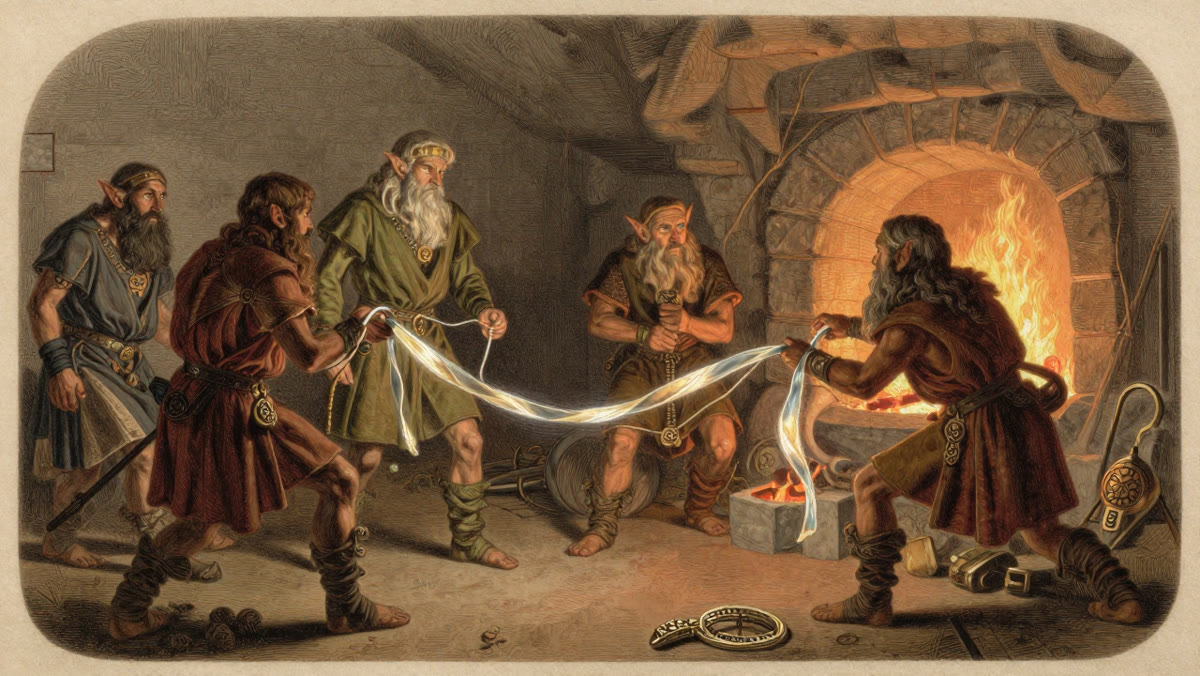
Suspicious, Fenrir demanded that one god place a hand in his mouth as a pledge of fair play. Nobody moved, until Tyr, the god who had fed him since he was a pup, put his right hand between the wolf’s jaws. When Fenrir realised he had been tricked, he bit it off. Tyr’s sacrifice is the Viking idea of courage in one picture: not the absence of fear, but doing what has to be done even when it costs you something you will never get back. And the prophecy was clear: on the last day, Fenrir would kill Odin.
The death of Baldur: the first domino
Baldur, son of Odin and Frigg, was the god of light and goodness, loved by everyone. When he began to dream of his own death, Odin rode his eight-legged horse Sleipnir to the land of the dead, woke a dead seeress and learned that the mead was already brewed for Baldur’s arrival. Frigg refused to accept it. She travelled the nine worlds and made fire, water, metals, stones, trees, sicknesses, poisons and animals swear never to harm her son. The relieved gods turned it into a game, throwing spears and stones at Baldur and watching them bounce away.
Loki, disguised as an old woman, learned from Frigg that one thing had not sworn: a young sprig of mistletoe, too small to seem worth asking. He put it in the hand of Baldur’s blind brother Hodur and guided his aim. The dart struck Baldur and he fell dead. The gods were too shocked even to speak.
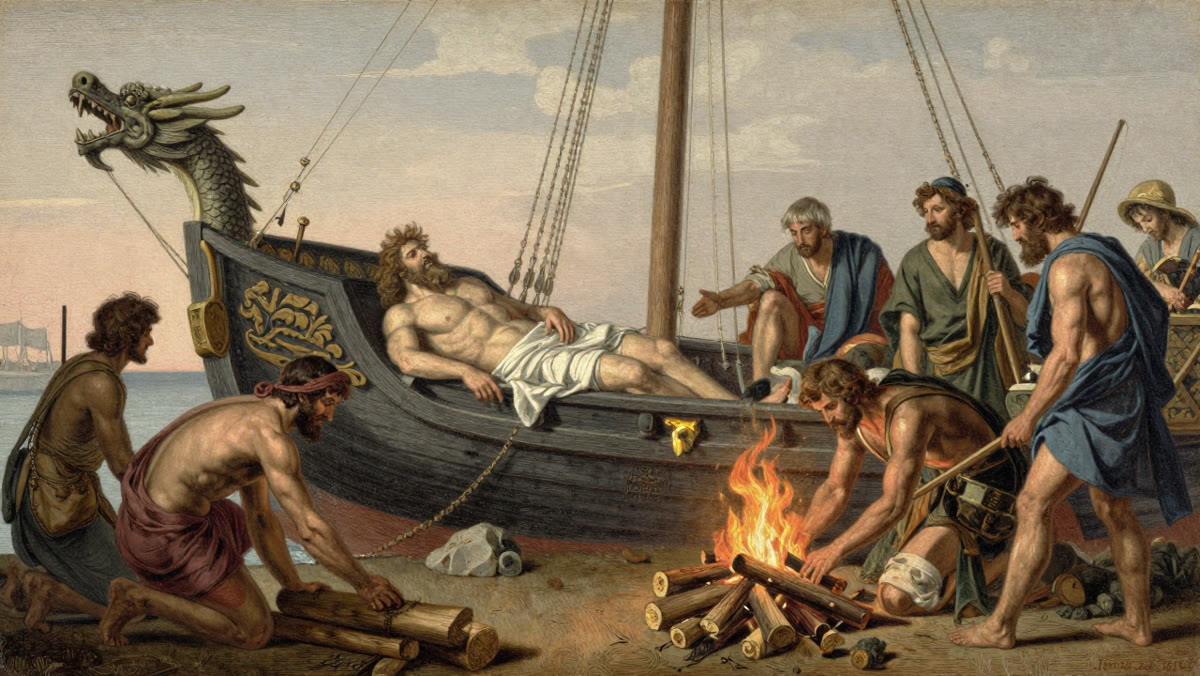
Baldur was burned on his own ship, and his wife Nanna, whose heart burst with grief, was laid beside him. Odin placed his golden ring on the pyre and, one poem says, whispered something into his son’s ear that nobody heard. Hermod rode to the underworld to plead for Baldur’s return, and Hel set one condition: everything in the world must weep for him. Everything did, which is why, the storytellers said, frost melting on stone looks like tears, except one old giantess in a cave who would weep only “dry tears”. People believed she was Loki. Because of one refusal, Baldur stayed dead, and the countdown to Ragnarök began.
Loki bound, and a Christian cross that remembers
The gods caught Loki, who had turned himself into a salmon, and bound him across three sharp rocks in a cave with a snake dripping venom onto his face. His wife Sigyn stayed with him, holding a bowl to catch the poison. Only when she turned away to empty it did the venom touch him, and his writhing, the Vikings said, is what causes earthquakes.
These stories were carved in stone in the Viking-age British Isles. The Gosforth Cross in Cumbria, northwest England, roughly a thousand years old, shows the crucifixion on one side, and, many experts believe, scenes of Ragnarök on others: a bound figure with a woman holding a vessel over him, a figure with a horn, and a man with his foot in the jaws of a beast. On the Isle of Man, Thorwald’s Cross, carved around 940, shows Odin with a raven on his shoulder being devoured by a wolf, and on the other side a figure with a cross and a book. The people who carved them lived where the old gods and the new faith met, and they put both stories on the same stone.
The signs of Ragnarök
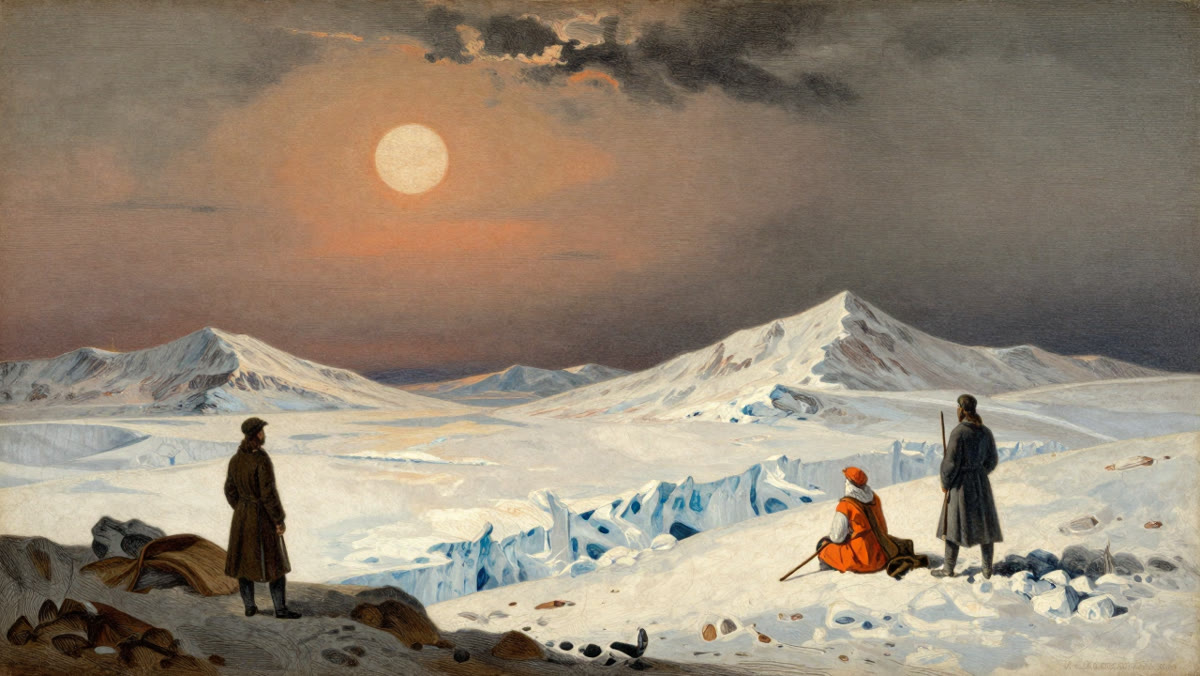
According to the Völuspá, the first signs of the end do not come from monsters but from people: brothers fight and kill each other, families betray one another and nobody shows mercy. The seeress calls it “an axe age, a sword age, a wind age, a wolf age”. Then comes the Fimbulwinter, the great winter: snow from every direction, biting frost, a sun without strength, and three winters in a row with no summer between them. Three years without a harvest.
Was Ragnarök based on a real event? The volcanic winter of 536
For a long time historians treated the Fimbulwinter as a spooky detail in an old poem. Then tree rings and ice cores drilled from Greenland and Antarctica revealed that in 536 something went badly wrong with the sky. Most researchers now link it to a large volcanic eruption, followed by another around 540, that filled the atmosphere with ash and dimmed the sun. The Byzantine historian Procopius wrote that for the whole year the sun gave its light without brightness, like the moon. Irish records describe a failure of bread; Chinese records describe cold and famine. The medieval historian Michael McCormick of Harvard has called 536 perhaps the worst year in history to be alive.
In Scandinavia, where one bad harvest already meant hunger, the effects appear in the ground. Archaeologists find many farms in Sweden and Norway apparently abandoned around this time, and pollen records show fields reverting to wilderness. Some researchers estimate that in certain areas as many as half the population may have died, and some interpret the large gold hoards buried in this period as offerings to bring back the sun. Several respected scholars have suggested that the Fimbulwinter preserves a memory of these years, passed down for generations until it became part of how the world would end. It cannot be proven, but it is the closest thing we have to an answer when people ask whether Ragnarök “already happened”.
A stone in Sweden may echo it. The Rök runestone, raised around 800 by a father named Varin in memory of his dead son, carries the longest runic inscription carved in stone. In 2020 a team of Swedish researchers proposed that several of its riddles are about the sun and about Odin’s warriors, and that the stone reflects fear of another great winter after a run of alarming sky events. Not every expert accepts this reading, and the debate continues.
The end begins
After the great winter everything breaks at once. The wolves Sköll and Hati, which have chased the sun and moon since the beginning of time, finally catch them; the stars fall and the world goes dark. The earth shakes, mountains fall, the World Tree groans, and every bond in the universe snaps. Fenrir runs free with his lower jaw on the ground and his upper jaw against the sky. Jörmungandr rises from the sea, flooding the shores and poisoning air and water.
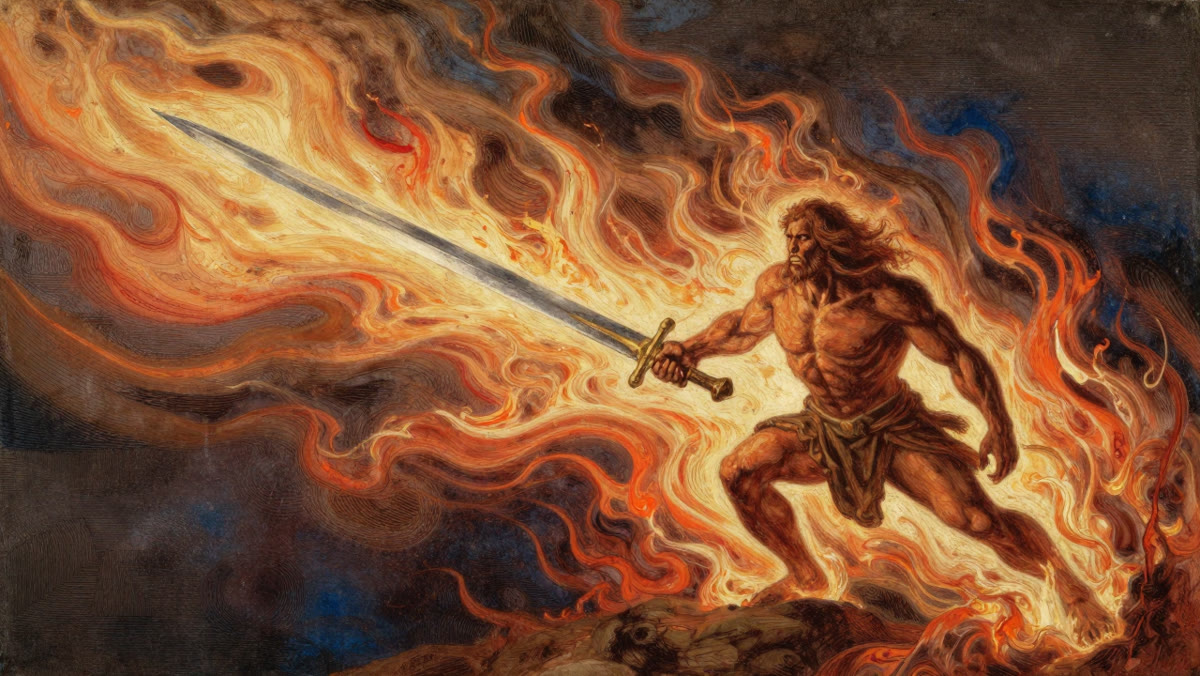
On the flood breaks loose Naglfar, the nail ship, crewed by giants. Loki leads an army from the land of the dead. From the burning south ride the fire giants under Surtr, whose sword shines brighter than the sun, and the rainbow bridge collapses beneath them. The hound Garm howls, three roosters crow across the worlds, and Heimdall, the watchman who can hear grass grow, blows the horn Gjallarhorn so loudly it echoes through all nine worlds. The armies gather on the plain of Vígríðr, and the gods ride out with their army of the dead.
The final battle: who fights whom
| God | Opponent | Outcome |
|---|---|---|
| Odin | Fenrir the wolf | Odin is swallowed whole |
| Thor | Jörmungandr, the Midgard Serpent | Thor kills the serpent, walks nine steps and dies of its venom |
| Freyr | Surtr, the fire giant | Freyr, who gave away his sword for love, is killed |
| Tyr | Garm, the hound of the underworld | They kill each other |
| Heimdall | Loki | They kill each other |
| Vidar | Fenrir | Vidar tears the wolf’s jaws apart and avenges Odin |
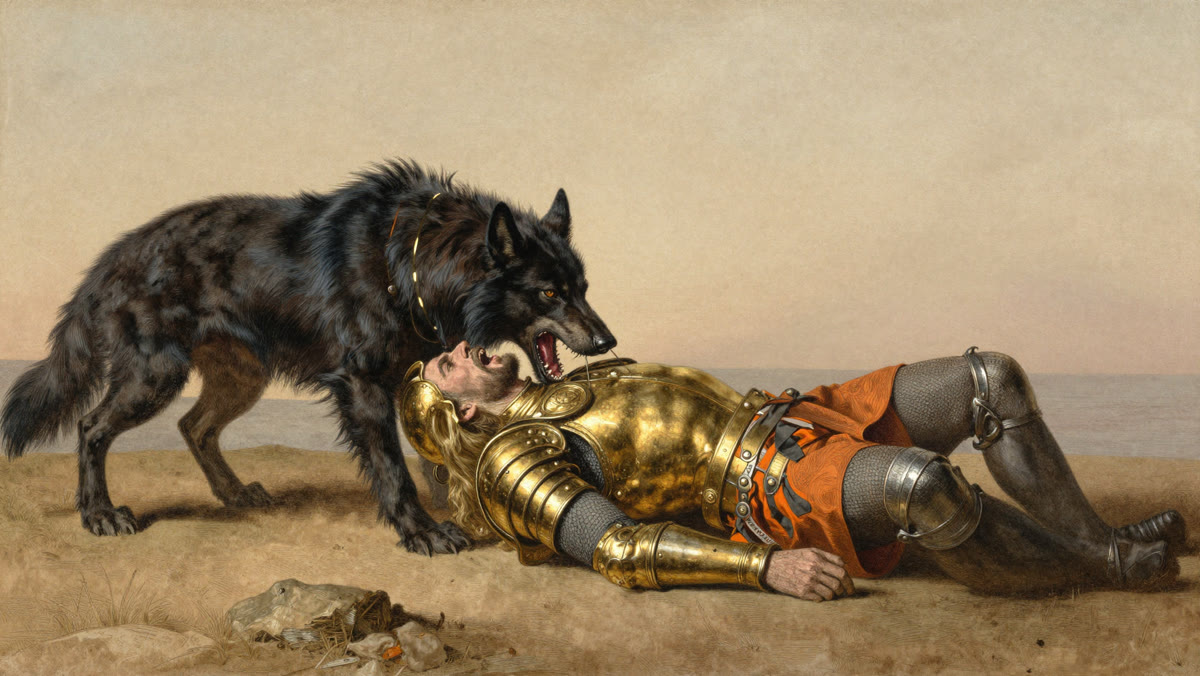
Odin rides at the front in a golden helmet, carrying his spear Gungnir, knowing exactly how it will end, and Fenrir swallows him. Thor, who once hooked the serpent while fishing with a giant and never got to finish the fight, finally kills it with Mjölnir, takes nine steps and falls dead from its poison. Freyr, god of sunshine and harvests, faces Surtr without a sword: long ago he gave it away to win the giantess Gerd. He lost not because he was weak but because he once chose love over power.
Then the silent god Vidar, another son of Odin, plants one foot on Fenrir’s lower jaw, grabs the upper jaw and tears the wolf apart. That is the scene many scholars see on the Gosforth Cross.
Vidar’s shoe and the ship of nails
Snorri adds two details that belong together. Vidar’s foot is protected by the thickest shoe ever made, built from all the scraps of leather people have ever trimmed from their own shoes, so anyone who wants to help the gods should throw those scraps away. And Naglfar, the enemy’s ship, is built from the untrimmed nails of the dead, a ship gods and humans alike would like to see finished as late as possible. The god’s shoe is made from what people give up; the enemy’s ship from what people neglect. In this mythology, the fate of the universe depends partly on the smallest everyday acts of ordinary people.
Even Vidar’s victory cannot save the world. Surtr flings fire across the earth, Asgard and Midgard burn, and the burning earth sinks beneath the sea.
Why the gods fought anyway
The gods knew all of this in advance. Odin knew Fenrir would kill him; Thor knew he would win and still die. None of them ran. Most stories promise that the good and brave will win in the end. The Norse story says chaos will win and everything you love will be destroyed, and then asks a different question: knowing that, how will you face it? The Hávamál, a collection of sayings attributed to Odin, answers in one of its best-known verses: cattle die, kinsmen die, you yourself will die, but the good name you earn never dies. You may not be able to change how the story ends, but you decide who you are when it does.
Watch the documentary
Hear the whole prophecy, from the fingernail ship to the last flight of Nidhogg, in our documentary on YouTube.
Who survives Ragnarök?
Ragnarök is not the end. After a long time under the water, the earth rises again, green and new. Waterfalls run down the mountains, an eagle hunts for fish, and fields grow without being sown. The survivors are:
- Vidar and Vali, sons of Odin.
- Modi and Magni, Thor’s sons, whose names mean courage and strength. They now carry their father’s hammer.
- Baldur and Hodur, who return from the dead together: the killer and the one he killed walk into the new world as brothers.
- Líf and Lífthrasir (“life” and “eager for life”), two humans who hid in Hoddmímir’s Wood, which many identify with the World Tree itself, surviving on morning dew.
- A new sun: before the wolf caught her, the sun gave birth to a daughter who now rides her mother’s path.
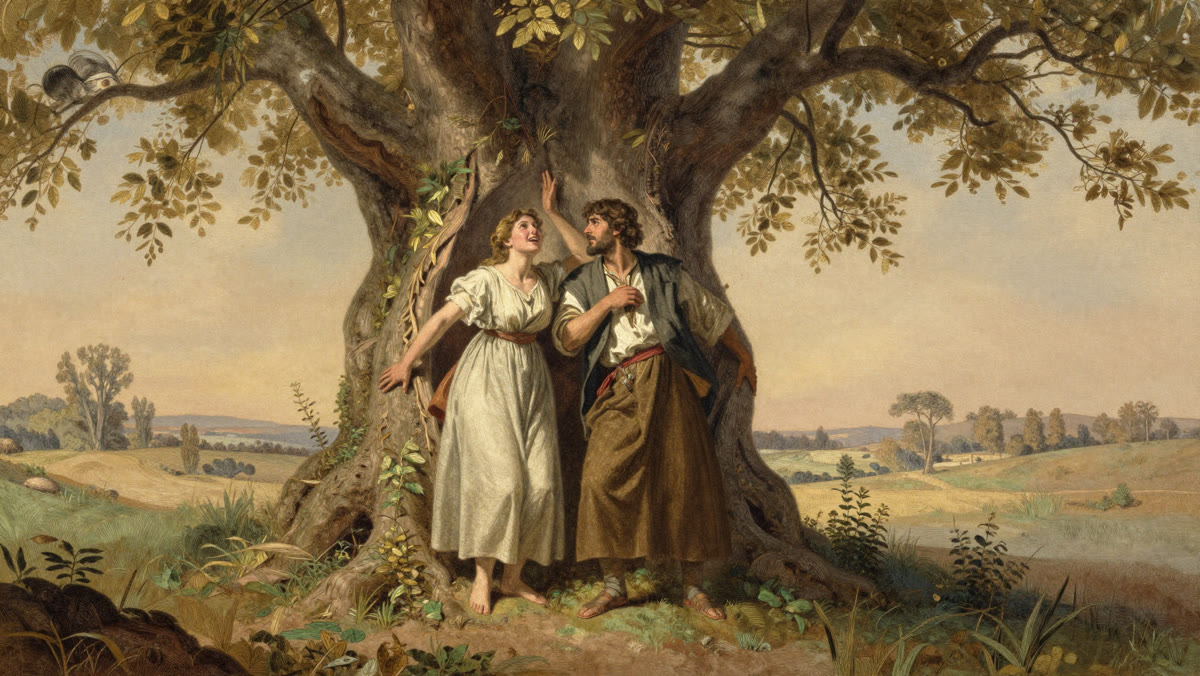
On the green field where Asgard stood, the surviving gods talk about the serpent, the wolf and everyone they lost, and in the grass they find the golden game pieces the old gods used to play with in happier days. After the end of the world, what survives is not a weapon or a crown but a reminder of the times they laughed together. The Völuspá also describes a hall roofed with gold, brighter than the sun, called Gimlé, where good people will live in happiness.
What did Odin whisper to Baldur?
In the poem Vafthrúdnismál, Odin disguises himself as a wanderer and challenges the wisest of the giants, Vafthrúdnir, to a contest of questions with their heads as the stake. Much of what we know about the survivors of Ragnarök comes from this poem. The giant answers everything, until the wanderer asks what Odin said into his son’s ear before Baldur was placed on the pyre. Only one being could know that, and the giant realises who he has been talking to and that he has lost.
The poem never gives the answer. Some think Odin whispered a magic word; others think it was simply goodbye. Many readers believe it was a promise that Baldur would return and walk in the sunlight of a new world, which is exactly what happens in the story. It remains one of the most beautiful unanswered questions in Norse mythology.
Is the happy ending Christian?
It is a fair question. These poems were written down by Christians, and the renewed world resembles the Christian idea of a new heaven and a new earth. One version of the Völuspá even mentions a mighty ruler coming from above, a stanza many scholars suspect was added later. Some believe the oldest pagan version was darker, with nothing returning at all; others argue rebirth was always part of it, for people who lived through brutal winters that always gave way to spring. Some scholars suggest the story took its final shape exactly as the old gods were being abandoned, so that for the people telling it, the twilight of the gods was happening in front of them. The carved crosses at Gosforth and on the Isle of Man suggest many people saw the same shape in both stories: a world that falls and a world that rises.
The ending most retellings leave out
You might expect the Völuspá to finish with happily ever after. It does not. In its last lines the seeress sees Nidhogg, the dark dragon from the roots of the World Tree, flying up from below with the bodies of the dead in its wings, gliding over the fields of the new world. Then she says she must sink back down, and the poem ends. Some read this as the last of the old evil leaving forever. Others read it as a warning that darkness never quite dies and the cycle may begin again.
Ragnarök in your calendar and in pop culture
You say the names of these doomed gods every week. Tuesday is named after Tiw, the Old English form of Tyr. Wednesday is Woden’s day, and Woden is the Old English Odin. Thursday belongs to Thor, and Friday is usually linked to Frigg, the mother who tried to save Baldur. The temples fell, but the gods slipped into the calendar.
The prophecy never gives a date for Ragnarök, which did not stop the Jorvik Viking Centre in York from announcing it for 22 February 2014, the middle of its annual Viking festival. News sites around the world ran the story, and the world carried on. Today Ragnarök is everywhere, from Marvel’s Thor: Ragnarok to the game God of War Ragnarök. The original is different in revealing ways: Hel is Loki’s daughter, not Odin’s, and Thor does not walk away a hero. He wins, takes nine steps, and dies.
Now watch it
Our documentary tells the whole story in one sitting, the way it was meant to be heard: out loud, by the fire. If it gives you chills, subscribe to History Candle for more long-form history and mythology.
Frequently asked questions
What does Ragnarök mean?
Ragnarök is Old Norse for 'the fate of the gods': ragna means the gods and rök means fate or doom. A related form, ragnarøkkr, means 'twilight of the gods', which is where that English phrase and Wagner's opera title Götterdämmerung come from.
What are the signs of Ragnarök?
According to the poem Völuspá, the first signs are human: brothers kill brothers and nobody shows mercy, an 'axe age, sword age, wind age, wolf age'. Then comes the Fimbulwinter, three winters in a row with no summer. Finally the wolves swallow the sun and moon, the stars fall, the earth shakes and every bond breaks, freeing Fenrir and Loki.
Who kills Odin at Ragnarök?
The giant wolf Fenrir, son of Loki, swallows Odin during the final battle. Odin's son Vidar then avenges him by tearing Fenrir's jaws apart.
Who survives Ragnarök?
The gods Vidar and Vali, Thor's sons Modi and Magni (who inherit Thor's hammer), and Baldur and Hodur, who return from the land of the dead. Two humans, Líf and Lífthrasir, survive by hiding in Hoddmímir's Wood and repopulate the new world.
Was Ragnarök based on a real event?
It cannot be proven, but several scholars think the Fimbulwinter preserves a memory of the volcanic winter of 536 and the eruption around 540, when the sun was dimmed for more than a year, harvests failed and many farms in Scandinavia were abandoned.
What did Odin whisper to Baldur?
Nobody knows. In the poem Vafthrúdnismál, Odin wins a contest of wisdom by asking the giant Vafthrúdnir what he whispered into Baldur's ear on the funeral pyre, a question only Odin himself could answer. The poem never reveals the words; many readers believe it was a promise of rebirth.
Sources and further reading
- Völuspá, Vafthrúdnismál, Grímnismál and Hávamál, in the Poetic Edda (Codex Regius, GKS 2365 4to, Iceland, 13th century).
- Snorri Sturluson, Prose Edda, especially Gylfaginning (c. 1220).
- Procopius, History of the Wars, on the dimmed sun of 536.
- Sigl, M. et al. (2015). “Timing and climate forcing of volcanic eruptions for the past 2,500 years”. Nature. doi.org
- Gibbons, A. (2018). “Why 536 was ‘the worst year to be alive'”. Science. www.science.org
- Holmberg, P., Gräslund, B., Sundqvist, O. & Williams, H. (2020). “The Rök Runestone and the End of the World”. Futhark: International Journal of Runic Studies.
- The Árni Magnússon Institute for Icelandic Studies, Reykjavík, which holds the Codex Regius.