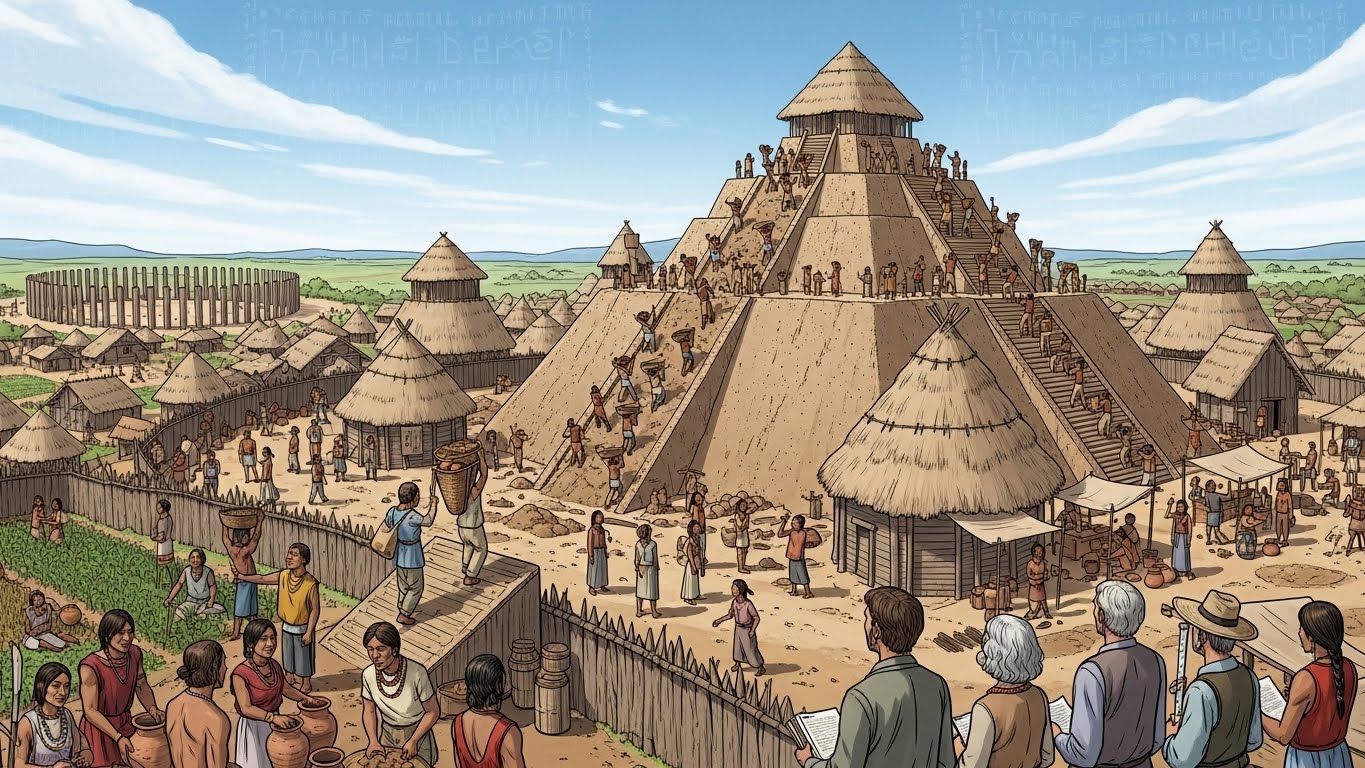

Long before the Mayflower landed, before Columbus set sail, a magnificent city rose from the Mississippi River floodplains—rivaling the great medieval cities of Europe in size and sophistication. This is the untold story of Cahokia, America’s forgotten kingdom.
The Rise of North America’s Greatest Metropolis
Between 1050 and 1200 CE, while Europe was building its Gothic cathedrals and England was dealing with Norman conquest, a thriving metropolis flourished in what is now Illinois. Cahokia was home to an estimated 10,000 to 20,000 people—larger than London at the same time period.
Located near present-day St. Louis, this urban center sprawled across six square miles and served as the political, economic, and ceremonial heart of a vast trading network that stretched from the Great Lakes to the Gulf of Mexico.
Cahokia by the Numbers
| Metric | Details |
|---|---|
| Peak Population | 10,000-20,000 residents |
| Total Area | 6 square miles (urban core) |
| Number of Mounds | 120+ earthen structures |
| Peak Period | 1050-1200 CE |
| Monks Mound Height | 100 feet (10 stories) |
Monks Mound: America’s Ancient Pyramid

At the heart of Cahokia stood Monks Mound, the largest prehistoric earthwork in the Americas. This massive structure rose 100 feet into the sky, covering 14 acres at its base—larger than the Great Pyramid of Giza in footprint.
Constructed entirely by human labor, basket by basket of earth, Monks Mound required an estimated 814,000 cubic yards of soil. Atop this monumental platform stood the residence of Cahokia’s paramount chief—a leader who commanded authority over thousands and orchestrated a complex society.
Engineering Marvel Facts
- Construction Timeline: Built in stages over 200+ years
- Labor Force: Thousands of workers organized in shifts
- Baskets Carried: Estimated 15-18 million basketloads of earth
- Modern Comparison: Equivalent to moving the earth for 40 Olympic swimming pools
A Sophisticated Urban Society
Cahokia was far more than a collection of mounds. It was a planned city with distinct neighborhoods, a central plaza larger than 35 football fields, and an astronomical observatory known as “Woodhenge”—a circle of wooden posts that tracked the sun’s movements and marked the seasons.

Daily Life in Ancient Cahokia
Archaeological evidence reveals a complex society with specialized craftspeople, extensive trade networks, and social hierarchies:
Arts & Crafts
Skilled artisans created pottery, shell beads, copper ornaments, and intricate stone carvings traded across the continent.
Agriculture
Farmers cultivated corn, beans, squash, and sunflowers in the fertile Mississippi River floodplains.
Trade Networks
Goods from the Gulf Coast, Great Lakes, Appalachian Mountains, and Great Plains flowed through Cahokia’s markets.
Social Structure
Elite lived atop mounds in large structures while commoners resided in smaller homes on lower ground.
The Mysterious Decline
By 1350 CE, Cahokia was abandoned. The great city that had dominated the Mississippi Valley for centuries was empty, its plazas silent, its mounds returning to grass. But why?
Theories Behind the Collapse
| Theory | Evidence |
|---|---|
| Environmental Degradation | Deforestation and overhunting depleted resources |
| Climate Change | Extended droughts affected agricultural productivity |
| Political Instability | Internal conflicts and loss of centralized authority |
| Disease | Dense population may have facilitated epidemic spread |
| Resource Depletion | Population exceeded the land’s carrying capacity |
Most scholars believe a combination of these factors led to Cahokia’s gradual abandonment. The city that once teemed with life slowly emptied as people dispersed to smaller communities throughout the region.
Rediscovering America’s Lost Kingdom
For centuries, Cahokia’s mounds were mistakenly attributed to a mythical “lost race” or even Vikings. It wasn’t until the 20th century that archaeologists confirmed these were the achievements of Indigenous North Americans—ancestors of modern Native American tribes including the Osage, Quapaw, and others.
Today, Cahokia Mounds State Historic Site preserves 72 of the original 120 mounds. In 1982, UNESCO designated it a World Heritage Site, recognizing its outstanding universal value to human history.
Why Cahokia Matters Today
Cahokia fundamentally challenges the narrative of pre-Columbian North America as an “empty wilderness.” It demonstrates that:
- Indigenous peoples built complex urban civilizations comparable to medieval European cities
- Sophisticated engineering, astronomy, and social organization existed in North America for centuries
- American history extends far beyond 1492—thousands of years of human achievement preceded European contact
- The continent’s first peoples left an enduring architectural legacy that rivals ancient wonders worldwide
Comparing Cahokia to Medieval Cities
| City | Location | Population (1150 CE) | Notable Feature |
|---|---|---|---|
| Cahokia | Illinois, USA | 10,000-20,000 | 120+ mounds, Woodhenge |
| London | England | 15,000-18,000 | Tower of London, London Bridge |
| Paris | France | ~20,000 | Notre-Dame construction begun |
| Rome | Italy | ~35,000 | Center of Catholic Church |
Visit Cahokia: Connecting with Ancient America
You can visit Cahokia Mounds today and walk the same grounds where thousands once lived, worked, and worshipped. Climb the stairs of Monks Mound, explore the museum’s artifacts, and stand at the reconstructed Woodhenge as the sun rises—just as the ancient Cahokians did a thousand years ago.
Visitor Information
Location: Collinsville, Illinois (8 miles from St. Louis, Missouri)
Admission: Free (suggested donations accepted)
Best Time to Visit: Spring and fall for comfortable weather
Tip: Arrive for sunrise at Woodhenge during the equinoxes for an unforgettable experience

The Legacy Lives On
Cahokia’s story is more than ancient history—it’s a testament to human ingenuity, ambition, and the rise and fall of civilizations. It challenges us to reconsider what we know about pre-Columbian America and reminds us that great cities and sophisticated societies flourished on this continent long before European contact.
The people of Cahokia didn’t simply disappear—their descendants live on in modern Native American communities throughout the Midwest and beyond, carrying forward the cultural legacy of this remarkable civilization.
Discover the Full Story of Cahokia
Want to dive deeper into the mysteries of America’s forgotten kingdom? Watch our comprehensive documentary exploring the rise, glory, and mysterious fall of Cahokia—complete with stunning visualizations, expert interviews, and archaeological evidence.
Subscribe to History Candle for more untold stories from America’s hidden past!
Further Reading & Resources
- Cahokia Mounds State Historic Site: Official visitor information and archaeological updates
- UNESCO World Heritage Site Designation: Recognition of Cahokia’s global significance
- Timothy R. Pauketat’s “Cahokia: Ancient America’s Great City on the Mississippi” – Comprehensive archaeological perspective
- The Cahokia Mounds Museum Society: Educational programs and preservation efforts
Cahokia represents one of the greatest achievements in pre-Columbian North American history. By understanding and preserving this legacy, we honor the ingenuity and accomplishments of Indigenous peoples who shaped this continent for millennia.
Watch the full video on YouTube: Cahokia: The Lost City Bigger Than London