
In February 1987 tomb robbers tunnelling into a crumbling mud-brick pyramid on the north coast of Peru broke into a chamber full of gold. A quarrel among them brought in the police, and the police called a museum director named Walter Alva. This is the story of the golden lords of the Lambayeque Valley, told in our new documentary.
The short answer
The golden lords of the Lambayeque Valley are two rulers of northern Peru whose tombs archaeologists found intact. The Lord of Sipán, a Moche ruler buried around the year 250, was excavated from 1987 by Walter Alva’s team. A Sicán lord, buried around 1000 seated upside down beneath a gold mask, was excavated by Izumi Shimada’s team from 1991.
Watch the full video
A 66-minute journey through the valley of the golden lords.
This article follows the documentary chapter by chapter. The pictures are illustrations made for the film, not photographs of the real objects. Where scholars disagree, we say so.
A desert valley of rivers and mud-brick pyramids
The north coast of Peru is a desert between the Pacific and the Andes, made green only where rivers come down from the mountains. In Lambayeque several run close together, and for centuries people led their water across the plain in canals. Across the valley stand mounds of sun-dried mud brick called huacas, sacred places; one count puts the eroded pyramids of the Lambayeque valley at about two hundred and fifty.
The Moche and the Sacrifice Ceremony
The first golden lord was Moche. Historians date this civilization roughly from the first or second century to around 800, and the estimates vary. Their painted pots show one great ritual again and again: prisoners sacrificed and their blood offered in a goblet to a richly dressed warrior-priest. Many scholars thought this was only mythology.
1987: the split pyramid of Sipán
Beside the village of Sipán rise two eroded pyramids cut through by a road, so locals call the site Huaca Rajada, the split huaca. On the night of 25 February 1987 the police chief sent for Alva, director of the Brüning Museum in Lambayeque. By dawn he, his assistant Luis Chero and about twenty policemen were at the pyramid. Alva later said that in one night the looters had destroyed a tomb that would have taken his team a year to excavate.
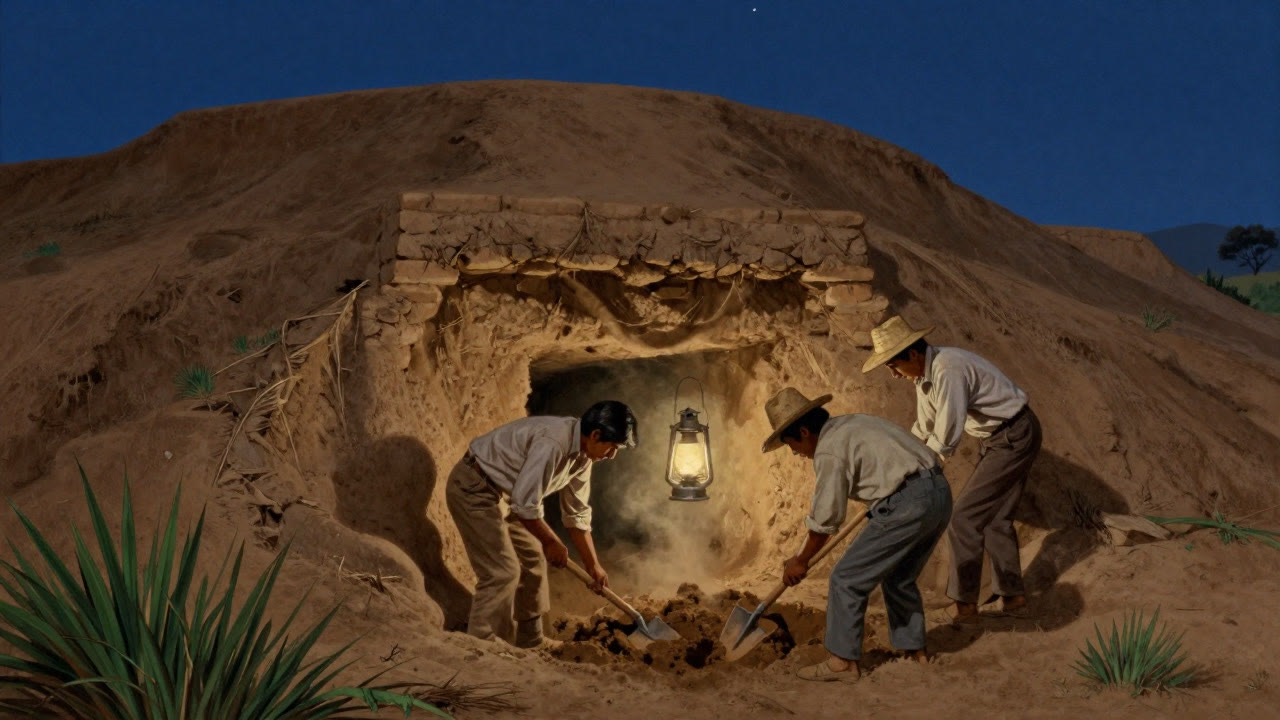
With $900 from local businessmen, the team stayed and dug properly, at first hiding at night in looters’ holes. In a later raid the looter Ernil Bernal was mortally wounded by a police bullet, and relations with the village were poisoned for years.
The Lord of Sipán: gold on the right, silver on the left
Next to the looters’ tunnel lay more than a thousand clay pots, a guardian whose feet had been removed, and below him a sealed chamber. In July 1987 the team began to uncover the Lord of Sipán, a man of about thirty-five to forty-five, in a plank coffin. Around him lay other people, a dog and two llamas; accounts differ slightly on how to count the people.
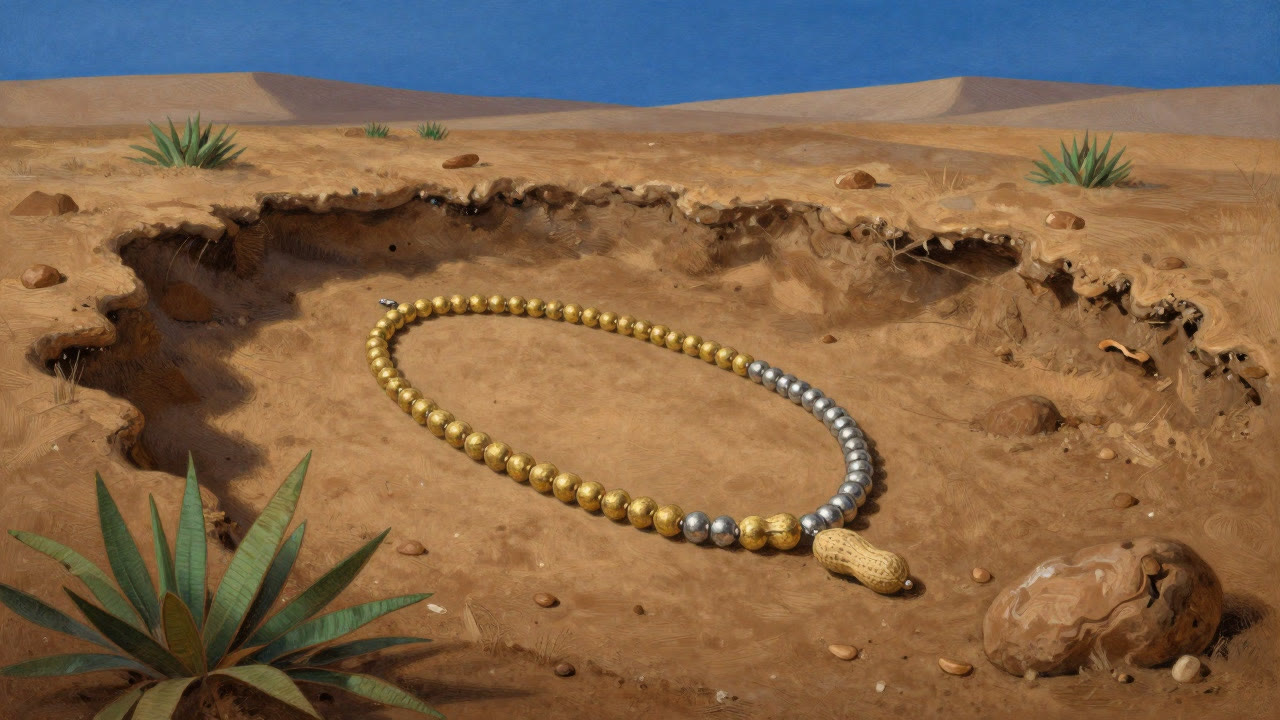
His regalia included a gold crescent crown, a gold mask, ear ornaments of gold and turquoise, and a necklace of twenty oversized peanuts, ten of gold and ten of silver. Alva noticed gold placed on the lord’s right and silver on his left, which he read as a pairing of opposites. Because the regalia matched the warrior-priest on the pots, Alva concluded that men like this lord had played that role in real life. In his own account he calls it the first intact tomb of a ruler of ancient Peru recovered scientifically.
The Sicán, the people of the House of the Moon
After a severe drought in the late sixth century, the late Moche city of Pampa Grande burned not long after 700; the most widely accepted explanation is a popular revolt. Around 900 a new civilization rose in the forests of the La Leche valley: the Sicán, or Lambayeque culture. In old Mochica, Sicán may mean house of the moon, though not every linguist agrees. Its lords wore gold, while ordinary people owned plain copper.
The lord who was buried upside down
Izumi Shimada began the Sicán Archaeological Project at Batán Grande in 1978. In October 1991 his team dug a shaft at the foot of the Huaca Loro mound and, around eleven metres down, reached an untouched chamber. A man of about forty to fifty sat upside down, his head detached and turned to face west, his body painted with red cinnabar. His gold mask had eyes of amber and emerald set in silver alloy. Two young women and two children lay with him, among about 1.2 tons of offerings.
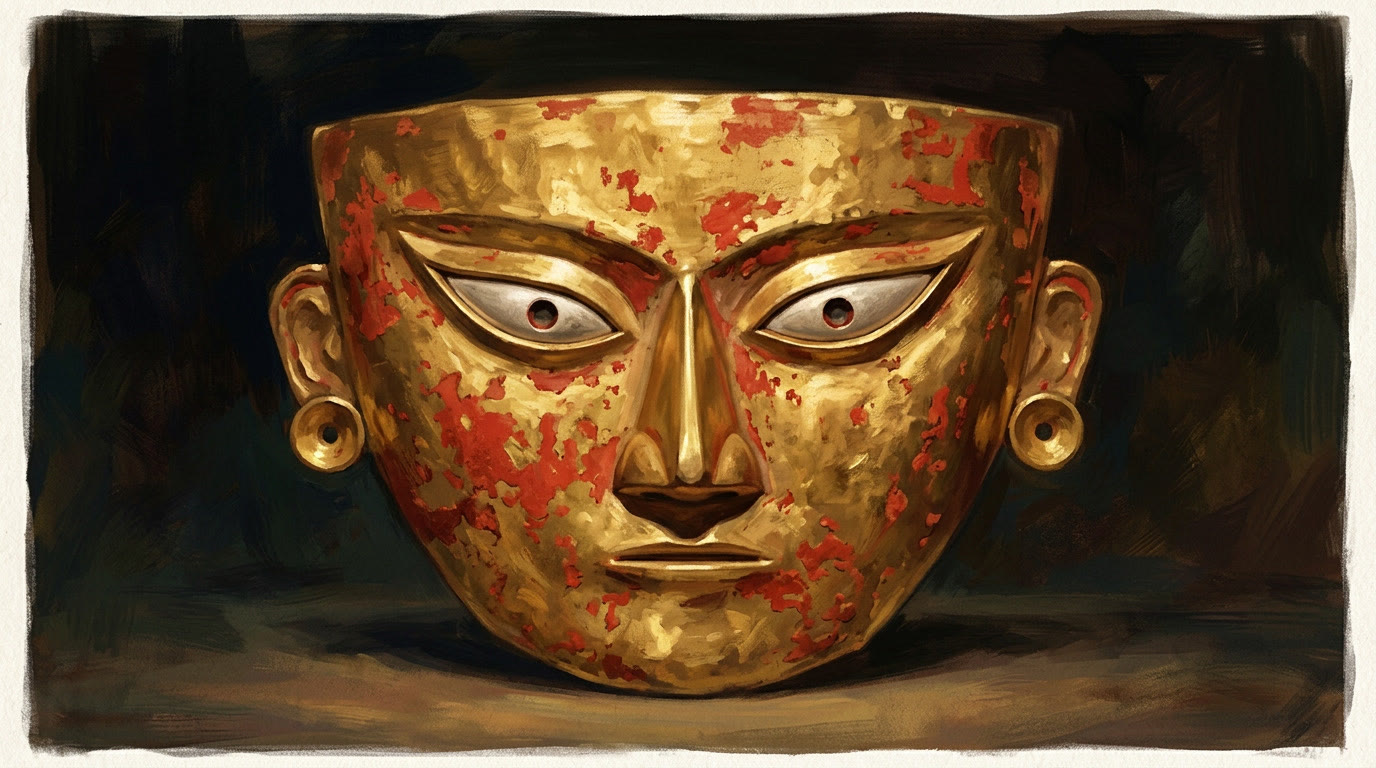
In 2021 scientists found that the red paint on the mask had been mixed with human blood and bird egg; to the Sicán it may have meant life force and rebirth. Shimada and Jo Ann Griffin described the tomb in Scientific American.
Fire in the forest, and a forest of holes
The metal came from nearby hills, where workers knelt around small furnaces and blew through long tubes. The Sicán also made bundles of I-shaped copper sheets called naipes; Shimada’s team thinks they served as something close to money, while other scholars remain unsure. The forest was later looted for decades: in 1978 Shimada counted more than a hundred thousand looters’ holes on aerial photographs.
Naylamp, the king who came from the sea
The people of Lambayeque had their own origin story, written down only once, by the priest Miguel Cabello Balboa in 1586. A lord named Naylamp arrived by sea with a fleet of balsa rafts and forty officials, among them a servant who scattered shell dust where his lord would walk. He built a palace called Chot. When he died, his people buried him secretly and said he had grown wings and flown away. The last of his line, Fempellec, tried to move the palace idol; then, the story says, came thirty days of rain and a year of hunger, and he was thrown into the sea.
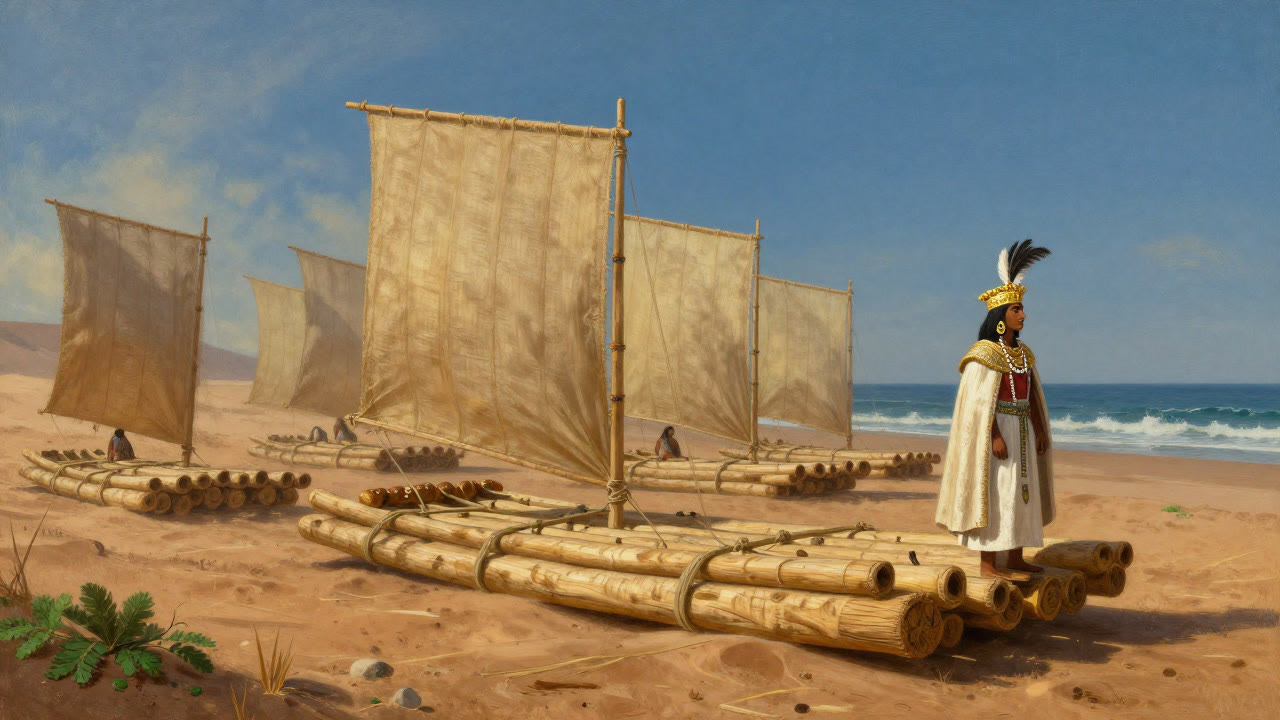
The legend cannot be proven. Some modern readers suspect the thirty days of rain remember a real El Niño. Some see Naylamp in the winged, masked figure of Sicán art, but not every scholar agrees, and Izumi Shimada does not share that view.
Túcume, the Chimú and the Inca
The Sicán faced their own catastrophe: a long drought, then around the middle of the eleventh century a great El Niño, though scholars still debate the exact dates. The temples at the Sicán capital were burned, and the capital moved to Túcume, where twenty-six pyramids stand around a lonely hill, a place locals call El Purgatorio. In 1992 Thor Heyerdahl’s team found a relief there of birdmen on seagoing vessels, which he read as a sign of ancient ocean voyages; that remains his interpretation. The Chimú later conquered the valley, the Incas took Chimor around 1470, and in 1532 Pizarro marched down this coast. For that chapter, read five myths about the Inca Empire.
Bringing the lords home
In November 2002 the Royal Tombs of Sipán Museum opened in Lambayeque, with Walter Alva as director, and the Sicán lord has his own museum in Ferreñafe. In 1997 an undercover FBI agent in Philadelphia recovered a gold ornament looted from Sipán, and it went home to Peru.
Video chapters
Jump to any part of the video on YouTube:
| Time | Chapter |
|---|---|
| 0:00 | Opening: a tomb robbery in 1987 |
| 2:55 | A Valley of Many Rivers |
| 7:51 | The Moche |
| 10:21 | The Split Pyramid |
| 14:41 | The Sealed Chamber |
| 18:04 | Gold on the Right, Silver on the Left |
| 21:13 | The Priest and the Old Lord |
| 23:53 | The Long Silence |
| 26:16 | The House of the Moon |
| 30:57 | The Lord Who Was Buried Upside Down |
| 35:46 | Fire in the Forest |
| 40:23 | A Forest of Holes |
| 44:20 | The King Who Came from the Sea |
| 51:54 | Fire, Flood and the Valley of Pyramids |
| 56:23 | Conquerors from the South |
| 1:01:02 | Bringing the Lords Home |
| 1:03:44 | The Valley at Night |
Now watch it
Follow both golden lords in the full documentary. If you enjoy it, subscribe for new long-form history.
Frequently asked questions
Who was the Lord of Sipán?
A Moche ruler buried around the year 250 at Huaca Rajada, near Sipán in northern Peru. After looters broke into the site in 1987, Walter Alva’s team excavated his sealed tomb, which Alva calls the first intact tomb of a ruler of ancient Peru recovered scientifically.
What is the difference between the Moche and the Sicán?
They were different peoples of the same coast. The Moche flourished roughly from the first or second century to around 800. The Sicán, or Lambayeque culture, rose around 900. The Sicán lord was buried about seven and a half centuries after the Lord of Sipán.
How was the Sicán lord of Huaca Loro buried?
Seated upside down at the bottom of a shaft around eleven metres deep, his head turned to face west under a gold mask and his body painted with cinnabar. In 2021 scientists found the mask’s red paint was mixed with human blood and bird egg.
Who was Naylamp?
The legendary founder of the lords of Lambayeque, known only from Miguel Cabello Balboa’s account of 1586. In the legend, he arrived by sea with a fleet of balsa rafts and, after a secret burial, was said to have flown away. It cannot be proven.
Where can you see the golden lords of Lambayeque today?
The Lord of Sipán is shown at the Royal Tombs of Sipán Museum in Lambayeque. The Sicán lord has his own museum in Ferreñafe, and the Brüning Museum in Lambayeque shows the Priestess of Chornancap.
Sources and further reading
- Walter Alva, “El señor de Sipán”, Revista Museos. PDF
- I. Shimada and J. A. Griffin, “Precious Metal Objects of the Middle Sicán”, Scientific American (1994).
- I. Shimada and A. K. Craig, Chungará 45(1), 2013. PDF
- Miguel Cabello Balboa, Miscelánea Antártica (1586). archive.org
- Pires et al., Journal of Proteome Research 20(11), 2021.
- Roger Atwood, “Stealing History”, Mother Jones (2002).