
At thirty-five minutes past ten on the morning of 17 December 1903, a machine of spruce and cotton cloth slid along a wooden rail on a freezing North Carolina beach and rose into a hard north wind. It stayed up for twelve seconds and travelled about 120 feet, less than the wingspan of a modern jumbo jet.
Four local men and a boy watched, and one squeezed the bulb of a camera he had never used before. Almost nobody else knew. The pilot, Orville Wright, and his brother Wilbur were not university scientists and had no government money. They ran a bicycle shop in Dayton, Ohio.
The short answer
Orville Wright made the first powered, controlled flight of a heavier-than-air machine on 17 December 1903. It happened at Kill Devil Hills, four miles south of Kitty Hawk, North Carolina. It lasted 12 seconds and covered about 120 feet. Wilbur flew the fourth flight that morning: 852 feet in 59 seconds.
This article follows our documentary, The Wright Brothers' First Flight, a calm hour-long film like our other evening history stories.
Key dates at a glance
| Date | What happened |
|---|---|
| 1867 / 1871 | Wilbur is born in Indiana; Orville follows in Dayton, Ohio |
| 30 May 1899 | Wilbur writes to the Smithsonian: “an enthusiast, but not a crank” |
| Sept 1900 | Wilbur reaches Kitty Hawk; the first glider flies that autumn |
| Autumn 1901 | The wind tunnel is built and about 200 wing shapes are tested |
| 2 Oct 1902 | Orville works out the movable rudder, completing three-axis control |
| 7 Oct, 8 Dec 1903 | Langley’s Aerodrome falls into the Potomac twice |
| 14 Dec 1903 | First attempt: Wilbur stalls after 3.5 seconds |
| 17 Dec 1903 | Four flights; the first lasts 12 seconds, the fourth 59 |
| 17 Dec 1948 | The Flyer is unveiled at the Smithsonian, 45 years to the day |
Two bicycle makers who read everything
Wilbur was born in 1867 and Orville in 1871. In 1878 their father, a bishop, brought home a toy helicopter of paper, bamboo and cork, powered by a twisted rubber band. It really flew, and years later the brothers called it the first spark of their interest in flight. In December 1892 they opened a bicycle shop, where they learned that a rider stays upright by constant tiny corrections.
Otto Lilienthal, the German who made around two thousand glides, died after a fall in August 1896, and the Wrights later dated their serious interest to that moment. On 30 May 1899 Wilbur wrote to the Smithsonian asking for everything published on flight, and called himself “an enthusiast, but not a crank.” They decided the unsolved problem was control. Twisting an empty inner-tube box, Wilbur saw how a wing could be twisted the same way: wing warping.
Kitty Hawk, a wind tunnel and the 1902 glider
They would glide first and worry about engines later. Wilbur found Kitty Hawk in Weather Bureau wind records, and in September 1900 he arrived by train and then a small boat across the sound. The larger 1901 glider gave about a third of the lift their figures predicted, and a discouraged Wilbur told Orville that men would not fly in a thousand years.
So they tested the old air-pressure tables themselves. In autumn 1901 they built a wooden wind tunnel about six feet long, with delicate balances made from bicycle spokes, and tried around 200 wing shapes. The old Smeaton figure for air pressure was too high, and Lilienthal’s numbers did not fit the different wings the Wrights had built. The 1902 glider, built from their own figures, still slid sideways into the sand sometimes. On 2 October 1902 Orville worked out a movable rudder linked to the pilot’s hip cradle, so the wings twisted and the rudder turned together. For the first time a flying machine could be controlled in pitch, roll and yaw.
An engine in six weeks
Engine makers were too busy, so shop mechanic Charlie Taylor built one in six weeks, with four cylinders and an aluminum body. It gave about twelve horsepower. The propellers were harder: library books on ships offered only rules of thumb, so the brothers worked out that a propeller is a wing moving in a spiral. The finished Flyer had a 40-foot-4-inch wingspan, and the pilot lay on the lower wing with the engine beside him.
The professor who had the money
Samuel Langley of the Smithsonian had a War Department grant and an engine of about 53 horsepower, roughly four times the Wrights’. His Aerodrome, launched by catapult from a houseboat, fell into the Potomac on 7 October 1903 and again on 8 December. Pilot Charles Manly was pulled out unhurt both times. Langley had launched a pilot who had never flown; the Wrights had spent three years learning to fly, glide by glide.
An autumn on the dunes, and a coin toss
The brothers reached camp on 25 September 1903 to find a storm had blown their shed off its posts, and a gale of more than 75 miles an hour soon followed. A propeller shaft cracked on 28 November, and Orville went home for solid steel shafts.
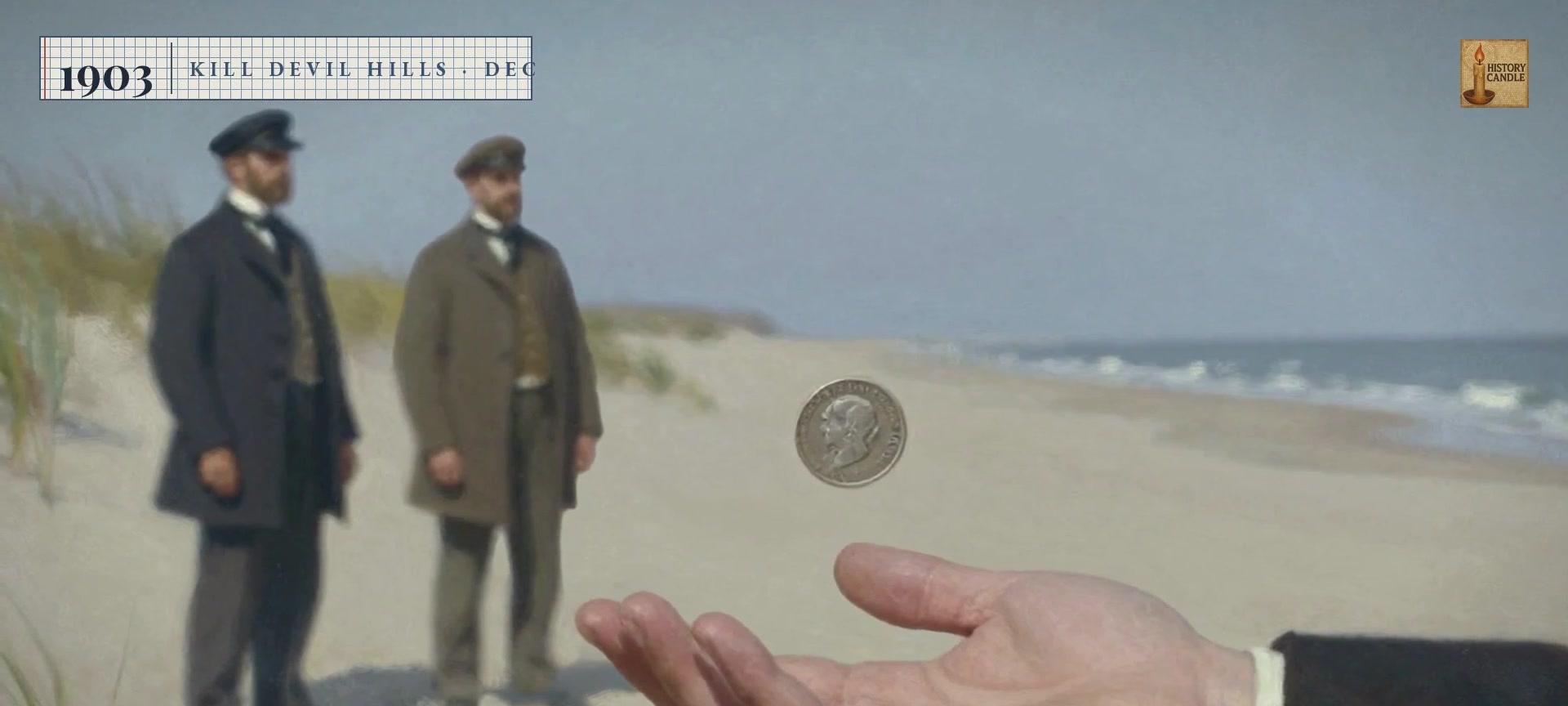
On Monday 14 December Wilbur won the toss. Launching from the slope of Big Kill Devil Hill, he pointed the nose up too steeply and stalled after about three and a half seconds. He wrote home that there was “now no question of success.”
Thursday, 17 December: four flights
On Thursday the puddles were frozen and the north wind blew at 22 to 27 miles an hour. Around ten o’clock the brothers hung out a signal, and five witnesses came: John Daniels, Will Dough and Adam Etheridge of the Life-Saving Station, W. C. Brinkley of Manteo and a boy from Nags Head, Johnny Moore. Orville, whose turn it was, lay on the lower wing and at 10:35 released the restraining wire. After about forty feet it lifted, and Daniels squeezed the bulb.
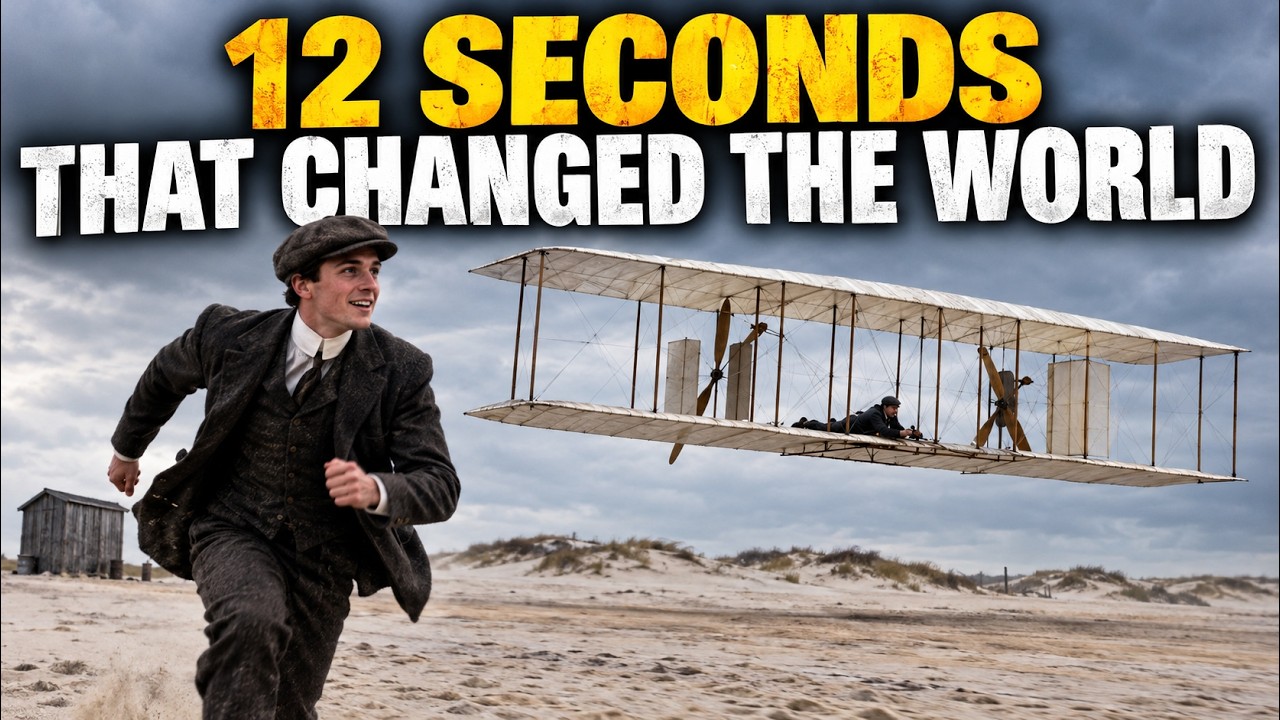
The elevator was so touchy that the Flyer darted up about ten feet and down again. Orville wrote that the flight lasted only twelve seconds, but it was the first of its kind in the history of the world.
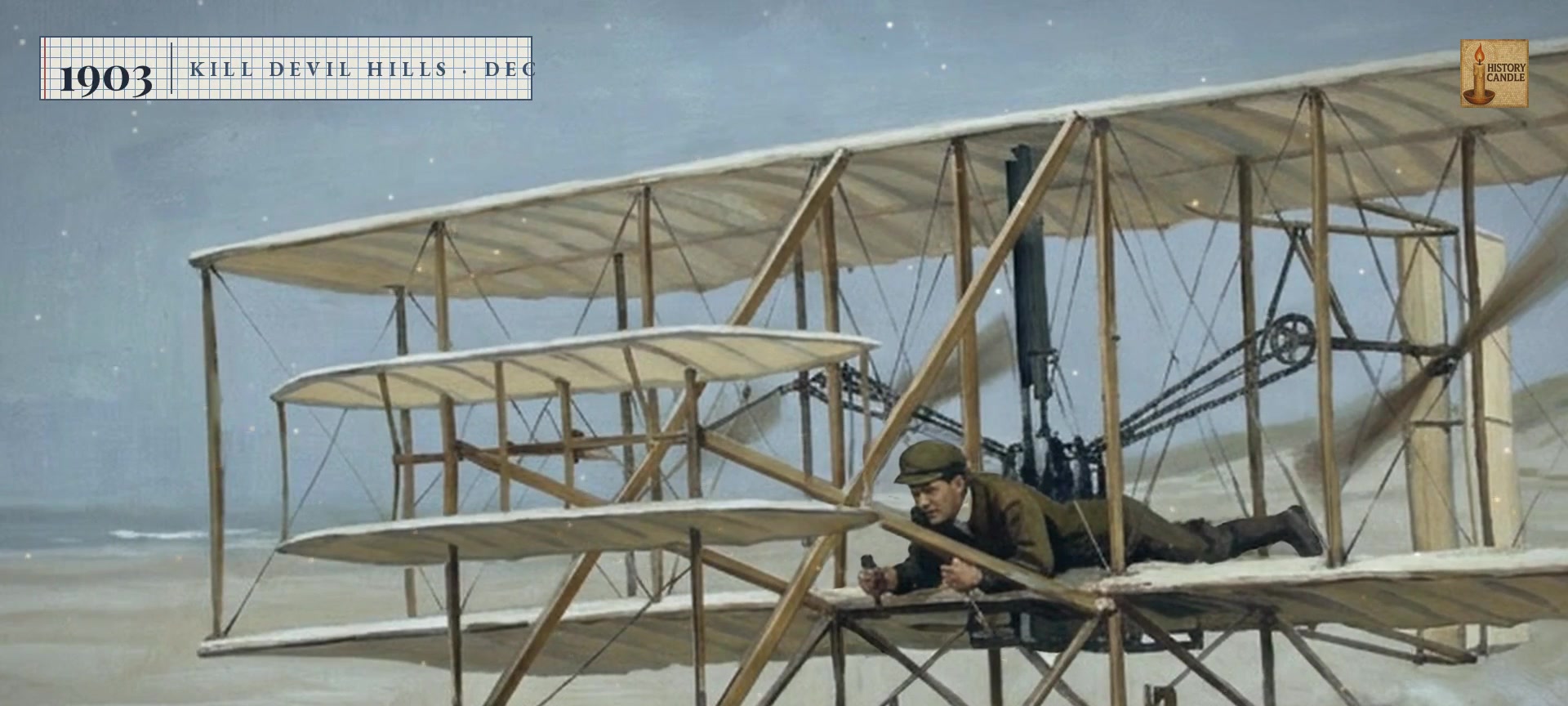
Wilbur made the second flight at 11:20, somewhere around 175 feet (accounts of its length differ a little). Orville flew a steadier third flight of 15 seconds and a little over 200 feet. At almost exactly noon Wilbur began the fourth, and after a few bobbing hundred feet the Flyer sailed almost level, until it struck the ground at 852 feet and 59 seconds. Then a gust rolled the parked machine over, with John Daniels tumbling inside; he was bruised, and always said he had survived the first airplane crash. The Flyer never flew again.
Watch the documentary
See the dunes, the wind tunnel and the four flights in our hour-long film.
A plain telegram, and what came next
That evening a telegram reached their father in Dayton at 5:25 p.m.: “Success four flights thursday morning all against twenty one mile wind started from Level with engine power alone average speed through air thirty one miles longest 57 seconds inform Press home Christmas.” As it arrived, it held two errors: the longest flight was 59 seconds, and Orville’s name was misspelled. Its wind figure was also a little lower than the 24 to 27 miles an hour the weather station recorded. The Dayton Journal would not run the story: the flights seemed too short to matter.
In 1904, at a cow pasture near Dayton called Huffman Prairie, Wilbur flew the first complete circle. On 8 August 1908 his smooth turns at Le Mans silenced French doubters. Wilbur died of typhoid fever on 30 May 1912, aged 45. The Flyer survived a flood in 1913, spent years in London after a long dispute with the Smithsonian, and was unveiled in Washington on 17 December 1948, exactly 45 years after it flew. A granite monument on Big Kill Devil Hill, dedicated in 1932, now marks the place.
Now watch it
If you enjoy slow, careful history in the evening, subscribe to History Candle for new long-form documentaries.
Frequently asked questions
Who made the first airplane flight, and when?
Orville Wright made the first powered, controlled flight of a heavier-than-air machine at 10:35 a.m. on 17 December 1903 at Kill Devil Hills, near Kitty Hawk, North Carolina. It lasted 12 seconds and covered about 120 feet.
Why did the Wright brothers choose Kitty Hawk?
They wanted strong, steady winds, soft sand to land on and few onlookers. Wilbur found Kitty Hawk in Weather Bureau wind records, and a local man wrote back that visitors would find a hospitable people.
What was the Wright brothers’ real invention?
Control. While others chased bigger engines, the Wrights worked out how a pilot could steer. Their 1902 glider combined wing warping, a movable rudder and a front elevator, giving control of pitch, roll and yaw.
Did Samuel Langley try to fly before the Wrights?
Yes. His full-size Aerodrome fell into the Potomac River on 7 October 1903 and again on 8 December 1903, nine days before Kitty Hawk. The pilot, Charles Manly, was unhurt both times.
Where is the original 1903 Wright Flyer today?
At the Smithsonian in Washington. After a long dispute with the Smithsonian, Orville sent it to London’s Science Museum in 1928. It came home in 1948 and was unveiled on 17 December 1948, exactly 45 years after its only day of flight.
Sources and further reading
- Orville Wright, “How We Made the First Flight”, Flying, December 1913 (FAA reprint, with Wilbur Wright’s letter to the Smithsonian of 30 May 1899). faa.gov
- Telegram from Orville Wright to his father announcing four successful flights, 17 December 1903. Library of Congress / World Digital Library.
- National Park Service, Wright Brothers National Memorial: “1903 – The First Flight”. nps.gov
- Smithsonian National Air and Space Museum: “The Wright Brothers Made History at Kitty Hawk”. airandspace.si.edu
- Smithsonian National Air and Space Museum: “How the Wright Flyer Got to the Smithsonian”. airandspace.si.edu
- Background: Wikipedia, “Wright brothers” and “Langley Aerodrome”.