
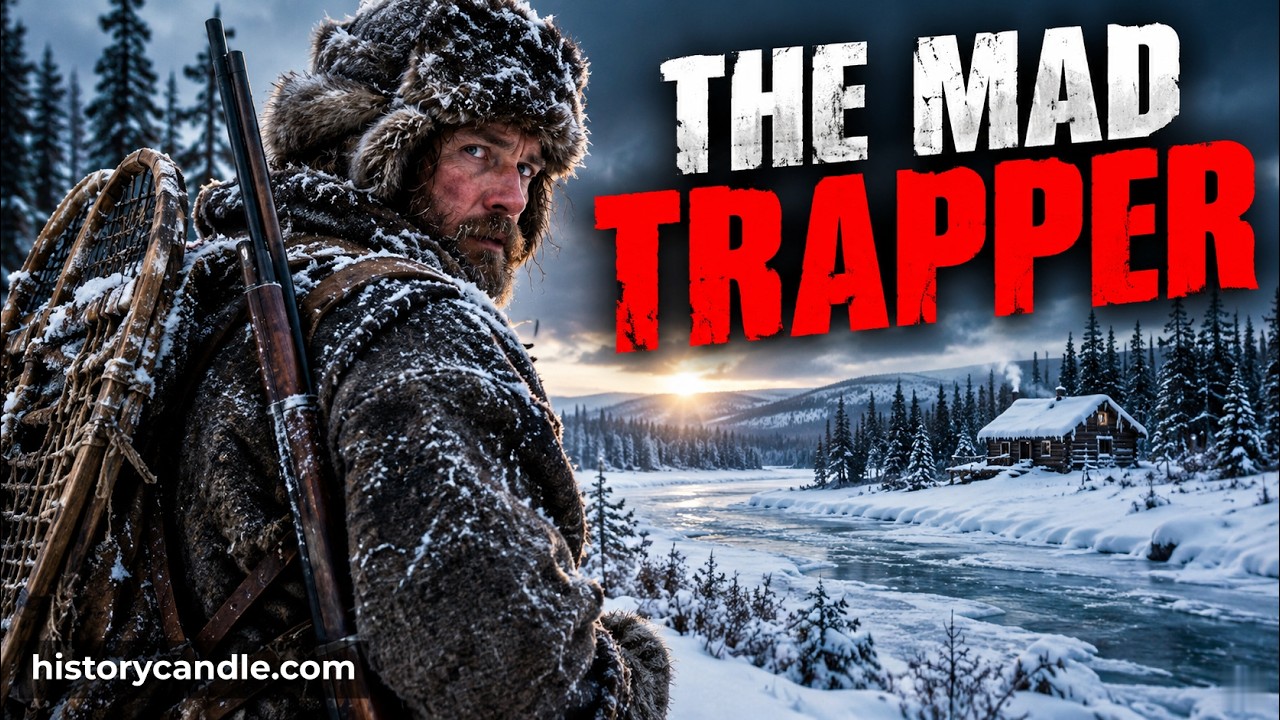
On 30 January 1932, a Mountie named Edgar Millen crept toward a thicket in the Arctic cold, looking for a man who had already wounded one policeman through a cabin door. A single shot from the trees hit him in the chest. The shooter, a silent stranger known only as Albert Johnson, walked away across the snow. He still had more than two weeks of running left, and he would take his real name with him to the grave.
The short answer
The Mad Trapper of Rat River was a man calling himself Albert Johnson who, in the winter of 1931-32, shot two RCMP officers and evaded the police for about 48 days across the Northwest Territories and the Yukon. He was killed in a gunfight on the Eagle River on 17 February 1932. A 2007 exhumation and a 2021 DNA study traced his ancestry to Sweden, but no one has proved who he was.
This article follows the same trail as our documentary, The Mad Trapper of Rat River: from the first knock on a cabin door, through the dynamite, the bush pilot and the mountain crossing, to the gunfight on the Eagle River and the DNA results that still could not give him back his name. The sources disagree on a few small dates and numbers, and where they do, we say so.
Key dates at a glance
| Date | What happened |
|---|---|
| 9 July 1931 | Albert Johnson arrives at Fort McPherson, buys supplies and is questioned by Constable Edgar Millen |
| Late 1931 | Local trappers complain to the Aklavik detachment that their traplines are being interfered with |
| 26 December 1931 | Constable Alfred King and Special Constable Joe Bernard reach Johnson’s cabin; he will not speak to them |
| 31 December 1931 | King returns with a warrant and is shot through the cabin door |
| 9 January 1932 | A larger party besieges the cabin for about 15 hours in cold near minus 40; dynamite blows off the roof |
| 14-16 January 1932 | Police return to find the cabin empty and Johnson gone |
| 30 January 1932 | Johnson shoots and kills Constable Millen |
| 5 February 1932 | Pilot Wop May arrives in Aklavik with his Bellanca |
| 9 February 1932 | In a blizzard Johnson crosses the Richardson Mountains into the Yukon |
| 17 February 1932 | Johnson is shot dead on the Eagle River |
| 2007 and 2021 | The grave at Aklavik is opened; a DNA study points to Sweden |
A stranger on the Peel River
Johnson came into Fort McPherson by way of the Peel River on 9 July 1931. Constable Edgar Millen, the local RCMP officer, noticed a quiet man with what sounded like a Scandinavian accent and a lot of cash for supplies. Then Johnson went up the Rat River and built a cabin of about 2.5 by 3 metres. He had no trapping licence, and he did not explain himself to anyone.
That was the trouble. In the Mackenzie Delta, trapping was how families made a living, and Gwich’in trappers began to report that someone was tampering with their lines. The complaint reached the Aklavik detachment around Christmas 1931. It was small, local and ordinary. What turned it into Canada’s most famous Arctic manhunt was what Johnson did when the police arrived.
The door that stayed shut
On 26 December, Constable Alfred King and Special Constable Joe Bernard travelled roughly 100 km to the cabin. Johnson would not talk. When King looked in, Johnson covered the window. The officers went back for a search warrant.
They returned on 31 December. According to NWT Timeline, four RCMP officers plus Special Constables Joe Bernard and Lazarus Sittichinli surrounded the cabin. When King tried to force the door, Johnson fired through the wood and wounded him. Bernard dragged King to safety, and the party retreated to Aklavik. From that moment the man in the cabin was no longer a suspected trap thief. He was an armed man who had shot a police officer.
Dynamite and a vanishing act
On 9 January 1932, a bigger party of Mounties, special constables and volunteers besieged the cabin for about 15 hours in temperatures near minus 40. Hundreds of rounds went into the building. Inspector Alexander Eames, commanding at Aklavik, had dynamite taped together and thrown onto the roof. It blew the roof off and caved in part of a wall. (Sources give slightly different dates for the blast, from 4 to 10 January.)
Johnson was still alive. He had dug a dugout under the cabin, about 1.5 metres deep, and he fired from it without hitting anyone. The posse pulled back for reinforcements. When they came again, around 14 to 16 January, the cabin was empty. He had walked out onto the snow and disappeared.

The killing of Constable Millen
The hunt that followed ran through the deep snow of the delta. Gwich’in people supplied the search parties, and the RCMP set up a base camp about 15 km from the cabin. Johnson was by now a hunted man on snowshoes, and he moved with his rifle and very little else.
On 30 January, Constable Millen, one of the Mounties who had questioned Johnson in Fort McPherson, caught up with him in a thicket. In the RCMP Graves account, shots were exchanged, and Johnson’s third shot hit Millen in the heart. Millen fell face down in the snow. (RCMP Graves dates the death to 31 January; most other sources say 30 January.) The Mounties had now lost a man.
Wop May and the first air manhunt
Inspector Eames decided to call in an aircraft, and Wilfrid “Wop” May arrived in Aklavik on 5 February 1932 with his mechanic Jack Bowen, flying a ski-equipped Bellanca monoplane. May was already a famous name. As a young pilot in the First World War he was chased across the Somme by Manfred von Richthofen, the Red Baron, on 21 April 1918, and by the end of the war he was credited with 15 enemy aircraft.
In the Arctic, May ferried men and supplies and searched from the air. According to the Alberta Aviation Museum, it was the first use of an aircraft in an RCMP manhunt. The search still depended on men on the ground, but now they had eyes in the sky.
Over the Richardson Mountains
The police blocked the two main passes across the Richardson Mountains, which separate the Northwest Territories from the Yukon. Johnson did not use a pass. On or around 9 February, during a blizzard, he climbed over a peak of roughly 2,100 metres (about 7,000 feet), with very little food and no climbing equipment. Local mountain men told the RCMP this was nearly impossible, even with proper gear.
On 14 February, May saw tracks on the Bell River beyond the mountains and followed them south along the Eagle River. Wikipedia describes how Johnson had used caribou tracks across the river, where the snow was packed hard, and then left the river to camp on the bank. Another account says he climbed to a high ridge to watch the posse’s movements.
The Eagle River
On 17 February 1932, a posse led by Inspector Eames, including native trappers, army signalmen and Wop May overhead, found Johnson in the middle of the frozen Eagle River. He had piled snow around himself. In the exchange that followed, Staff Sergeant Earl Hersey of the Royal Canadian Corps of Signals knelt to take aim, and Johnson turned and shot him in the knee and elbow. May later landed on the ice, picked up Hersey, and flew him to Aklavik. The Alberta Aviation Museum says that without that flight Hersey would certainly have died.
With May signalling from the air, the posse caught Johnson in a crossfire. The fight lasted less than half an hour. NWT Timeline credits Special Constable John Moses with the fatal shot, though other accounts simply say the posse killed him, and they do not agree on how many bullets hit him. The chase of about 48 days, counted from the shooting of Constable King on 31 December, was over.
What they found on his body
His pockets and kit held more than $2,000 in United States and Canadian currency (the Legion Magazine puts this at roughly $60,000 in today’s money), some gold, a compass, a razor, a knife, fish hooks, nails and Beecham’s Pills. His teeth carried unusually good gold dental work. None of it said who he was. He was buried in Aklavik.
The DNA that still cannot name him
In August 2007, a film company, Myth Merchant Films, put together a forensic team that opened the grave near Aklavik. They found a man who was about 35 years old at death and who had scoliosis. The sophisticated dental work suggested origins in the American Midwest or Scandinavia. He was reburied with full religious rites.
Then in 2021, the company Othram built a DNA profile and traced his genetic ancestry to Sweden. His closest matches were relatives of Gustaf Magnusson (1776-1853) and Britta Svensdotter (1781-1846). Every candidate proposed over the years has been ruled out by DNA, so the identification is still not made. That is the strangest part of the story. A man who could outlast a posse in the Arctic winter is still, almost a century later, a name nobody can verify.
How much of Death Hunt was true?
The 1981 film Death Hunt starred Charles Bronson as Johnson and Lee Marvin as a Mountie. It is entertainment. Its producer, Murray Shostak, said it was not a documentary. In the film several men die at Johnson’s hands, but in reality only Constable Millen was killed. The pilot, “Captain Tucker”, shoots wildly at everyone, which the real Wop May never did. Johnson’s fictional war-veteran backstory is invented. The truth is that almost nothing is known about him before 1931.
Watch the documentary
The whole 77-minute story, from the first knock on the cabin door to the DNA results, is on YouTube.
If you want more stories about surviving brutal cold, read how Native American communities built heating systems for harsh winters, or what winter survival looked like in Victorian London.
So who was the Mad Trapper?
We know what he did and how he did it. He shot two policemen, survived a siege and a dynamite blast, climbed a mountain range in a blizzard and fought to the end on a frozen river. We do not know his name, his reason, or why a man with more than $2,000 and good dental gold was living alone on the Rat River. The honest answer is that nobody knows. Who do you think he really was?
Now watch it
See the manhunt, the pilot and the DNA search in our full documentary. If you enjoy it, subscribe to History Candle for new long-form history.
Frequently asked questions
Who was the Mad Trapper of Rat River?
He was a man who called himself Albert Johnson. He arrived at Fort McPherson in the Northwest Territories in July 1931, built a small cabin on the Rat River, and in the winter of 1931-32 shot two Royal Canadian Mounted Police officers and led the force on a chase of about 48 days. Nobody has ever proved who he really was.
How did the Mad Trapper die?
He was shot dead in a gunfight with a posse on the ice of the Eagle River in the Yukon on 17 February 1932. Pilot Wop May directed the posse from the air, and Johnson wounded Staff Sergeant Earl Hersey before he fell. Accounts differ on how many bullets hit him.
Why did the RCMP chase Albert Johnson?
The first reason was a complaint from local trappers that someone was tampering with their traplines. When Constable Alfred King came to Johnson's cabin with a warrant, Johnson shot through the door and wounded him. After that the case became a manhunt for an armed man who had fired on police.
What role did Wop May play in the manhunt?
Wilfrid "Wop" May, a First World War ace turned bush pilot, flew a ski-equipped Bellanca monoplane for the RCMP. He ferried men and supplies, spotted Johnson's tracks from the air on 14 February 1932, helped direct the final fight, and flew the wounded Sergeant Hersey to Aklavik. It was the first use of an aircraft in an RCMP manhunt.
Was the Mad Trapper ever identified?
No. A grave exhumation near Aklavik in 2007 and a DNA study published in 2021 narrowed his ancestry to Sweden, but every named candidate has been ruled out and his real identity remains unconfirmed.
How accurate is the movie Death Hunt?
Not very. The 1981 film, with Charles Bronson as Johnson and Lee Marvin as a Mountie, is a dramatization. Its producer said they were not making a documentary. In real life Johnson killed one officer, Constable Edgar Millen, and the film's invented backstory and wild-shooting pilot are fiction.
Sources and further reading
- Wikipedia: Albert Johnson (criminal). en.wikipedia.org
- NWT Timeline: The Mad Trapper of Rat River. nwttimeline.ca
- Legion Magazine: A Mountie is killed by the Mad Trapper. legionmagazine.com
- RCMP Graves: The Mad Trapper of Rat River, Part I. rcmpgraves.com
- RCMP Graves: Mad Trapper. rcmpgraves.com
- Alberta Aviation Museum: Mad Trapper Aerial Manhunt Marks 90th Anniversary. albertaaviationmuseum.com
- Mysteries of Canada: Albert Johnson, the Mad Trapper. mysteriesofcanada.com
- Yukon Nuggets: The Mad Trapper. yukonnuggets.com
- Wikipedia: Wop May. en.wikipedia.org
- Othram / GlobeNewswire (2021): Scientists Narrow Search For Mysterious Mad Trapper To Sweden. globenewswire.com
- Wikipedia: Death Hunt (1981 film). en.wikipedia.org