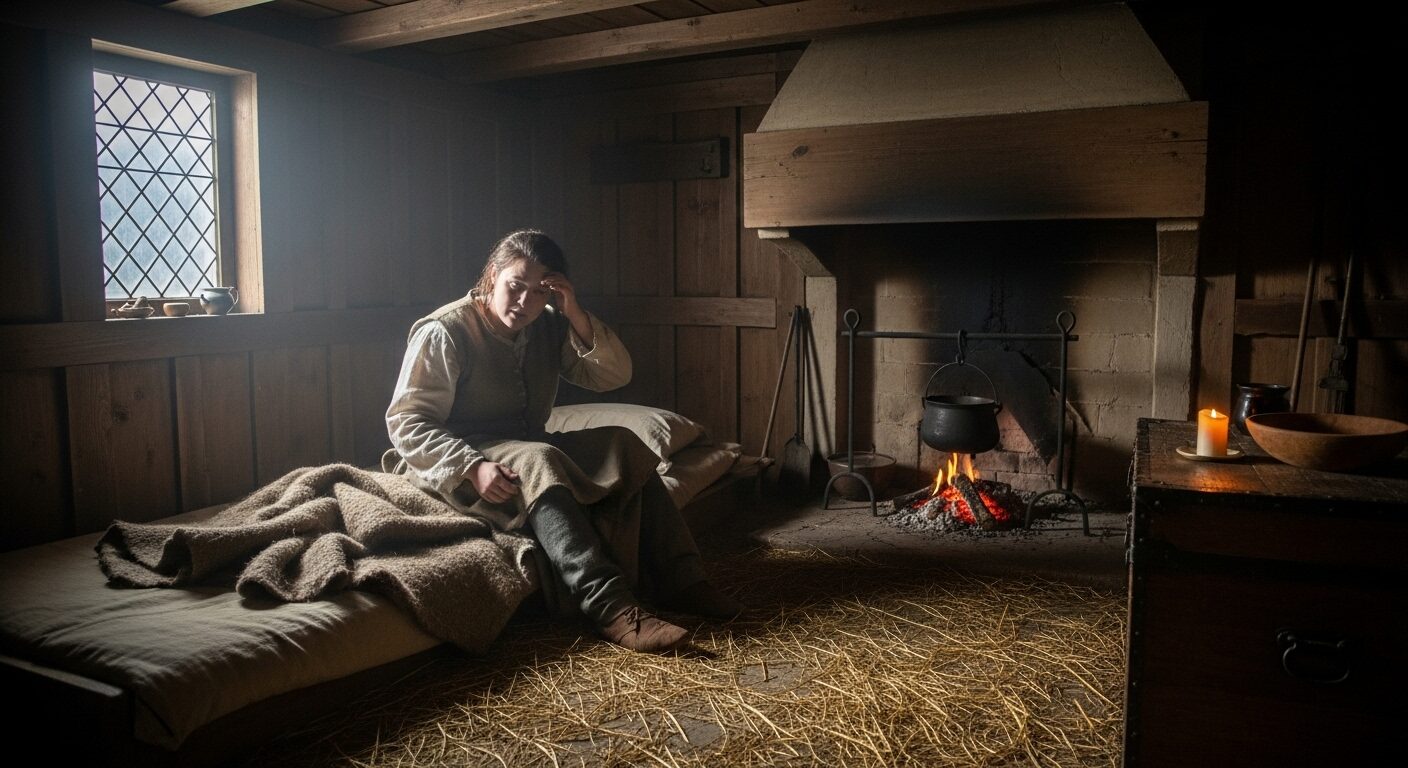

When we think of medieval women, certain images immediately come to mind: damsels in distress locked in towers, silent wives hidden behind castle walls, or perhaps accused witches facing persecution. But the reality of women’s lives during the Middle Ages was far more complex, varied, and surprisingly powerful than popular culture would have us believe.
The Diversity of Medieval Women’s Experiences
The term “medieval women” encompasses nearly a thousand years of history (roughly 500-1500 CE) and spans an enormous geographical area. A peasant woman in 12th-century England lived a vastly different life from a merchant’s wife in 14th-century Florence or a noblewoman in 13th-century France.
Women of Different Social Classes
Peasant Women: The Backbone of Medieval Society
The majority of medieval women were peasants, and their lives revolved around hard, physical labor. Contrary to the notion that women were confined to domestic duties, peasant women worked alongside men in the fields during planting and harvest seasons. They also tended vegetable gardens, raised chickens and pigs, produced dairy products, brewed ale, spun wool, and wove cloth for their families.
These women were essential economic contributors to their households. In fact, a widow could inherit and manage her late husband’s land holdings, making her own agricultural decisions and representing herself in manorial courts.
Noble and Aristocratic Women: Power Behind the Throne
Medieval noblewomen often wielded considerable power and influence. When their husbands were away at war, on Crusade, or managing distant estates, these women acted as regents, managing vast properties, settling disputes, and making critical political decisions.
Women like Eleanor of Aquitaine, who was Queen of France and later England, participated actively in politics, patronized the arts, and even led troops. Matilda of Tuscany commanded armies in Italy during the 11th century, and many abbesses ruled over wealthy monasteries with the authority of feudal lords.
Urban Women: Entrepreneurs and Craftswomen
In medieval cities and towns, women participated extensively in commercial life. They worked as brewers, bakers, silk makers, and merchants. Guilds sometimes included women members, and widows frequently continued their husbands’ businesses. In Paris during the 13th century, women dominated certain trades entirely, particularly silk working and embroidery.
Marriage, Family, and Legal Rights
Marriage in the Middle Ages
Marriage was primarily an economic arrangement for most medieval people, though the Church increasingly emphasized consent as necessary for a valid marriage. Women typically married in their late teens or early twenties, though noble girls might be betrothed much younger for political alliances.
Women’s Legal Status
Medieval women’s legal rights varied significantly by region and time period. Under English common law, a married woman’s legal identity was largely subsumed under her husband’s (a principle called coverture). However, she retained some rights over her dowry and dower (the portion of her husband’s estate she would receive upon his death).
Single women and widows had more legal autonomy. They could own property, enter contracts, and conduct business in their own names. Many medieval court records show women suing, being sued, and representing their own interests before the law.
Education and Religious Life
Literacy and Learning
While formal education was limited for most medieval people regardless of gender, literacy rates among women varied by class and region. Noblewomen were often taught to read, particularly religious texts. Some learned Latin, and many corresponded extensively in vernacular languages.
Convents served as important centers of learning for women. Nuns copied manuscripts, wrote chronicles, composed music, and corresponded with scholars. Hildegard of Bingen, a 12th-century abbess, wrote theological works, composed music, and documented her mystical visions.
The Monastic Option
For many women, religious life offered an alternative to marriage and motherhood. Convents provided opportunities for education, spiritual development, and administrative leadership that were unavailable elsewhere. Abbesses wielded considerable power, managing extensive landholdings and supervising communities of nuns.
Some women also pursued religious lives outside convents as anchoresses (living in solitary cells attached to churches) or as members of groups like the Beguines, who lived in semi-religious communities without taking formal vows.
Women’s Work and Economic Contributions
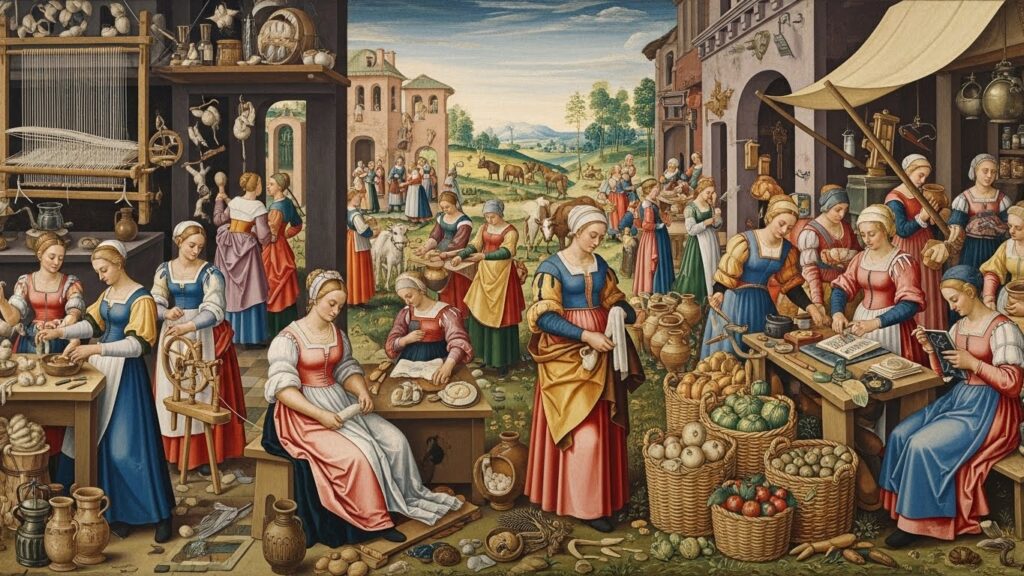
The idea that medieval women didn’t work outside the home is a modern misconception. Women’s labor was essential to the medieval economy across all social classes.
Agricultural Labor
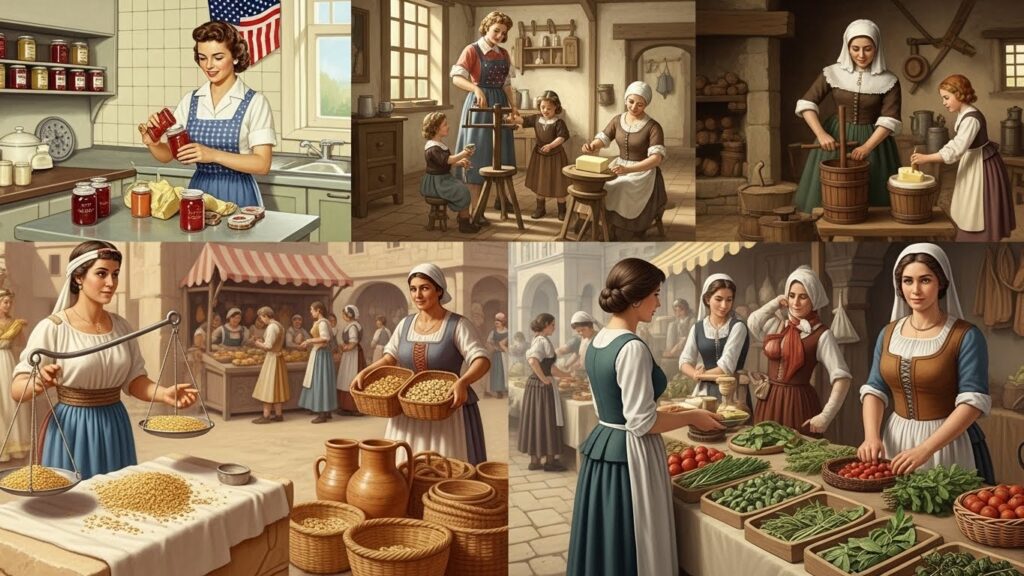
In rural areas, women worked in the fields during critical seasons, particularly during harvest. They also performed essential tasks like dairying, chicken and pig keeping, vegetable gardening, and preserving food for winter.
Textile Production
One of the most important industries in which women dominated was textile production. Women spun thread and yarn (hence the term “spinster” for unmarried women), wove cloth, and created garments for their families and for sale. The wool trade, which was central to medieval European economies, depended heavily on women’s labor.
Brewing and Food Production
Women were the primary brewers of ale in medieval England, selling their surplus to neighbors. They also baked bread, produced cheese and butter, and preserved meats—all activities that could generate income as well as feed their families.
Healthcare and Childbirth
Medieval women played crucial roles as healers and midwives. While university-trained physicians were almost exclusively male, most ordinary people received medical care from local women who had learned healing arts through apprenticeship and tradition.
Midwifery was an exclusively female profession, and experienced midwives were respected members of their communities. However, childbirth was extremely dangerous in the Middle Ages due to limited medical knowledge, and maternal mortality rates were high.
Challenges and Limitations
While medieval women had more agency than often portrayed, they still faced significant limitations and challenges.
Violence and Vulnerability
Women were vulnerable to violence from husbands, lords, and soldiers during times of war. While laws existed against rape and assault, enforcement was inconsistent, and legal systems generally favored men.
Limited Political Rights
With rare exceptions, women couldn’t hold most political offices, vote in civic elections, or serve as judges in secular courts. Their political influence was typically exercised informally through male relatives.
The Church’s Mixed Messages
The medieval Catholic Church sent contradictory messages about women. While the Virgin Mary was venerated and some female saints were widely celebrated, Church fathers often repeated ancient views of women as spiritually weak and prone to sin.
Regional Variations Matter
It’s crucial to remember that “medieval women” is not a monolithic category. Women’s experiences varied dramatically based on:
- Geography: Women in Scandinavian regions, for instance, often had more property rights than those in other parts of Europe
- Religion: Jewish women, Muslim women in medieval Spain, and Christian women all operated under different legal and cultural frameworks
- Time period: Women’s status and opportunities changed significantly over the thousand years of the Middle Ages
- Urban vs. rural settings: City women often had more economic opportunities than rural peasants
Separating Myth from Reality
Many modern assumptions about medieval women are based on Victorian-era romanticization of the Middle Ages or misunderstandings about pre-industrial life. The notion of universal chivalry protecting women, for instance, was more literary ideal than lived reality. Similarly, the idea that all medieval women were helpless and oppressed ignores the substantial evidence of women’s work, agency, and resistance.
The Legacy of Medieval Women
Despite the limitations they faced, medieval women left lasting legacies. They produced magnificent artworks in convents, wrote important religious and literary texts, managed estates and businesses, raised children who would shape history, and quietly resisted restrictions on their lives in countless small ways.
Understanding medieval women’s real experiences helps us appreciate the complexity of the past and recognize that women have always been active participants in shaping their societies, even when facing significant constraints.
Want to Dive Deeper into Medieval Women’s Lives?
This article only scratches the surface of the fascinating, complex world of medieval women. For a comprehensive exploration of what life was truly like for women during the Middle Ages—complete with historical sources, expert analysis, and engaging storytelling—watch the full documentary on the History Candle YouTube Channel.
👉 Watch the Complete Video: What Life Was Really Like for Medieval Women
Discover the untold stories, surprising facts, and nuanced realities that textbooks often miss. Subscribe to History Candle for more deep dives into fascinating historical topics that challenge what you think you know about the past!