
For many history channels, the first meeting with a new viewer is no longer a search result. It is a 40-second clip on TikTok, Instagram Reels or YouTube Shorts that made someone stop scrolling. If you run a history channel, history TikTok and its cousins are where new viewers first meet you, and a long documentary is where they decide to stay.
We are History Candle. We make calm, long-form history documentaries on our YouTube channel and write the companion stories on this site. This guide is the short-video routine we recommend to other history creators: what to post, how to plan it a week at a time, and how to use anniversaries without turning your channel into a daily-facts page. It is a planning method, not a promise of numbers, and we also show where a tool such as Wisppilot can take over the repetitive production steps.
The short answer
History channels grow on short-video platforms by posting a small number of focused, well-sourced shorts every week, each one built around a single question, date or object, and each one pointing back to a longer video. Plan the week on one day, write scripts in a batch, prepare vertical videos and a few image posts, review them, then schedule them across TikTok, Instagram and YouTube Shorts. Use an anniversary calendar so that dates like 17 December 1903 arrive with a short already prepared.
Why history TikTok, Reels and Shorts work for history channels
History is made of moments that fit in under a minute: a ship leaving harbour, a law being signed, a strange object pulled from the ground. A good history short is not a summary of a war. It is one surprising detail, told well, with a reason to want more.
Short video helps a history channel in three practical ways:
- Discovery. Viewers who would never type the name of a medieval king into a search box will watch 30 seconds about why people once slept twice a night.
- Testing. A short is a cheap way to see which subjects people care about before you spend weeks on a full documentary.
- A path to the long video. On YouTube in particular, Shorts and long videos live on the same channel, so a viewer who likes a Short is one tap from your full films. YouTube’s own guide, Get started creating YouTube Shorts, explains the basics of the format.
The catch is consistency. One brilliant short a month does little. A steady weekly rhythm, kept up for months, is what lets a history channel build an audience. That is why the rest of this guide is about a routine rather than tricks.
What makes good history shorts
Before the calendar, the craft. These are the rules we recommend when you cut a story down to a short, and they apply whether you post on TikTok, Reels or Shorts.
One question per video
“Why did the Vikings stop?” is a documentary. “Why did a Boston merchant pack ice in sawdust?” is a short. Choose the question that a single scene can answer. Our story of Frederic Tudor, the Boston “Ice King” could give you five separate shorts: the joke that started it, the failed first cargo, debtors’ prison, the sawdust trick and the voyage to Calcutta.
Open with the strangest true detail
Your first line does the work that a thumbnail does on a long video. Lead with the detail that sounds wrong but is true: a twelve-second flight that changed the century, a cargo of frozen pond water sailing 16,000 miles. Then explain.
Show, do not lecture
Use maps, objects, dates on screen and clear subtitles. Many people watch with the sound off, so the words on screen should carry the story on their own.
Be careful with facts
Short-form history has a reputation problem: myths spread fast because they are fun. Your channel’s reputation depends on being the account that gets it right. Keep one or two sources for every short and say “historians think” when the evidence is uncertain. If a story is legend rather than record, say so in the video.
End with a door, not a wall
Every short should end by pointing somewhere: the full documentary, a related short, or a question for the comments. “The whole story is in our film about the first flight” is better than simply stopping.
The weekly short-video routine
Here is a simple routine for a small history channel run by one or two people. The days are an example; move them to fit your week. The important part is that each task has a fixed slot, so nothing depends on finding time.
| Day | Task | Output |
|---|---|---|
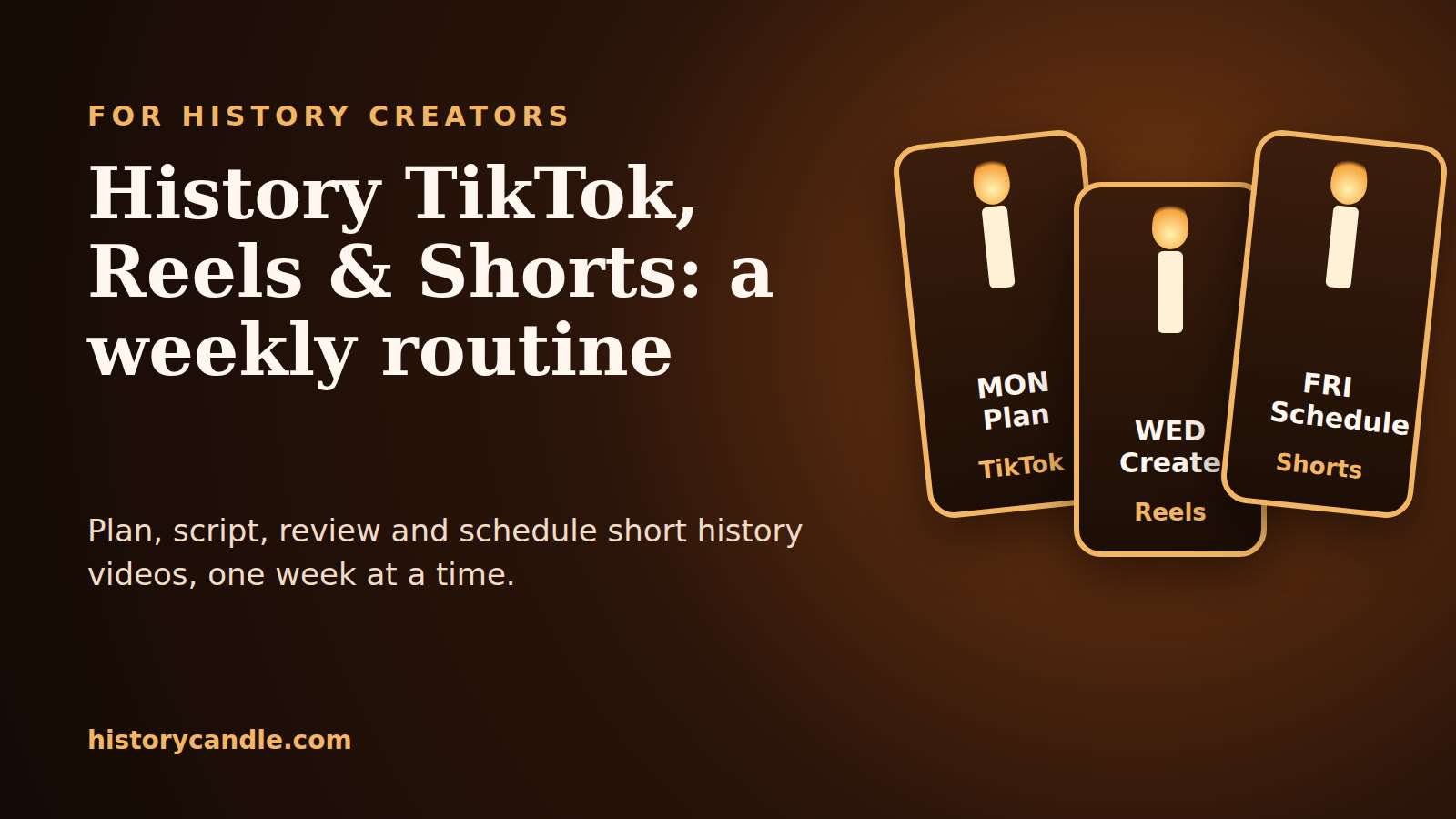
| Monday | Plan the week: check the anniversary calendar, pick topics, note sources | A list of topics with one source each |
| Tuesday | Write scripts in one sitting: hook, three beats, closing line | Short scripts, read aloud and timed |
| Wednesday | Produce vertical videos and a few image posts (a map, a quote, a date card) | Draft videos and posts |
| Thursday | Review: fact-check, spelling of names and dates, subtitles, captions | Approved content |
| Friday | Schedule across TikTok, Instagram and YouTube Shorts; link each to a long video | A full week in the queue |
| Weekend | Read comments, note questions, add good ones to next week’s list | New topic ideas |
How many shorts? Start with what you can keep up for three months without burning out. For many small channels that might be three shorts and two image posts a week, as an example, not a rule. Raise it once the routine feels easy.
Two habits make this routine work. First, batch: writing four scripts in one afternoon is faster than writing one script on four different days. Second, review before publishing: Thursday is the day a wrong date gets caught, not the day after it goes viral.
Planning “on this day in history” content
Anniversaries are the easiest way to give a history short a reason to exist today. People search for what happened in history on this day all year round, and a short that lands on the right date feels timely instead of random. The trick is to plan anniversaries weeks ahead, not to scramble for a fact each morning.
What happened in history on this day: building an anniversary calendar
- Start with your own catalogue. Go through your long videos and articles and write down every exact date they contain. Our documentary and article on the Wright brothers’ first flight gives you 17 December 1903, a date the National Park Service documents in detail.
- Put the dates in a simple calendar: a spreadsheet with date, event, source, and the long video it links to.
- Prepare the short two to three weeks early and schedule it for the anniversary morning.
- Mark round anniversaries (50th, 100th, 250th) a year ahead. They deserve more than one short.
- Keep it to your subject. An anniversary only helps if it fits your channel. A medieval channel does not need a short for every modern event.
This approach also keeps you away from the trap of becoming a “today in history” feed. Your channel is about stories you know well; the calendar simply decides when each one is told.
Planning for Black History Month and other observances
Observance months are planned the same way, just on a bigger scale. February is Black History Month in the United States. It grew out of Negro History Week, started by the historian Carter G. Woodson in 1926, and the joint site of the Library of Congress, the National Archives, the Smithsonian and other federal institutions, africanamericanhistorymonth.gov, is a good place to start research.
- Begin research in December, not in February.
- Choose stories you can tell with care and real sources, and credit the archives and historians you rely on.
- Spread the work across the whole month: a short series with a shared look works better than one rushed post on the first day.
- Questions like “what happened on this day in Black history” are common, so check every date against a primary or official source before it goes on screen.
The same method works for national days, founding anniversaries, famous voyages and centenaries in your own niche.
Turning shorts into growth for your history YouTube channel
Short videos are the doorway. The room behind it is your history YouTube channel. Make the path between them obvious:
- Give each short a matching long video and mention it in the last line and in the caption or description.
- Group related shorts into a series with the same title style, so viewers recognise them.
- Use the same channel name, logo and colours on every platform, so a viewer who saw you on TikTok recognises you on YouTube.
- Read which shorts bring comments and questions, and turn the strongest ones into your next long documentary.
For us, a long film such as The Wright Brothers’ First Flight is the anchor, and short clips about single moments would be the invitations.
Tools that keep the routine running
The routine above has a lot of repetitive steps: writing captions, making vertical videos with subtitles, resizing image posts, and uploading the same piece to several networks. You can do all of it by hand, and many creators do. You can also hand parts of it to software.
Wisppilot is an AI social media manager that fits the Wednesday-to-Friday part of the week. You give it a topic; it writes the script and creates a short video with voice-over, subtitles and music, plus branded visual posts. Nothing goes out until you approve it in the dashboard, which keeps your Thursday fact-check in place. Once approved, it publishes or schedules to 10 networks, including TikTok, Instagram and YouTube. It also keeps a monthly bank of topic ideas with reminders for special days, which pairs well with an anniversary calendar. Its video generator offers documentary, 2D and 3D animation and infographic styles, among others.
Whatever tools you use, keep the editorial decisions human: which story, which source, and whether the facts are right.
Common mistakes that stall history shorts
- Posting in bursts. Ten shorts in one week and none for a month is harder to grow than three a week, every week.
- Repeating myths because they perform well. They also bring the corrections in the comments.
- No link to the long video. A short that goes nowhere wins a view, not a viewer.
- Different branding on every platform, so nobody connects the TikTok account with the YouTube channel.
Make the routine lighter
Wisppilot turns a topic into vertical videos and visual posts, waits for your approval, then publishes to TikTok, Instagram, YouTube and nine more networks on your schedule.
Frequently asked questions
How do history channels grow on TikTok?
By posting short, focused videos on a steady weekly schedule. Each video answers one question or tells one moment, opens with a surprising true detail, and points to a longer video or a follow-up short. Consistency over months matters more than any single viral clip.
What should history shorts be about?
One question, date, person or object per video. Good starting points are the surprising details inside your long videos, anniversaries that fit your subject, and questions viewers ask in the comments.
How often should a history YouTube channel post Shorts?
As often as you can keep up for months. Many small channels start with a few shorts a week and raise the number once the routine is comfortable. A steady rhythm is more useful than a busy week followed by silence.
How do I plan “on this day in history” content?
Collect every exact date from your own videos and research into a calendar with a source for each one. Prepare the short two to three weeks ahead and schedule it for the anniversary. Plan observance months such as Black History Month from December.
Can one person run a history channel on several platforms?
Yes, if the work is batched. Plan on one day, write on another, produce and review, then schedule everything at once. Tools such as Wisppilot can create the videos and posts from a topic and publish them after your approval, which leaves you the research and fact-checking.
Sources and further reading
- YouTube Help: “Get started creating YouTube Shorts”. support.google.com
- Library of Congress, National Archives, Smithsonian and partners: African American History Month. africanamericanhistorymonth.gov
- National Park Service, Wright Brothers National Memorial: “1903 – The First Flight”. nps.gov