
In May 1833 a small wooden brig slipped out of Boston carrying 180 tons of frozen pond water, bound for Calcutta, 16,000 miles away. The man behind it had already lost money on one ice cargo, spent time in debtors’ prison, and been laughed at by his whole city. This is the story of Frederic Tudor, and of how a cargo that every sensible person expected to melt made him rich.
The short answer
Frederic Tudor shipped ice from Boston to India by packing it in sawdust and stacking it tightly in the hold. The brig Tuscany left Boston on 12 May 1833 with about 180 tons of ice and reached Calcutta in September 1833 with about 100 tons still frozen. Calcutta became his most profitable market, earning an estimated $220,000 over the next twenty years.
This article follows our documentary, Frederic Tudor: The Boston “Ice King” Who Shipped Ice to India, from the early failures to the sawdust trick, the voyage to Calcutta and the machine that ended the trade.
Key dates at a glance
| Year | What happened |
|---|---|
| 1806 | The brig Favorite sails for Martinique with Tudor’s first ice cargo; he loses about $4,500 |
| 1812-13 | He spends parts of two years in debtors’ prison |
| 1825 | Nathaniel Wyeth’s horse-drawn ice plow cuts harvesting costs from 30 to 10 cents a ton |
| 1833 | The Tuscany carries about 180 tons of ice to Calcutta; about 100 tons arrive |
| 1842-43 | Ice houses open at Madras and Bombay; ice cutters start working Walden Pond |
| 1851 | John Gorrie receives US patent 8080 for a machine to make ice |
| 1864 | Tudor dies in Boston on 6 February, aged 80 |
A stubborn young man with a motto
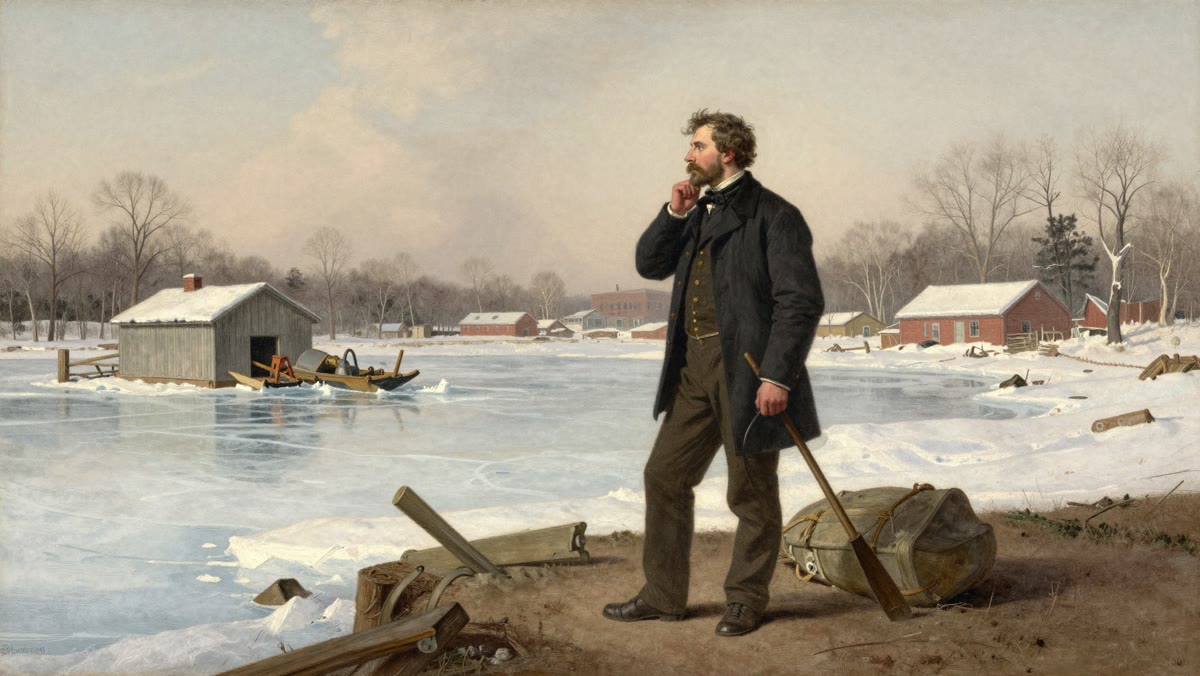
Tudor was the third son of William Tudor, a Boston lawyer who had served as judge advocate general in Washington’s army. His brothers went to Harvard. At thirteen Frederic took a job as an apprentice in a Boston store instead.
The family story, which is tradition rather than a documented event, says the idea began as a joke at a summer gathering: why not sell the ice from the family pond in the tropics? On 1 August 1805 Tudor started a journal, and on its leather cover he printed a motto: “He who gives back at the first repulse and without striking the second blow despairs of success has never been, is not, and never will be a hero in war, love, or business.” He would need it.

1806: “We hope this will not prove a slippery speculation”
Nobody would carry a cargo that could melt and rot a ship’s hold, so Tudor bought his own brig, the Favorite. She sailed on 10 February 1806 with ice cut on the family farm at Saugus, bound for Martinique, about 1,500 miles away. A Boston newspaper noted: “No joke. A vessel has cleared at the Custom House for Martinique with a cargo of ice. We hope this will not prove a slippery speculation.”
The critics were right, that time. Much of the ice melted on the three-week trip, Martinique had no ice houses, and Tudor sold what remained for an overall loss of about $4,500. The 1807 embargo then stopped American ships from trading abroad, and his debts grew. In 1812 and 1813 he spent parts of two years in debtors’ prison.
The puzzle: melting, storage and demand
His failures showed him three problems. Melting: after years of tests he settled on sawdust, a free waste product of New England’s lumber mills. Ice was stacked like well-fitted masonry and packed in sawdust, shavings or rice chaff. Storage: ice that arrived safely still needed somewhere cold, so he built ice houses. Demand: people who had never tasted a cold drink had no reason to pay for ice. Ice cost only the labour of cutting it, and many Boston ships left port nearly empty, so he could hire them cheaply.
In November 1815 he sailed for Havana to build an ice house, leaving, he wrote, “pursued by sheriffs to the very wharf.” The double-shelled building held about 150 tons. His first Havana sale came on 5 March 1816, ten years to the day after his first sale in Martinique, and about nine-tenths of what he sold went to coffee-houses for ice cream and cold drinks. He wrote: “Drink, Spaniards, and be cool, that I, who have suffered so much in the cause, may be able to go home and keep myself warm.”
Cutting ice like a factory
Uneven blocks left gaps in the hold where warm air crept in. In 1825 Nathaniel Wyeth, who worked with Tudor, developed a horse-drawn ice plow that scored the pond in a grid, so blocks came out uniform. It cut the cost of harvesting from about 30 cents to 10 cents a ton.
The trade stayed wasteful. By one estimate only about 10 percent of the ice harvested in the 1820s and 1830s was eventually sold; the rest melted in ice houses, on wagons, at sea and on the docks. Tudor survived because his raw material cost almost nothing.
1833: the Tuscany sails for Calcutta
In 1833 a Boston merchant, Samuel Austin, proposed a partnership to send ice to India, some 16,000 miles and four months away, with no Suez Canal to shorten the route. Tudor needed the money: a coffee speculation had gone badly wrong, and by his own end-of-1834 accounting it cost about $175,000 (other accounts put his total debt at $200,000 or more).
On 12 May 1833 the brig Tuscany left Boston with about 180 tons of ice cut that winter. When she reached the Ganges in September, many people thought the arrival was an elaborate joke. About 100 tons were still ice.
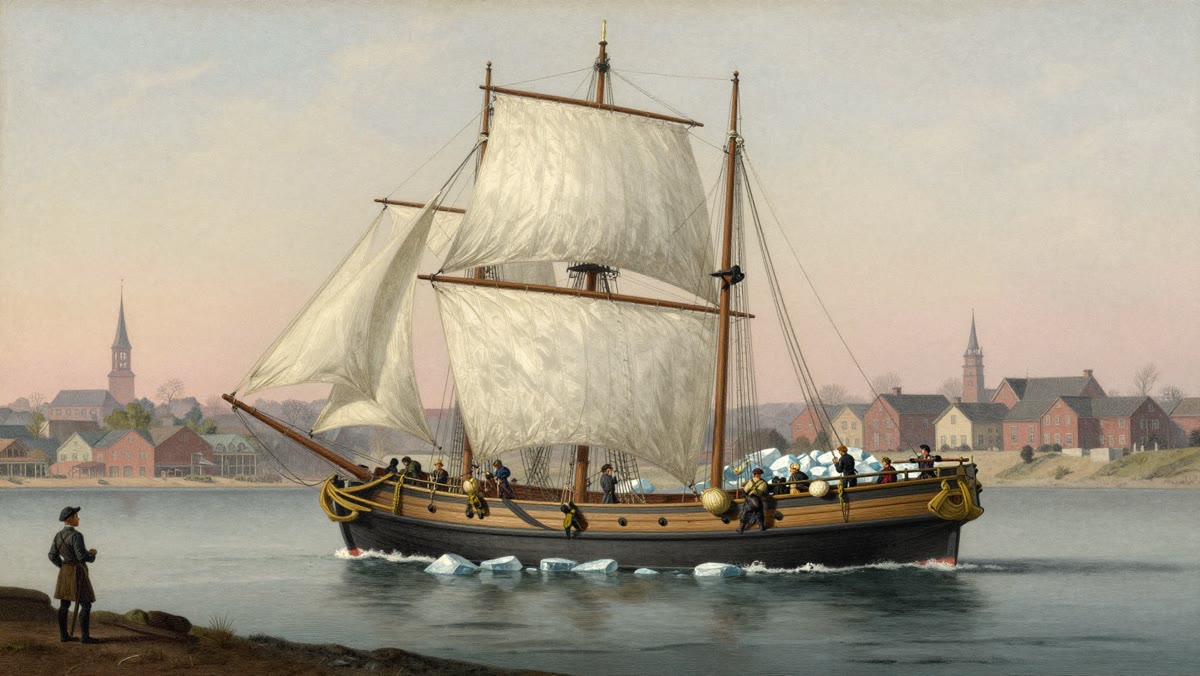
Colonial accounts describe crowds at the docks, and one bystander is said to have asked the ship’s captain whether ice grew on trees in America. The authorities let the first cargo in without the usual customs formalities, and the local British community built a stone ice house for imports. The ice sold for about three pence a pound, and the first shipment made a profit of about $9,900. Over twenty years, Calcutta yielded an estimated $220,000.
Watch the documentary
The full story, from the sheriffs on the wharf to the ice house in Chennai, is told in our documentary on YouTube.
The Chennai ice house that became Vivekananda House
Tudor built ice houses at Madras in 1842 and Bombay in 1843, and a short-lived one in Hong Kong from 1845 to 1850. The Madras building stood on the seafront in what is now Triplicane, Chennai. It was later sold and renamed Castle Kernan. Swami Vivekananda stayed there from 6 to 14 February 1897. Renamed Vivekanandar Illam, or Vivekananda House, in 1963, it has housed an exhibition on his life since 1997.
Thoreau and the Ganges
From 1842, Tudor and other companies harvested ice at Walden Pond near Concord. Henry David Thoreau, who lived by the pond from 1845 to 1847, watched the cutters: “To speak literally, a hundred Irishmen, with Yankee overseers, came from Cambridge every day to get out the ice.” Then he made the connection: “Thus it appears that the sweltering inhabitants of Charleston and New Orleans, of Madras and Bombay and Calcutta, drink at my well.” And of the Ganges: “The pure Walden water is mingled with the sacred water of the Ganges.”
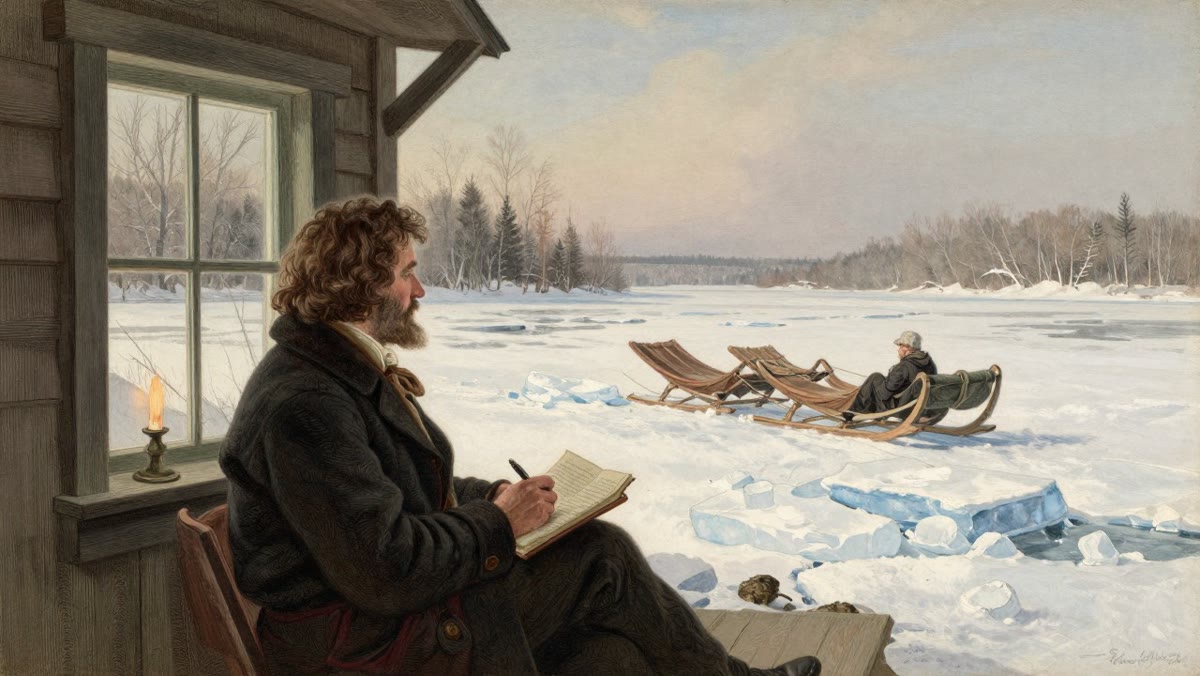
Much of that labour was done by Irish immigrants in bitter cold; their wider story is told in our article on the Irish Famine of the 1840s.
A doctor with a machine
Dr John Gorrie, a physician in Apalachicola, Florida, wanted ice to cool the rooms of fever patients. He first made ice mechanically in 1844 and received US patent 8080 for a machine to make ice on 6 May 1851. But his partner died, the venture failed, and he died in 1855, ruined. A popular story blames the ice industry, and Tudor in particular, for sabotaging him. We found no documentary proof, and the loss of his partner explains the failure on its own. Florida later chose Gorrie for its statues in the US Capitol, placed there in 1914, the year American plant ice (26 million tons) overtook the natural harvest (24 million).
What Tudor’s story still teaches
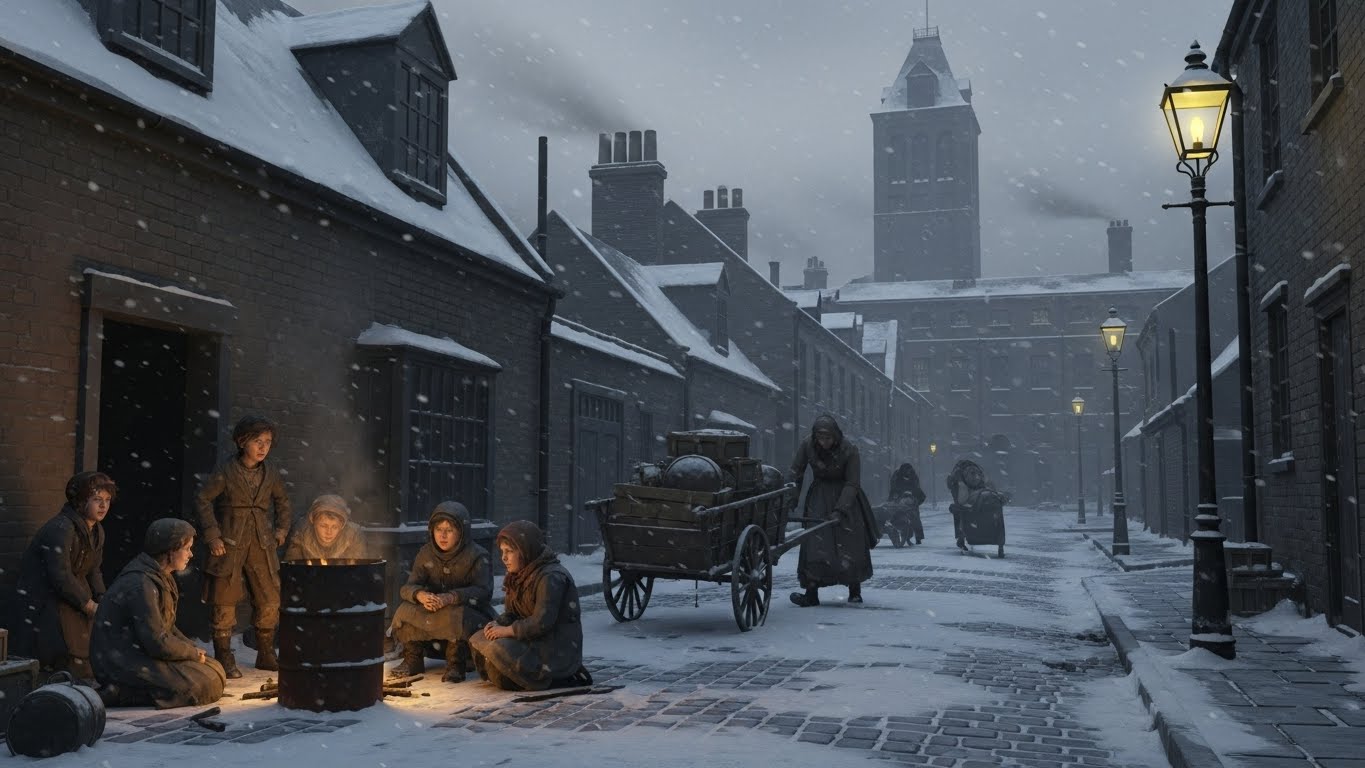
Tudor died in Boston on 6 February 1864, aged 80. He had also spent decades planting trees on bare Nahant, offering them free to summer residents. His fortune came from connecting cheap things: free ice, free sawdust and ships that would otherwise have sailed empty. He taught customers to need what he sold, and he controlled the ice houses everyone else required. He could not stop a better technology. To feel how hard it once was to keep food fresh, read what people really ate in the 1700s, or see how Victorian Londoners survived winter.
Now watch it
See the whole story in our full documentary. If you enjoy it, subscribe to History Candle for new long-form history.
Frequently asked questions
Who was Frederic Tudor, the Ice King?
Frederic Tudor (1783-1864) was a Boston merchant who built the first global trade in natural ice. He cut ice from New England ponds and shipped it to the Caribbean, the American South and India, and he became known as the Ice King. His first cargo, to Martinique in 1806, lost money, and he spent parts of 1812 and 1813 in debtors’ prison before the business took off.
How did Tudor keep ice from melting on a four-month voyage?
He packed the blocks tightly, stacked like masonry, and surrounded them with insulation such as sawdust, wood shavings or rice chaff. Sawdust was a free waste product of New England lumber mills. About 100 of the 180 tons loaded on the Tuscany in 1833 were still ice when it reached Calcutta.
When did the first American ice reach India?
The brig Tuscany sailed from Boston on 12 May 1833 with about 180 tons of ice and reached Calcutta in September 1833 with about 100 tons left. The voyage covered roughly 16,000 miles and took about four months.
What happened to the Madras Ice House?
Tudor built an ice house at Madras (now Chennai) in 1842. Swami Vivekananda stayed there from 6 to 14 February 1897, and since 1963 it has been called Vivekanandar Illam (Vivekananda House). It now houses an exhibition on his life.
Did Thoreau really write about the ice trade at Walden Pond?
Yes. In Walden, Thoreau describes ice cutters harvesting the pond and writes that the ‘sweltering inhabitants of Charleston and New Orleans, of Madras and Bombay and Calcutta, drink at my well.’ He adds that the pure Walden water is mingled with the sacred water of the Ganges.
Did the ice trade try to stop John Gorrie’s ice machine?
Gorrie, a Florida physician, received US patent 8080 for a machine to make ice on 6 May 1851 but could not finance it and died in 1855. A popular story blames the ice industry, and Tudor in particular, for sabotaging him, but we found no documentary evidence, so treat it as a rumor.
Sources and further reading
- Henry G. Pearson, “Frederic Tudor, Ice King”, read to the Massachusetts Historical Society, November 1933 (Proceedings); source of the journal motto, “pursued by sheriffs to the very wharf” and the “Drink, Spaniards” line.
- Carl Seaburg, Stanley Paterson and Alan Seaburg, The Ice King: Frederic Tudor and His Circle (Massachusetts Historical Society, 2003).
- Gavin Weightman, The Frozen Water Trade (2003).
- Wikipedia: “Frederic Tudor”, “Ice trade”, “Vivekanandar Illam” and “John Gorrie”.
- Anu Kumar, “How ice shipped all the way from America became a luxury item in colonial India”, Scroll.in, 2015. scroll.in
- Susan S. Bean, “Cold Mine”, American Heritage, July/August 1991. americanheritage.com
- Henry David Thoreau, Walden (1854), chapter “The Pond in Winter” (Project Gutenberg).
- David G. Dickason, “The Nineteenth-Century Indo-American Ice Trade: An Hyperborean Epic”, Modern Asian Studies 25 (1991).
- Architect of the Capitol: John Gorrie statue, National Statuary Hall Collection. visitthecapitol.gov
- New England Historical Society, “Frederic Tudor”. newenglandhistoricalsociety.com