
When we think of medieval fortifications, towering stone castles and walled cities typically come to mind. Yet across the vast woodlands of medieval Europe, indigenous and rural communities developed their own sophisticated defensive systems—fortified villages that blend seamlessly with the forest landscape while offering remarkable protection against raiders and invaders.
What Were Woodland Fortified Villages?
Fortified woodland villages were defensive settlements built by communities living in heavily forested regions of medieval Europe, particularly in areas of Central and Eastern Europe, Scandinavia, and the British Isles. Unlike the stone fortresses of nobility, these settlements utilized the natural resources of their environment—timber, earth, and the forest itself—to create formidable defensive structures.
These communities, often referred to as “woodland peoples,” included Slavic tribes, Baltic groups, Finnish populations, and various Germanic forest dwellers who maintained traditional lifestyles well into the medieval period.
The Architecture of Survival: Design and Construction
Palisade Walls and Earthworks
The primary defensive feature of woodland fortified villages was the palisade wall—a barrier constructed from vertical wooden stakes or logs driven deep into the earth. These walls could reach heights of 15-20 feet and were often reinforced with horizontal crossbeams for additional stability.
Behind the palisade, communities typically constructed earthen ramparts. Workers would dig deep ditches around the village perimeter, piling the excavated soil to create elevated platforms. This double barrier of ditch and rampart made scaling the defenses extremely difficult for attackers.
Strategic Forest Integration
Woodland peoples demonstrated remarkable ingenuity in using the forest as part of their defensive strategy. Villages were often situated in naturally defensible locations such as:
- Forest clearings surrounded by dense woods that channeled attackers into predetermined paths
- Elevated ground within wooded areas, providing visibility advantages
- Near water sources like streams or marshes that created natural moat-like barriers
- Behind fallen trees and deliberately created abatis—obstacles made from felled trees with sharpened branches pointing outward
Gate Systems and Watchtowers
Entry points featured sophisticated gate systems, often with multiple doors creating a “killing zone” where defenders could trap attackers. Wooden watchtowers positioned at strategic intervals along the palisade provided elevated observation posts and platforms for archers.
Daily Life Behind the Walls
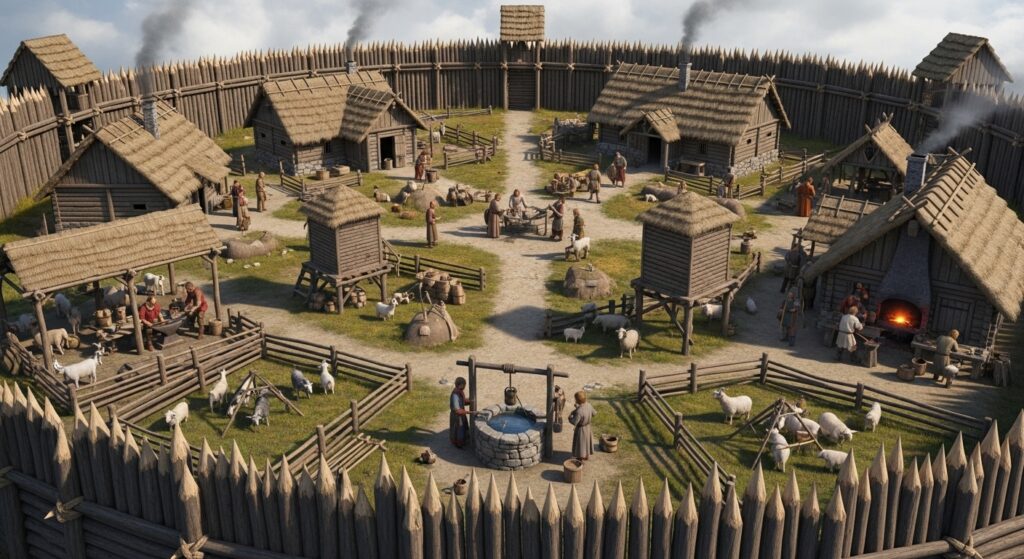
Life within these fortified villages centered around self-sufficiency and community cooperation. Inside the protective palisade, residents constructed timber longhouses, workshops, and storage buildings. The village layout typically included:
- Central communal areas for gatherings and decision-making
- Livestock pens to protect valuable animals during sieges
- Food storage pits and granaries
- Wells or water collection systems
- Forge areas for metalworking and weapon production
The woodland peoples maintained their traditional ways of life—hunting, fishing, gathering forest resources, and practicing slash-and-burn agriculture in forest clearings—while having a secure base to retreat to when threatened.
Who Threatened These Communities?
Medieval woodland fortified villages faced various threats that necessitated their defensive architecture:
- Viking raiders seeking slaves and plunder
- Crusading knights during the Northern Crusades against pagan populations
- Rival tribal groups competing for territory and resources
- Bandits and outlaws who found refuge in the forests
- Expansionist kingdoms seeking to incorporate woodland territories
Famous Examples of Woodland Fortifications
Gord Settlements of the Slavs
The Slavic peoples of medieval Poland, Bohemia, and Rus built circular or oval fortified settlements called gords. These impressive structures featured multiple rings of wooden walls and earthworks. The Gord at Gniezno, Poland, served as an early capital and demonstrated the sophisticated defensive capabilities of Slavic woodland engineering.
Baltic Hill Forts
Lithuanian and Prussian Baltic tribes constructed remarkable hill forts throughout their forested territories. These fortifications combined natural hilltop positions with elaborate timber defenses. The hill fort of Kernavė in Lithuania showcases how woodland peoples created multi-layered defensive systems.
Scandinavian Ring Forts
While Denmark’s famous Trelleborg ring forts are well-known, similar circular fortified villages appeared throughout Scandinavian woodlands, serving both defensive and administrative functions for communities living in forested regions.
The Decline of Woodland Fortified Villages
As medieval kingdoms consolidated power and military technology advanced, woodland fortified villages gradually declined. The introduction of siege weapons, the spread of Christianity (which often came with stone church construction), and the feudal system’s expansion all contributed to the transformation of these settlements.
By the late medieval period, many woodland communities had been absorbed into larger kingdoms, their residents converted to Christianity, and their timber fortifications replaced with stone structures or abandoned entirely.
Archaeological Discoveries and Modern Understanding
Modern archaeology continues to reveal the sophistication of these woodland fortified villages. Excavations across Eastern Europe, Scandinavia, and the British Isles have uncovered:
- Evidence of advanced carpentry techniques
- Complex drainage systems
- Trade goods indicating wider economic networks
- Religious artifacts showing pre-Christian beliefs
- Weapons and tools demonstrating skilled metalworking
These discoveries challenge earlier assumptions about “primitive” woodland peoples, revealing communities with sophisticated engineering knowledge, organized social structures, and effective defensive strategies.
Legacy and Cultural Impact
The fortified villages of medieval woodland peoples represent an important but often overlooked chapter in European history. They demonstrate how communities adapted to their environment, developed unique defensive solutions, and maintained their cultural identity in the face of external pressures.
Today, reconstructed examples of these fortifications serve as open-air museums, offering visitors glimpses into this fascinating period. Sites like the Archaeological Park in Groß Raden, Germany, and various reconstructed gords in Poland provide tangible connections to this medieval woodland heritage.
Discover More Medieval History
Ready to dive deeper into the fascinating world of medieval fortifications and forgotten communities?
Subscribe to the History Candle YouTube Channel for engaging video explorations of medieval life, ancient defensive structures, and the untold stories of history’s most intriguing peoples. From detailed reconstructions to expert analysis, History Candle illuminates the past like never before.
🕯️ Light up your understanding of history—Subscribe to History Candle today!
Don’t miss our upcoming series on medieval warfare, castle construction, and the daily lives of people throughout the ages. Hit that subscribe button and ring the notification bell to join our community of history enthusiasts!